Loading...
Done
Juliza meets with colleagues at her home. (Photo by Diana Bagnoli/The Washington Post)

Lucha libre is Mexico’s version of what in the United States refer to as pro wrestling. Its dates to 1863, when a Mexican wrestler named Enrique Ugartechea developed a form of “freestyle” wrestling that was based on Greco-Roman wrestling. Lucha libre began to soar in popularity in Mexico after two Italian businessmen started promoting fights in the early 1900s. It has since become popular around the globe. Here: Juliza meets with colleagues at her home. (Photo by Diana Bagnoli/The Washington Post)
Details
15 Jun 2018 00:05:00
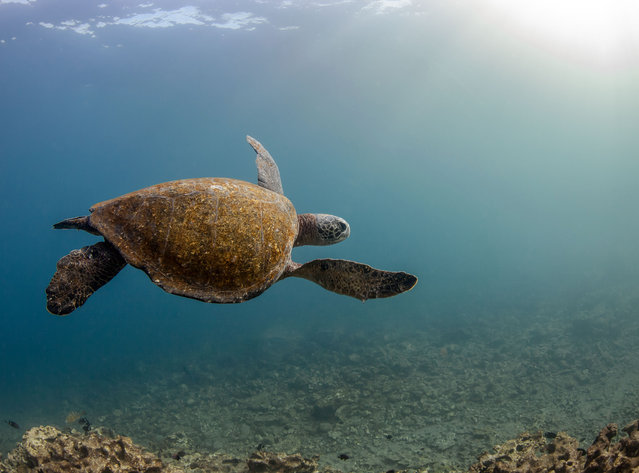
Green turtles take special care of their carapace, scraping algae off on rocks or letting cleaner fish remove parasites. Thanks to long-term protection of nesting sites, and measures to reduce the numbers caught in fishing gear, some green turtle populations are starting to recover. (Photo by Philip Hamilton/The Guardian)

Teeming with images of spectacular underwater scenes from around the world, Call of the Blue is the culmination of a five-year project by the photographer and ocean conservationist Philip Hamilton. This groundbreaking book includes contributions from acclaimed scientists and ocean “guardians”, who reveal what drove them to answer the call of the blue. (Photo by Philip Hamilton/The Guardian)
Details
23 Nov 2018 00:03:00
Hundreds of houses painted in bright colors in what organizers claim is Mexico's largest mural, is part of a government-sponsored project is called Pachuca Paints Itself, in the Palmitas neighborhood, in Pachuca, Mexico, Thursday, July 30, 2015. German Crew is the artist collective responsible for painting the mural project. Director Enrique Gomez, who goes by MYBE, said the crew has painted 1,500 square meters with 20,000 liters of paint. (Photo by Sofia Jaramillo/AP Photo)

Hundreds of houses painted in bright colors in what organizers claim is Mexico's largest mural, is part of a government-sponsored project is called Pachuca Paints Itself, in the Palmitas neighborhood, in Pachuca, Mexico, Thursday, July 30, 2015. German Crew is the artist collective responsible for painting the mural project. Director Enrique Gomez, who goes by MYBE, said the crew has painted 1,500 square meters with 20,000 liters of paint. Working hand-in-hand with residents, muralists have painted the facades of 200 homes bright lavender, lime green, incandescent orange – hues more commonly found in a bag of Skittles than in the drab, cement-and-cinderblock neighborhoods where many of Mexico's poor live. The project aims to bring the community together and rehabilitate the area. (Photo by Sofia Jaramillo/AP Photo)
Details
03 Aug 2015 12:02:00
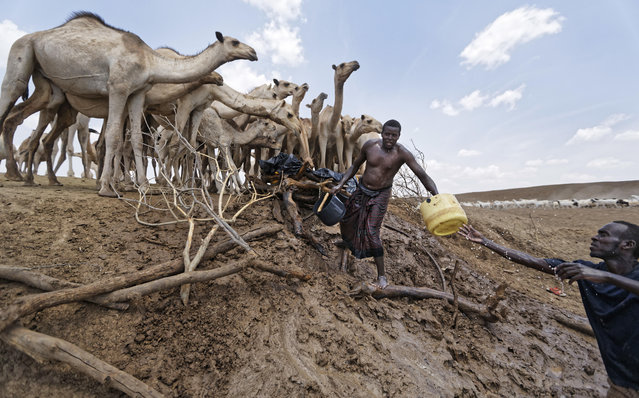
Camel herders scoop up water in plastic buckets from one of the few watering holes in the area, to water their animals near the drought-affected village of Bandarero, near Moyale town on the Ethiopian border, in northern Kenya, Friday, March 3, 2017. The U.N. humanitarian chief, Stephen O'Brien, toured Bandarero village on Friday and called on the international community to act to “avert the very worst of the effects of drought and to avert a famine to make sure we don't go from what is deep suffering to a catastrophe”. (Photo by Ben Curtis/AP Photo)

Camel herders scoop up water in plastic buckets from one of the few watering holes in the area, to water their animals near the drought-affected village of Bandarero, near Moyale town on the Ethiopian border, in northern Kenya, Friday, March 3, 2017. The U.N. humanitarian chief, Stephen O'Brien, toured Bandarero village on Friday and called on the international community to act to “avert the very worst of the effects of drought and to avert a famine to make sure we don't go from what is deep suffering to a catastrophe”. (Photo by Ben Curtis/AP Photo)
Details
05 Mar 2017 00:03:00
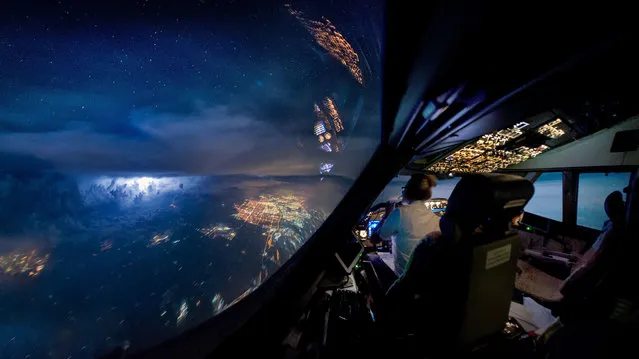
An incredible view of Thunderstorms light up the insides of clouds near a beautiful sky line. This is truly heavenly weather as pictures taken from an airplane cockpit reveal what pilots see from above. It looks like at cruising altitude the weather really hots up, with the flight deck revealing some amazing scenes. Thunderstorms light up the insides of clouds, lightening streaks across the sky like cracks in a windscreen, the northern lights sweep uninterrupted across the sky and the galaxy stretches on forever. The pictures were captured by senior first officer Christiaan van Heijst, a 33-year-old from the Netherlands, and his friend Daan Krans. (Photo by Christiaan van Heijst/Daan Krans/Caters News Agency)

An incredible view of Thunderstorms light up the insides of clouds near a beautiful sky line. This is truly heavenly weather as pictures taken from an airplane cockpit reveal what pilots see from above. It looks like at cruising altitude the weather really hots up, with the flight deck revealing some amazing scenes. Thunderstorms light up the insides of clouds, lightening streaks across the sky like cracks in a windscreen, the northern lights sweep uninterrupted across the sky and the galaxy stretches on forever. The pictures were captured by senior first officer Christiaan van Heijst, a 33-year-old from the Netherlands, and his friend Daan Krans. (Photo by Christiaan van Heijst/Daan Krans/Caters News Agency)
Details
22 Sep 2016 09:45:00
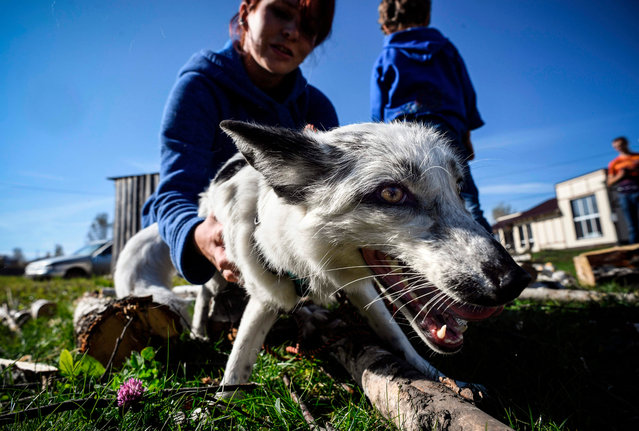
Tatyana Abramova, 33, plays with her home fox Plombir at her countryside house outside Siberian city of Novosibirsk on September 12, 2020. The official start of the Soviet experiment to better understand the domestication of animals by humans began in 1959, and was initiated by geneticists Dmitri Beliaiev and Lioudmila Trout on a farm in Akademgorodok, the scientific center of excellence in Siberia. Their primary objective was to domesticate foxes, to understand how the ancestor of wolves, another canine, evolved into a loyal and loving dog. And understand what this domestication tells us about the genetic evolution of species. (Photo by Alexander Nemenov/AFP Photo)

Tatyana Abramova, 33, plays with her home fox Plombir at her countryside house outside Siberian city of Novosibirsk on September 12, 2020. The official start of the Soviet experiment to better understand the domestication of animals by humans began in 1959, and was initiated by geneticists Dmitri Beliaiev and Lioudmila Trout on a farm in Akademgorodok, the scientific center of excellence in Siberia. Their primary objective was to domesticate foxes, to understand how the ancestor of wolves, another canine, evolved into a loyal and loving dog. And understand what this domestication tells us about the genetic evolution of species. (Photo by Alexander Nemenov/AFP Photo)
Details
25 Oct 2020 00:05:00
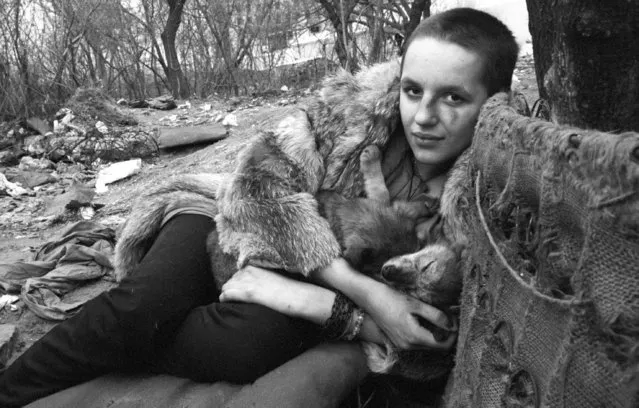
Suffering from a broken nose and bruised ribs Natasha Dzhuley, 16, relaxes after inhaling glue for the first time – something she swore she would never do, 2002. She was beaten by her pimps men in what Ruslana believes was a warning to other prostitutes to stay in line. Though another child believes her pimp had her beaten because she was pregnant. Less than a week after this picture of Natasha was taken she was dragged away by six men. She has not been heard or seen since. (Photo by Kurt Vinion /Getty Images)

Suffering from a broken nose and bruised ribs Natasha Dzhuley, 16, relaxes after inhaling glue for the first time – something she swore she would never do, 2002. She was beaten by her pimps men in what Ruslana believes was a warning to other prostitutes to stay in line. Though another child believes her pimp had her beaten because she was pregnant. Less than a week after this picture of Natasha was taken she was dragged away by six men. She has not been heard or seen since. (Photo by Kurt Vinion /Getty Images)
Details
18 Feb 2017 00:05:00
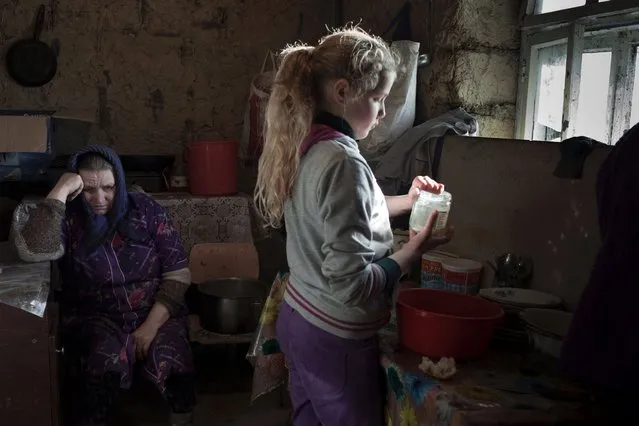
According to the U.S. government, Moldova, one of the poorest countries in Europe, depends on about $1.6 billion annually sent back from the roughly one million Moldovans who left for work in in Europe, Russia, and other former Soviet Bloc countries. Photographer Myriam Meloni went to Moldova to document what she refers to as “social orphans” – children whose parents have emigrated to another country in search of a job and a better future for their families. Here: Lulia is seen washing dishes in her grandmother's house, where she lives. (Photo by Myriam Meloni)

According to the U.S. government, Moldova, one of the poorest countries in Europe, depends on about $1.6 billion annually sent back from the roughly one million Moldovans who left for work in in Europe, Russia, and other former Soviet Bloc countries. Photographer Myriam Meloni went to Moldova to document what she refers to as “social orphans” – children whose parents have emigrated to another country in search of a job and a better future for their families. Here: Lulia is seen washing dishes in her grandmother's house, where she lives. (Photo by Myriam Meloni)
Details
12 Mar 2016 14:57:00