Loading...
Done
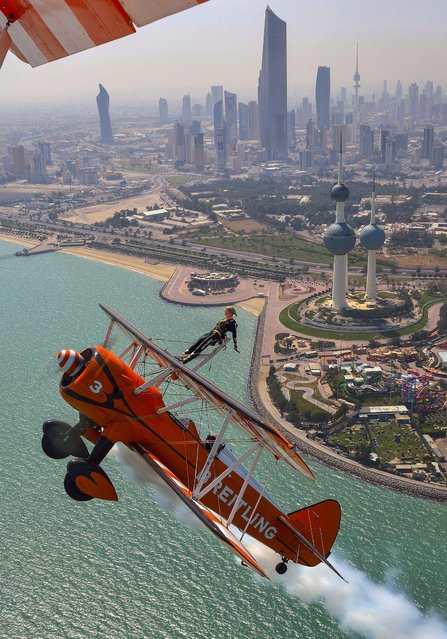
Breitling Wingwalker Freya Paterson, from Liverpool, UK, flies above Kuwait City's iconic Water Towers with pilots David Barrell and Martyn Carrington, on March 6, 2014. The team loop and roll up to 160 mph enduring G-forces of 4-5g. (Photo by Katsuhiko Tokunaga/Breitling)

Breitling Wingwalker Freya Paterson, from Liverpool, UK, flies above Kuwait City's iconic Water Towers with pilots David Barrell and Martyn Carrington, on March 6, 2014. The team loop and roll up to 160 mph enduring G-forces of 4-5g. Crowds are expected to line the Kuwaiti coastline to catch a glimpse of the Wingwalking team on Saturday, March 8, 2014, to mark the opening of the first dedicated boutique in the city for the prestigious watch brand. (Photo by Katsuhiko Tokunaga/Breitling)
Details
08 Mar 2014 10:42:00
One of the worlds shortest models Mary Russell at 4 feet 1 inch with 6 foot model Georgia Meacham in London, UK on June 16, 2016. The 4ft1 beauty suffers with achondroplasia  a medical term for dwarfism, which means she has as average sized torso but short arms and short legs, with an oversized head. As well as stifled growth, Mary also suffers with sciatica and spinal stenosis, an abnormal narrowing of the spinal canal – which cause agonising nerve problems, leaving her in excruciating pain and unable to stand for long periods of time. The condition leaves Mary, 47, struggling with everyday tasks  things most people take for granted like going to the supermarket, getting cash from an ATM and ordering a drink at a bar become a challenge. (Photo by Simon Jacobs/Caters News Agency)

One of the worlds shortest models Mary Russell at 4 feet 1 inch with 6 foot model Georgia Meacham in London, UK on June 16, 2016. The 4ft1 beauty suffers with achondroplasia a medical term for dwarfism, which means she has as average sized torso but short arms and short legs, with an oversized head. As well as stifled growth, Mary also suffers with sciatica and spinal stenosis, an abnormal narrowing of the spinal canal – which cause agonising nerve problems, leaving her in excruciating pain and unable to stand for long periods of time. The condition leaves Mary, 47, struggling with everyday tasks things most people take for granted like going to the supermarket, getting cash from an ATM and ordering a drink at a bar become a challenge. (Photo by Simon Jacobs/Caters News Agency)
Details
28 Aug 2016 10:12:00
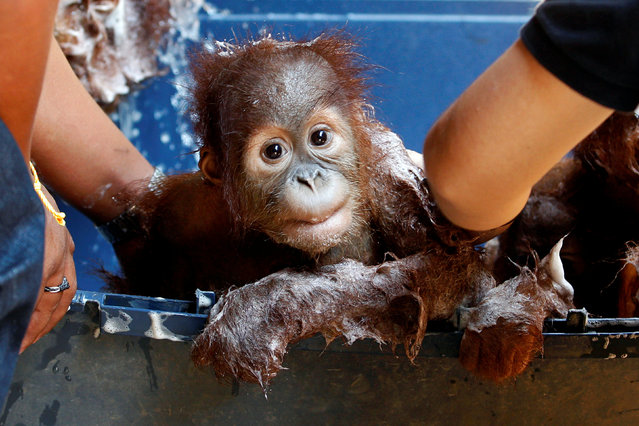
A baby Sumatran orangutan is bathed after arriving at a wildlife center at Ratchaburi province in Thailand  September 13, 2017. (Photo by Kerek Wongsa/Reuters)

A baby Sumatran orangutan is bathed after arriving at a wildlife center at Ratchaburi province in Thailand September 13, 2017. (Photo by Kerek Wongsa/Reuters)
Details
17 Sep 2017 07:39:00
People play on a beach along the Arabian Sea on a hot summer day in Mumbai, India, April 29, 2016. (Photo by Danish Siddiqui/Reuters)

People play on a beach along the Arabian Sea on a hot summer day in Mumbai, India, April 29, 2016. (Photo by Danish Siddiqui/Reuters)
Details
02 May 2016 10:27:00
An employee of a bakery talks on his mobile while balancing on his head a tray of freshly baked bread from a local bakery in a street in Cairo, Egypt, January 12, 2016. (Photo by Asmaa Waguih/Reuters)

An employee of a bakery talks on his mobile while balancing on his head a tray of freshly baked bread from a local bakery in a street in Cairo, Egypt, January 12, 2016. (Photo by Asmaa Waguih/Reuters)
Details
13 Jan 2016 11:31:00
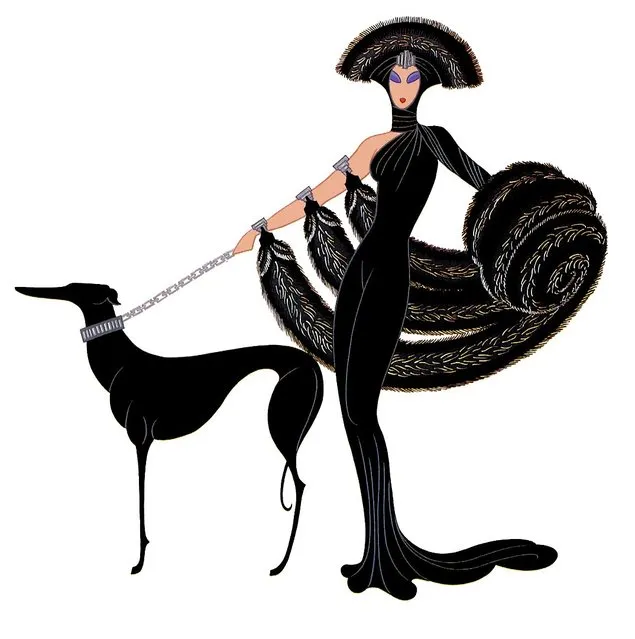
Romain de Tirtoff (Erte) – Symphony In Black

“Romain de Tirtoff (23 November 1892 – 21 April 1990) was a Russian-born French artist and designer known by the pseudonym Erté, the French pronunciation of his initials, R.T. He was a diversely talented 20th-century artist and designer who flourished in an array of fields, including fashion, jewellery, graphic arts, costume and set design for film, theatre, and opera, and interior decor”. – Wikipedia. Photo: Romain de Tirtoff (Erte) – “Symphony In Black” (please click to enlarge).
Details
29 Jan 2014 13:34:00
On August 31, 2012, a long filament of solar material that had been hovering in the sun's atmosphere, the corona, erupted out into space at 4:36 p.m. EDT. The coronal mass ejection, or CME, traveled at over 900 miles per second. The CME did not travel directly toward Earth, but did connect with Earth's magnetic environment, or magnetosphere, causing aurora to appear on the night of Monday, September 3. (Photo by NASA/GSFC/SDO)

On August 31, 2012, a long filament of solar material that had been hovering in the sun's atmosphere, the corona, erupted out into space at 4:36 p.m. EDT. The coronal mass ejection, or CME, traveled at over 900 miles per second. The CME did not travel directly toward Earth, but did connect with Earth's magnetic environment, or magnetosphere, causing aurora to appear on the night of Monday, September 3. (Photo by NASA/GSFC/SDO via The Atlantic)
Details
14 Sep 2012 09:01:00
A girl plays on a pile of discarded flowers outside a market, the day after the Diwali celebrations in Mumbai, India October 31, 2016. (Photo by Shailesh Andrade/Reuters)

A girl plays on a pile of discarded flowers outside a market, the day after the Diwali celebrations in Mumbai, India October 31, 2016. (Photo by Shailesh Andrade/Reuters)
Details
01 Nov 2016 12:05:00