Loading...
Done
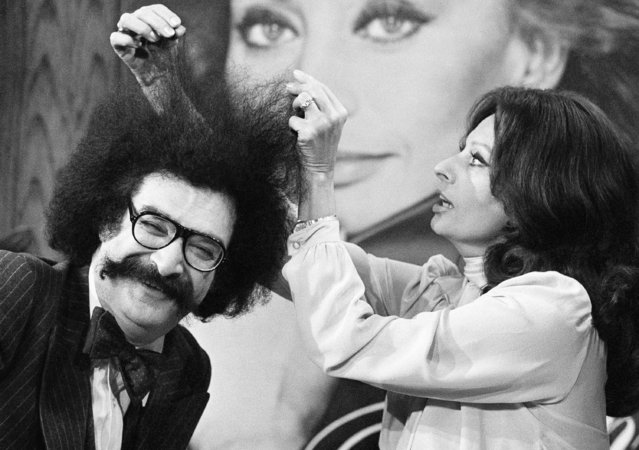
Actress Sophia Loren teases the hair of critic Gene Shalit in New York, Tuesday, February 20, 1979. During the filming of a segment for the NBC television “Today” show. In the background is a large photograph of Miss Loren. The segment is scheduled for airing later this week. (Photo by Dave Pickoff/AP Photo)

Actress Sophia Loren teases the hair of critic Gene Shalit in New York, Tuesday, February 20, 1979. During the filming of a segment for the NBC television “Today” show. In the background is a large photograph of Miss Loren. The segment is scheduled for airing later this week. (Photo by Dave Pickoff/AP Photo)
Details
23 Feb 2018 00:02:00
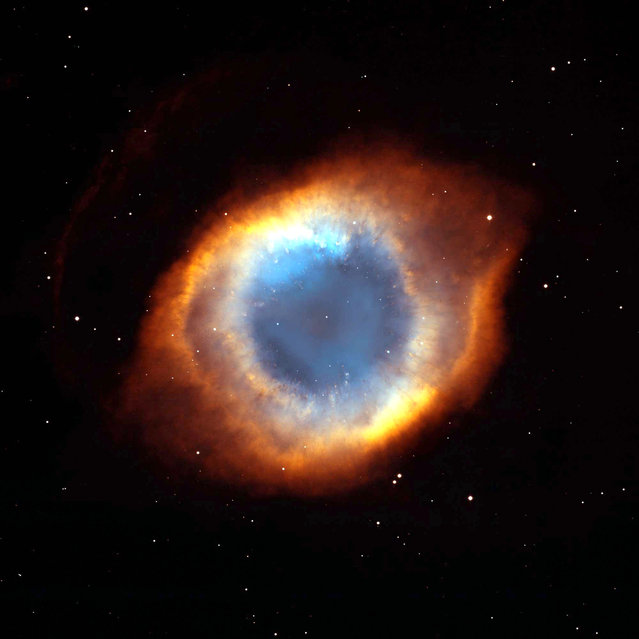
A coil-shaped Helix Nebula showing a fine web of filamentary “bicycle-spoke” features embedded in the colorful red and blue ring of gas. At 650 light-years away, the Helix is one of the nearest planetary nebulae to Earth. A planetary nebula is the glowing gas around a dying, Sun-like star. (Photo by Reuters/NASA)

A coil-shaped Helix Nebula showing a fine web of filamentary “bicycle-spoke” features embedded in the colorful red and blue ring of gas. At 650 light-years away, the Helix is one of the nearest planetary nebulae to Earth. A planetary nebula is the glowing gas around a dying, Sun-like star. (Photo by Reuters/NASA)
Details
22 Oct 2014 14:01:00
A starling jealously guards a seed station in the back garden of the photographer’s Michigan home in January 2024. (Photo by Lisa Cavanary/Solent News)

A starling jealously guards a seed station in the back garden of the photographer’s Michigan home in January 2024. (Photo by Lisa Cavanary/Solent News)
Details
04 Feb 2024 09:40:00
1914: A Thorneycroft motor van as used during World War I

A Thorneycroft motor van as used during World War I. (Photo by Topical Press Agency/Getty Images). August 1914
Details
13 Dec 2011 11:49:00
An aerial view taken with a drone shows the autumnally colored Fuerst-Pueckler-Park near Cottbus, eastern Germany, Saturday, October 29, 2016. The park, composed with great sensitivity in the 19th century by Prince Hermann von Pueckler-Muskau, is considered as one of the last great German landscape gardens. (Photo by Patrick Pleul/DPA via AP Photo)

An aerial view taken with a drone shows the autumnally colored Fuerst-Pueckler-Park near Cottbus, eastern Germany, Saturday, October 29, 2016. The park, composed with great sensitivity in the 19th century by Prince Hermann von Pueckler-Muskau, is considered as one of the last great German landscape gardens. (Photo by Patrick Pleul/DPA via AP Photo)
Details
18 Jan 2017 08:01:00
Visitors walk past a family of scarecrows during the Scarecrow Festival in Heather, Britain July 29, 2015. (Photo by Darren Staples/Reuters)

Visitors walk past a family of scarecrows during the Scarecrow Festival in Heather, Britain July 29, 2015. The annual event asks residents of Heather to make scarecrows to raise thousands of pounds for local groups and charities. (Photo by Darren Staples/Reuters)
Details
30 Jul 2015 12:42:00
Hawk T1 aircraft of the Royal Air Force Aerobatic Team, the Red Arrows, perform a vertical loop during a practice display in Fitties, Greece on November 10, 2025. The team conducted the display practice as part of Exercise SpringHawk 2025. (Photo by AS1 Iwan Lewis/RAF)

Hawk T1 aircraft of the Royal Air Force Aerobatic Team, the Red Arrows, perform a vertical loop during a practice display in Fitties, Greece on November 10, 2025. The team conducted the display practice as part of Exercise SpringHawk 2025. (Photo by AS1 Iwan Lewis/RAF)
Details
20 Nov 2025 05:04:00
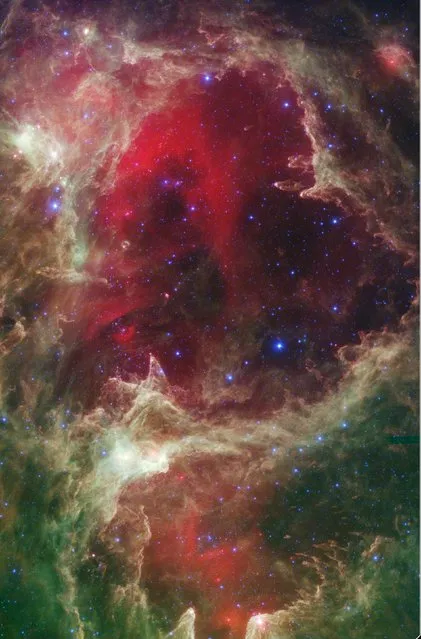
An infrared portrait from NASA's Spitzer Space Telescope which shows generations of stars is seen in this undated NASA handout image released February 14, 2013. In this wispy star-forming region, called W5, the oldest stars can be seen as blue dots in the centers of the two hollow cavities (other blue dots are background and foreground stars not associated with the region). Red shows heated dust that pervades the region's cavities, while green highlights dense clouds. (Photo by NASA/Reuters/JPL-Caltech/Harvard-Smithsonian/Handout)

An infrared portrait from NASA's Spitzer Space Telescope which shows generations of stars is seen in this undated NASA handout image released February 14, 2013. In this wispy star-forming region, called W5, the oldest stars can be seen as blue dots in the centers of the two hollow cavities (other blue dots are background and foreground stars not associated with the region). Red shows heated dust that pervades the region's cavities, while green highlights dense clouds. (Photo by NASA/Reuters/JPL-Caltech/Harvard-Smithsonian/Handout)
Details
03 Mar 2013 08:44:00