Loading...
Done
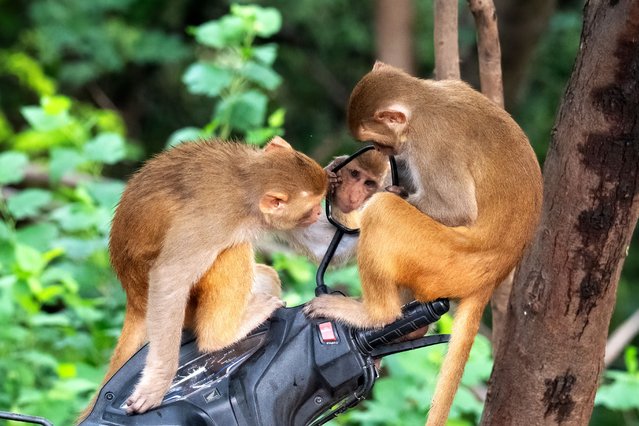
A pair of macaques check themselves out in the rear view mirror of a motorbike in Chandigarh, India in the last decade of August 2024. (Photo by Anuj Jain/Media Drum Images)

A pair of macaques check themselves out in the rear view mirror of a motorbike in Chandigarh, India in the last decade of August 2024. (Photo by Anuj Jain/Media Drum Images)
Details
01 Sep 2024 03:32:00
A woman arrives to cast her vote at a polling station as police officers stand guard during the general election, in Peshawar, Pakistan on February 8, 2024. (Photo by Fayaz Aziz/Reuters)

A woman arrives to cast her vote at a polling station as police officers stand guard during the general election, in Peshawar, Pakistan on February 8, 2024. (Photo by Fayaz Aziz/Reuters)
Details
02 Mar 2024 00:39:00
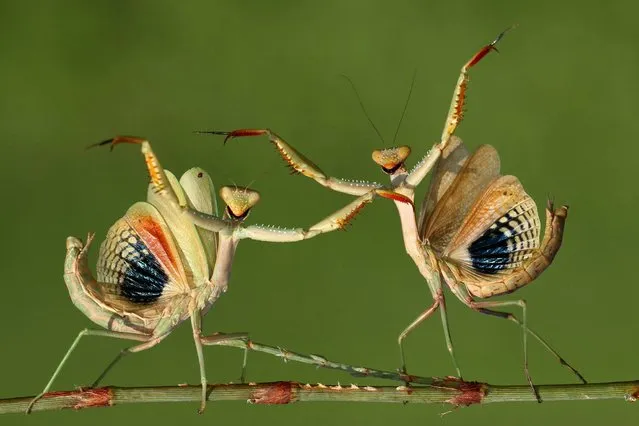
“Zeybeks”. That's Dance, Sunward and Zeybeks. (Photo by Hasan Baglar/2014 Sony World Photography Awards)

“Zeybeks”. That's Dance, Sunward and Zeybeks. (Photo by Hasan Baglar/2014 Sony World Photography Awards)
Details
07 Feb 2014 08:57:00
Children Cooling Off at Dhiari Homeland. Local children get wet and cool in Arnhem Land. (Photo by Matthew Abbott/Australian Life Prize 2015)

From the rocks of Arnhem Land to the backyards of the Sydney suburbs, from stretching by the pool to waiting for evening prayer, snapshots for the 2015 Australian Life prize demonstrated a nation in colour and motion. Here: Children Cooling Off at Dhiari Homeland. Local children get wet and cool in Arnhem Land. (Photo by Matthew Abbott/Australian Life Prize 2015)
Details
23 Nov 2015 08:03:00
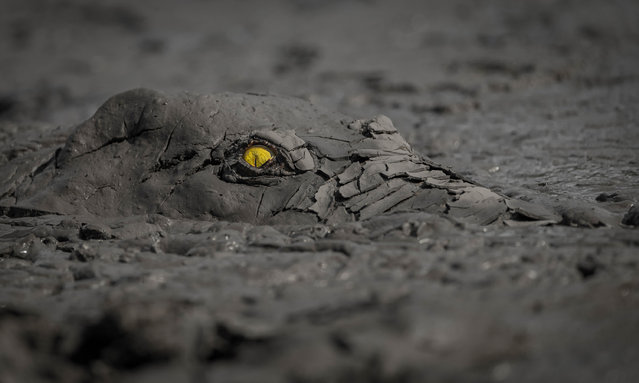
Winner, Other animals. Jens Cullmann – Danger in the Mud. Crocodile in a drying pool. (Photo by Jens Cullmann/2020 GDT Nature Photographer of the Year)

The German Society for Nature Photography (GDT) has selected its Nature Photographer of the Year 2020. Here: Winner, Other animals. Jens Cullmann – Danger in the Mud. Crocodile in a drying pool. (Photo by Jens Cullmann/2020 GDT Nature Photographer of the Year)
Details
01 May 2020 00:03:00
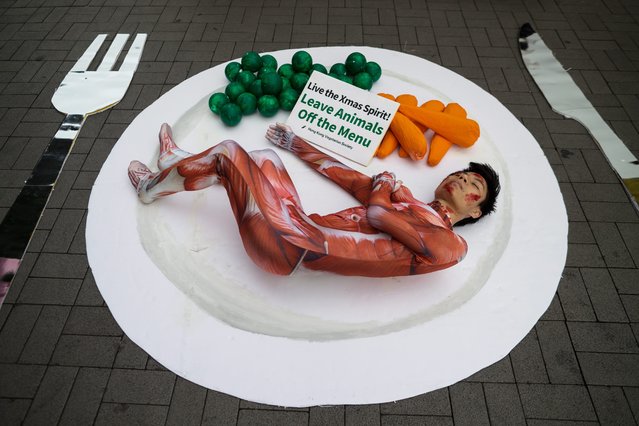
A Hong Kong Vegetarian Society activists lies on a giant plate alongside oversized peas, carrots and cutlery during a protest rally in the tourist district of Tsim Sha Tsui, Hong Kong, China, 23 December 2015. The activists urged passers-by to extend the holiday spirit to animals and to give thoughts to the cruelty inflicted on animals in meat productions. (Photo by Jerome Favre/EPA)

A Hong Kong Vegetarian Society activists lies on a giant plate alongside oversized peas, carrots and cutlery during a protest rally in the tourist district of Tsim Sha Tsui, Hong Kong, China, 23 December 2015. The activists urged passers-by to extend the holiday spirit to animals and to give thoughts to the cruelty inflicted on animals in meat productions. (Photo by Jerome Favre/EPA)
Details
24 Dec 2015 10:21:00
The sun rises this morning behind the 173ft spire of St Mary's church in the market town of Whittlesey in Cambridgeshire, UK on February 17, 2024. The church dates from the 13th century with the Ashlar faced tower added in the 15th century. (Photo by Andrew McCaren/London News Pictures)

The sun rises this morning behind the 173ft spire of St Mary's church in the market town of Whittlesey in Cambridgeshire, UK on February 17, 2024. The church dates from the 13th century with the Ashlar faced tower added in the 15th century. (Photo by Andrew McCaren/London News Pictures)
Details
01 Jun 2024 05:02:00
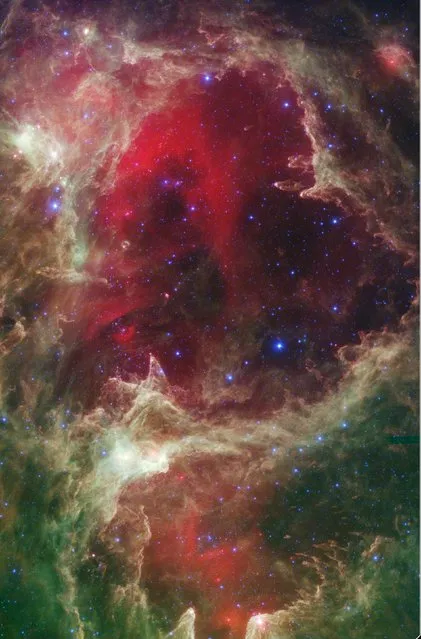
An infrared portrait from NASA's Spitzer Space Telescope which shows generations of stars is seen in this undated NASA handout image released February 14, 2013. In this wispy star-forming region, called W5, the oldest stars can be seen as blue dots in the centers of the two hollow cavities (other blue dots are background and foreground stars not associated with the region). Red shows heated dust that pervades the region's cavities, while green highlights dense clouds. (Photo by NASA/Reuters/JPL-Caltech/Harvard-Smithsonian/Handout)

An infrared portrait from NASA's Spitzer Space Telescope which shows generations of stars is seen in this undated NASA handout image released February 14, 2013. In this wispy star-forming region, called W5, the oldest stars can be seen as blue dots in the centers of the two hollow cavities (other blue dots are background and foreground stars not associated with the region). Red shows heated dust that pervades the region's cavities, while green highlights dense clouds. (Photo by NASA/Reuters/JPL-Caltech/Harvard-Smithsonian/Handout)

Details
03 Mar 2013 08:44:00