Loading...
Done
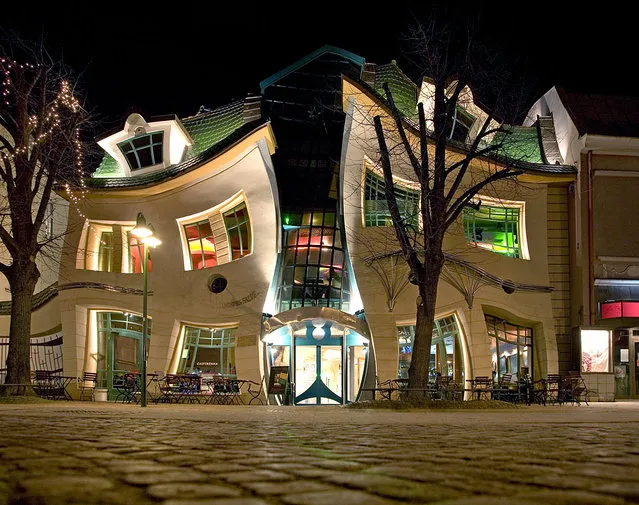
Crooked House


The Krzywy Domek is an irregularly-shaped building in Sopot, Poland. Its name translates in to English as the Crooked House. The Krzywy Domek was built in 2004. It is approximately 4,000 square meters in size and is part of the Rezydent shopping center. It was designed by Szotyńscy & Zaleski who were inspired by the fairytale illustrations and drawings of Jan Marcin Szancer and Per Dahlberg. It can be entered from either Monte Cassino or Morska Streets.
Details
29 Jun 2012 12:00:00
Plasticiens Volants Fly Inflatable Puppets Over Berlin

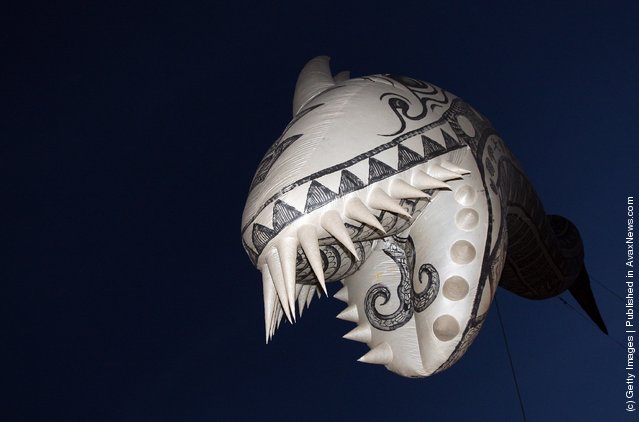
An inflatable snake hovers during a performance by the French street theater company Plasticiens Volants on September 4, 2011 in Berlin, Germany. The spectale, featuring gigantic flying inflatable fairy-tale creatures and performers on stilts and in costume was a part of celebrations for the 125th anniversary of the Kurfuerstendamm, known locally as the Ku'damm, a shopping boulevard. (Photo by Adam Berry/Getty Images)
Details
05 Sep 2011 12:56:00
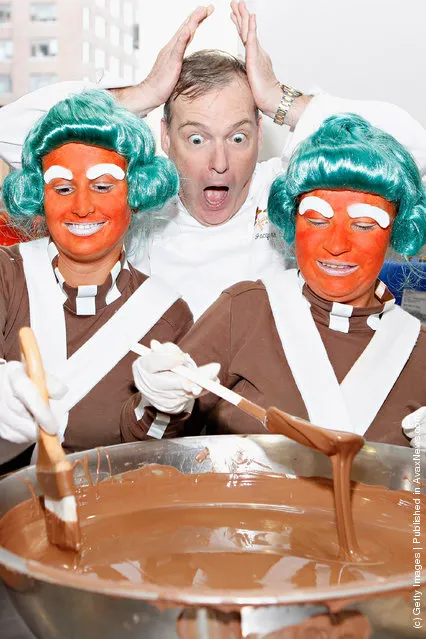
Chef Jacques Torres celebrates the 40th Anniversary of Willy Wonka & The Chocolate Factory with Oompa Loompas

Chef Jacques Torres celebrates the “40th Anniversary of Willy Wonka & The Chocolate Factory” with Oompa Loompas at his New York City chocolate shop event on October 18, 2011 in New York City. (Photo by Cindy Ord/Getty Images)
Details
19 Oct 2011 10:42:00
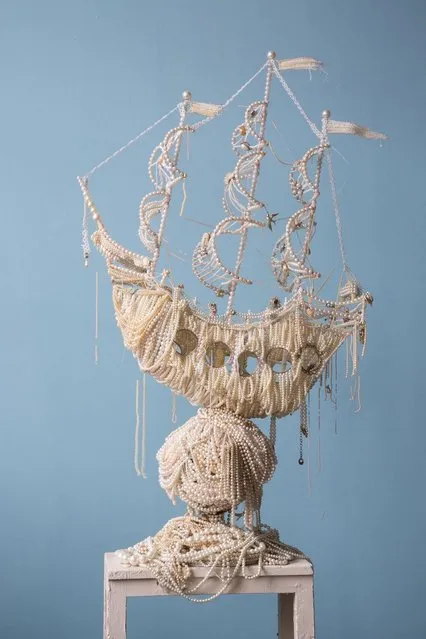
Ship Made By Old Pearl By Ann Carrington

Ann Carrington has a penchant for collecting old things. Her treasure is other peoples trash! For the past few years, she has been collecting old pearl necklaces from junk shops and boot fairs with a view to building the awesomely majestic galleons below.
Details
15 Jun 2015 11:15:00
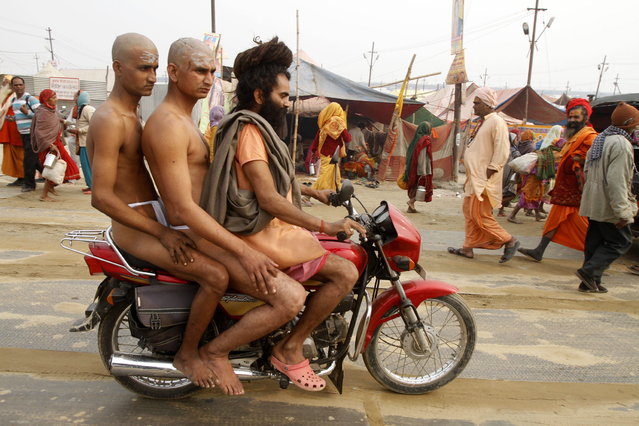
Two Hindu holy men of the Juna Akhara sect  are being take on a motorcycle by their teacher as they got delayed for a rituals that are believed to rid them of all ties in this life and dedicate themselves to serving God as a “Naga” or naked holy men, at Sangam, the confluence of the Ganges and Yamuna River during the Maha Kumbh festival in Allahabad, India, Wednesday, February 6, 2013. (Photo by Rajesh Kumar Singh/AP Photo)

Two Hindu holy men of the Juna Akhara sect are being take on a motorcycle by their teacher as they got delayed for a rituals that are believed to rid them of all ties in this life and dedicate themselves to serving God as a “Naga” or naked holy men, at Sangam, the confluence of the Ganges and Yamuna River during the Maha Kumbh festival in Allahabad, India, Wednesday, February 6, 2013. The significance of nakedness is that they will not have any worldly ties to material belongings, even something as simple as clothes. This ritual that transforms selected holy men to Naga can only be done at the Kumbh festival. (Photo by Rajesh Kumar Singh/AP Photo)
Details
07 Feb 2013 10:11:00
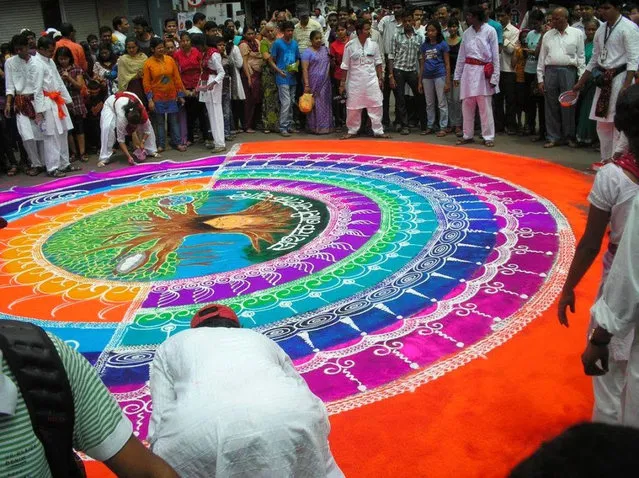
Rangoli Folk Art From India

Rangoli, also known as kolam or Muggu, is a folk art from India in which patterns are created on the floor in living rooms or courtyards using materials such as colored rice, dry flour, colored sand or flower petals. It is usually made during Diwali, Onam, Pongal and other Indian festivals. They are meant to be sacred welcoming areas for the Hindu deities. The ancient symbols have been passed down through the ages, from each generation to the next, keeping both the art form and the tradition alive. Similar practices are followed in different Indian states: in Tamil Nadu, there is Kolam in Tamil Nadu; Mandana in Rajasthan; Chaookpurna in Chhattisgarh; Alpana in West Bengal; Aripana in Bihar; Chowk pujan in Uttar Pradesh; Muggu in Andhra Pradesh and others.
Details
16 Jun 2014 10:37:00


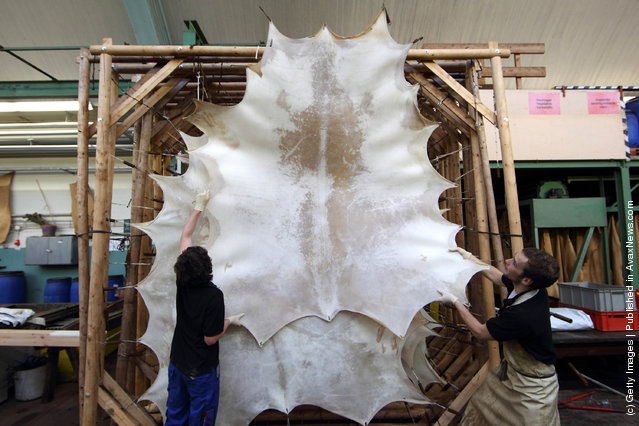
REUTLINGEN, GERMANY - NOVEMBER 17: Students hang out finished parchment leather at the LGR (Lederinstitut Gerberschule Reutlingen) tannery school on November 17, 2010 in Reutlingen, Germany. Even in early antiquity and up their hair or dried goat and sheep skins were used as material for documents. In the small Asian city Pergamon these skins were processed in large quantities for this purpose, so they formed the main trading arm of the city, of which the name is parchment is derived. In medieval times, reached the parchment is of great importance, it was such as France's production under the supervision of the University of Paris. Even now, important documents, placed on their unlimited shelf life as possible large value (eg diplomas, addresses, memory, writings, documents for primary and keystones) written on parchment...
Details
20 Nov 2011 18:17:00
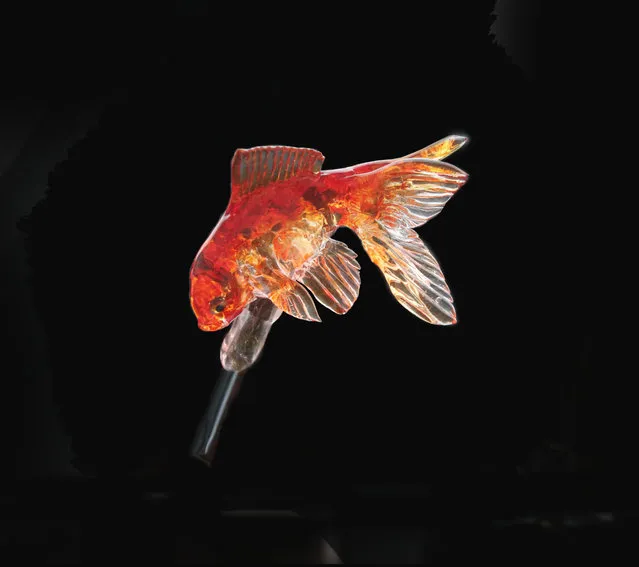
Realistic Animal Lollipops By Shinri Tezuka

Amezaiku is the Japanese craft of lollipop-making, which dates back to the 700s when artisans made mouth-watering and artistic lollipops to be presented as gifts. Carrying on the tradition is 26-year old Shinri Tezuka, the owner of a small shop in the Asakusa district of Tokyo called Ameshin.
Details
04 Sep 2015 08:50:00