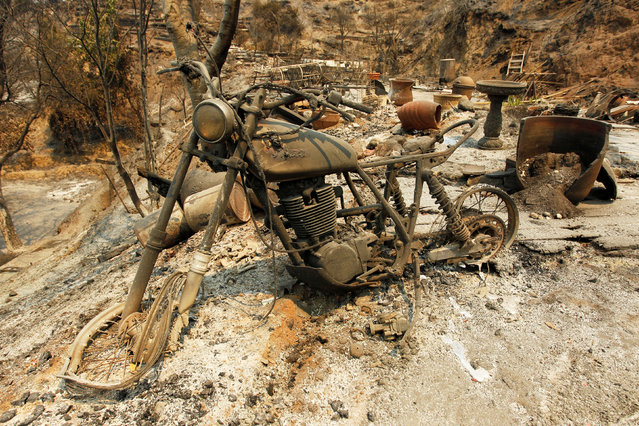
A motorcycle sits at the site of a destroyed home after the Soberanes Fire burned through the Palo Colorado area, north of Big Sur, California, July 31, 2016. (Photo by Michael Fiala/Reuters)
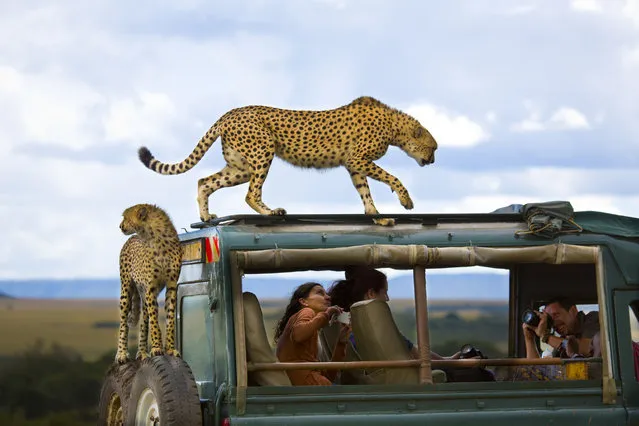
“Say cheese”. Cheetahs jumped on the vehicle of tourists in Masai Mara national park, Kenya. (Photo and caption by Yanai Bonneh/National Geographic Traveler Photo Contest)
ATTENTION! All pictures are presented in high resolution. To see Hi-Res images – just TWICE click on any picture. In other words, click small picture – opens the BIG picture. Click BIG picture – opens VERY BIG picture.
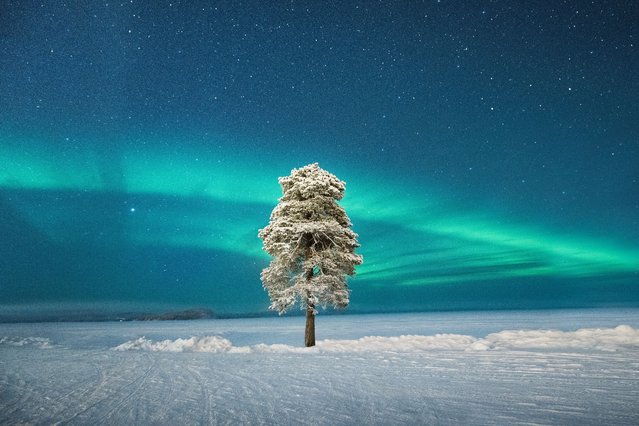
Aurorae category runner-up: Lone Tree under a Scandinavian Aurora by Tom Archer (UK). The photographer decided to explore the area around the hotel on a very crisp -35C evening in Finnish Lapland. When he found this tree, he decided to wait for the misty conditions to change and could not believe his luck when the sky cleared and the aurora came out in the perfect spot. Archer spent about an hour photographing it before his camera started to lock up because of the harsh conditions, but by then he was happy to call it a night. (Photo by Tom Archer/2020 Astronomy Photographer of the Year)
American singer-songwriter Taylor Swift kisses Kansas City Chiefs tight end Travis Kelce after an AFC Championship NFL football game against the Baltimore Ravens, Sunday, January 28, 2024, in Baltimore. The Kansas City Chiefs won 17-10. (Photo by Julio Cortez/AP Photo)
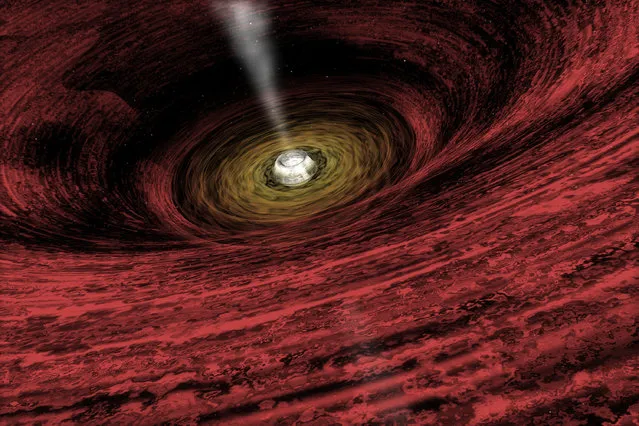
An artist's impression of a growing supermassive black hole located in the early Universe is seen in this NASA handout illustration released on June 15, 2011. Using the deepest X-ray image ever taken, astronomers found the first direct evidence that massive black holes were common in the early universe. This discovery from NASA's Chandra X-Ray Observatory shows that very young black holes grew more aggressively than previously thought, in tandem with the growth of their host galaxies. (Photo by Reuters/NASA/Chandra X-Ray Observatory/A.Hobart)
On August 31, 2012, a long filament of solar material that had been hovering in the sun's atmosphere, the corona, erupted out into space at 4:36 p.m. EDT. The coronal mass ejection, or CME, traveled at over 900 miles per second. The CME did not travel directly toward Earth, but did connect with Earth's magnetic environment, or magnetosphere, causing aurora to appear on the night of Monday, September 3. (Photo by NASA/GSFC/SDO via The Atlantic)
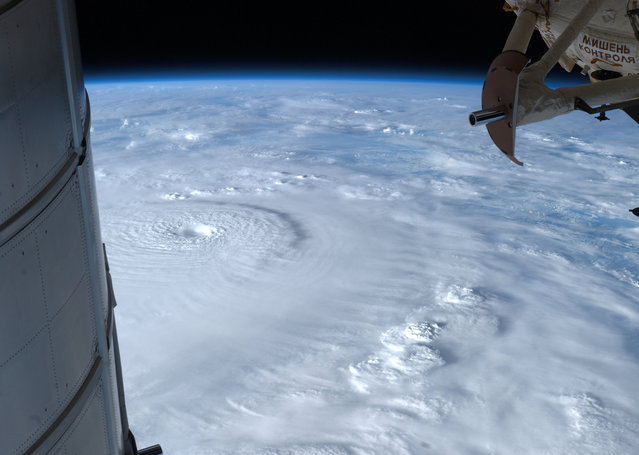
Sally Gomez drives to rescue of friend Michele Moore in flooded parking lot at Hyannis, Mass., September 9, 1969, after torrential rains of Hurricane Gerda flooded low areas of Cape Cod. Ann Davis of Osterville stands up in roof opening to lend a hand. Sally and Michele are from Centerville on the Cape. (Photo by Frank C. Curtin/AP Photo)