Moana Mason, 8, participates in the People's Summit event on Guajara Bay during the COP30 U.N. Climate Summit, Wednesday, November 12, 2025, in Belem, Brazil. (Photo by Joshua A. Bickel/AP Photo)
Puerto Rico's Grace Claxton warms up before competing in the Women's 400m Hurdles Round 1 during the athletics event at the Rio 2016 Olympic Games at the Olympic Stadium in Rio de Janeiro on August 15, 2016. (Photo by Jewel Samad/AFP Photo)
North Korean women in colorful traditional dresses are surrounded by flower blossoms known as “Kimilsungia” as they wait to guide guests at a flower exhibition in Pyongyang, North Korea, April 14, 2014. The flowers, named after Kim Il Sung, are on display to celebrate the late leader's official birth date of April 15, 1912. (Photo by David Guttenfelder/AP Photo)
Firefighters use flashlights to search for survivors among the rubble of collapsed buildings after a landslide hit an industrial park in Shenzhen, Guangdong province, China December 20, 2015. (Photo by Tyrone Siu/Reuters)
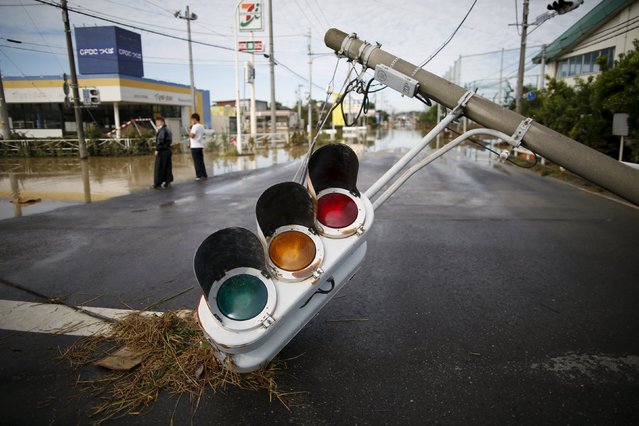
A damaged traffic signal is pictured along a street at a residential area flooded by the Kinugawa river, caused by typhoon Etau in Joso, Ibaraki prefecture, Japan, September 11, 2015. Unprecedented rain in Japan unleashed heavy floods on Friday that tore houses from their foundations, uprooted trees and forced more than 100,000 people from their homes. (Photo by Issei Kato/Reuters)
A man smiles as he carries firewood he bought on a street amid ongoing fuel and cooking gas shortages in Yemen's capital Sanaa December 2, 2015. (Photo by Khaled Abdullah/Reuters)
This Thursday, January 22, 2015 photo made with a long exposure shows the glow from a Noctiluca scintillans algal bloom along the seashore in Hong Kong. The luminescence, also called Sea Sparkle, is triggered by farm pollution that can be devastating to marine life and local fisheries, according to University of Georgia oceanographer Samantha Joye. Noctiluca itself does not produce neurotoxins like other similar organisms do. But its role as both prey and predator tends can eventually magnify the accumulation of toxins in the food chain, according to R. Eugene Turner at Louisiana State University. (Photo by Kin Cheung/AP Photo)