Loading...
Done
Wooden Churches - Travelling In The Russian North By Richard Davies Part 2

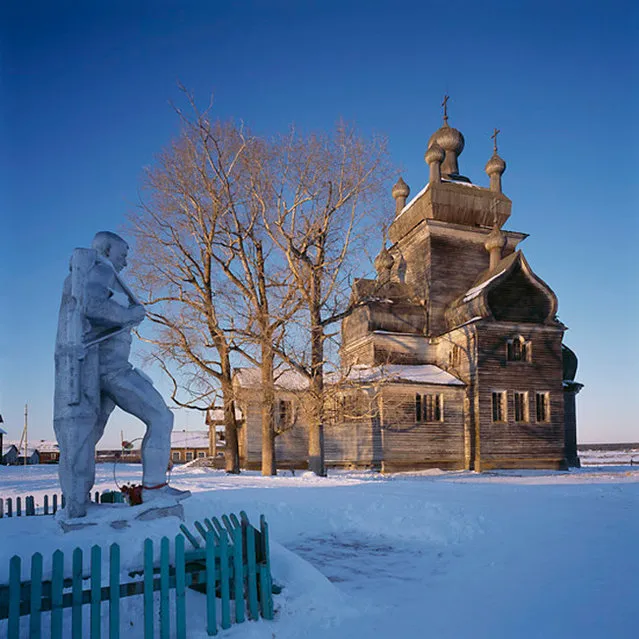
While communism, collectivism, worms, dry rot and casual looting failed to destroy the majestic wooden churches of Russia, it may be ordinary neglect that finally does them in. Dwindled now to several hundred remaining examples, these glories of vernacular architecture lie scattered amid the vastness of the world’s largest country. Just over a decade ago, Richard Davies, a British architectural photographer, struck out on a mission to record the fragile and poetic structures. Austerely beautiful and haunting, “Wooden Churches: Traveling in the Russian North” (White Sea Publishing; $132) is the result. Covering thousands of miles, Mr. Davies described how he and the writer Matilda Moreton tracked down the survivors from among the thousands of onion-domed structures built after Prince Vladimir converted to Christianity in 988.

See also: Wooden Churches Part1
Details
28 Nov 2013 12:13:00
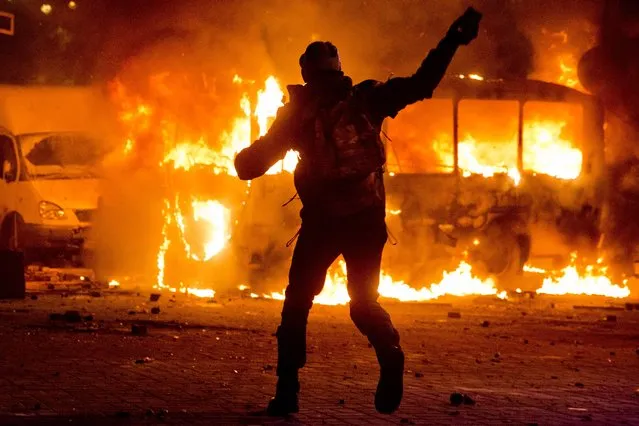
A protester  throws  a stone towards a burning police bus in front of him, during clashes with police,  in central Kiev, Ukraine, Sunday, January 19, 2014. (Photo by Evgeny Feldman/AP Photo)

A protester throws a stone towards a burning police bus in front of him, during clashes with police, in central Kiev, Ukraine, Sunday, January 19, 2014. Hundreds of protesters on Sunday clashed with riot police in the center of the Ukrainian capital, after the passage of harsh anti-protest legislation last week seen as part of attempts to quash anti-government demonstrations. The violent scenes further escalated this ex-Soviet republic's political crisis and showed a rift among opposition leaders, one of whom fought bravely to stop the violence, while others condemned the events from afar. (Photo by Evgeny Feldman/AP Photo)
Details
20 Jan 2014 09:54:00
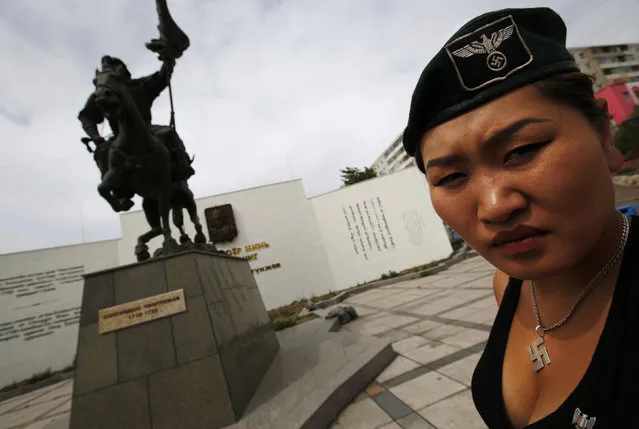
Uranjargal, a leader of the Mongolian neo-Nazi group Tsagaan Khass, stands next to a statue of Chingunjav, a Mongolian national hero, in Ulan Bator June 22, 2013. (Photo by Carlos Barria/Reuters)

Uranjargal, a leader of the Mongolian neo-Nazi group Tsagaan Khass, stands next to a statue of Chingunjav, a Mongolian national hero, in Ulan Bator June 22, 2013. The group has rebranded itself as an environmentalist organisation fighting pollution by foreign-owned mines, seeking legitimacy as it sends Swastika-wearing members to check mining permits. Over the past years, ultra-nationalist groups have expanded in the country and among those garnering attention is Tsagaan Khass, which has recently shifted its focus from activities such as attacks on women it accuses of consorting with foreign men to environmental issues, with the stated goal of protecting Mongolia from foreign mining interests. This ultra-nationalist group was founded in the 1990s and currently has 100-plus members. (Photo by Carlos Barria/Reuters)
Details
09 Jul 2013 07:23:00
Vintage G.I. Joe figurers are on display at the 2003 Hasbro International G.I. Joe Collectors' Convention June 27, 2003 in Burlingame, California. Hundreds of G.I. Joe fans from around the country are attending the convention to buy, sell and trade G.I. Joe and military action figures. (Photo by Justin Sullivan/Getty Images)

“G.I. Joe is a line of action figures produced by the toy company Hasbro. The term G.I. stands, in popular usage, for Government Issued and after the First World War became a generic term for U.S. soldiers. The origin of the term dates to World War I, when much of the equipment issued to U.S. soldiers was stamped “G.I.”, meaning that it was made from galvanized iron. The development of G.I. Joe led to the coining of the term “action figure”. G.I. Joe's appeal to children has made it an American icon among toys”. – Wikipedia. Photo: Vintage G.I. Joe figurers are on display at the 2003 Hasbro International G.I. Joe Collectors' Convention June 27, 2003 in Burlingame, California. (Photo by Justin Sullivan/Getty Images)
Details
27 Mar 2014 07:46:00


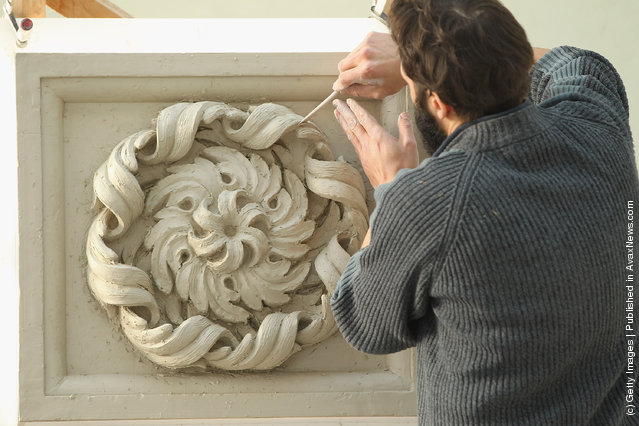
BERLIN, GERMANY - NOVEMBER 11: Sculptor Oleg Bessonov creates a rosette from clay at the Schlossbauhuette studio where a team of sculptors is creating decorative elements for the facade of the Berliner Schloss city palace on November 11, 2011 in Berlin, Germany. The Berliner Schloss was the residence of the Prussian Kaiser and was among the major architectural landmarks of Berlin until it was heavily damaged by Allied bombing in 1945. The communist authorities of East Berlin demolished the building in the 1950s, and today's Berlin government is pursuing an ambitious project to rebuild the palace according to a design by Italian architect Franco Stella, which will recreate the facade of the building but with a modern interior at a cost of approximately EUR 590 million. The Humboldt Forum, the foundation leading the project, has given the Schlossbauhuette sculptors the formidable task of recreating the hundreds of architectural elements that decorated the facade, and though some original pieces were saved, more often the sculptors have only old black and white photos as reference. (Photo by Sean Gallup/Getty Images)
Details
21 Nov 2011 11:22:00
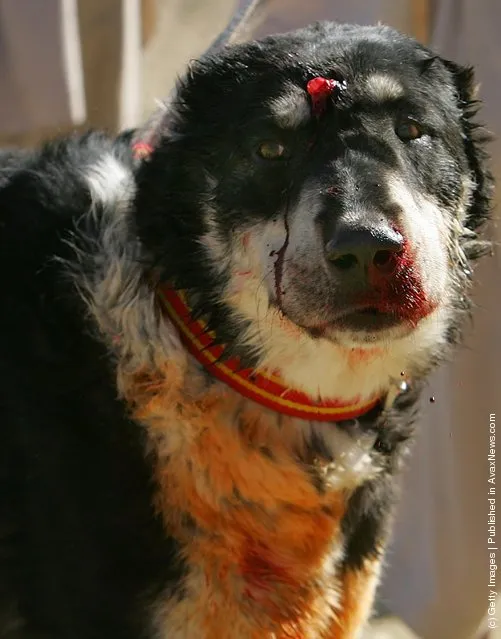
Afghan Dog Fighting

“Dog fighting is a form of blood sport in which game dogs are made to fight, sometimes to the death. It is illegal in most developed countries. Dog fighting is used for entertainment and may also generate revenue from stud fees, admission fees and gambling”. – Wikipedia

Photo: A bloody Afghan dog is bleeding with many wounds after he lost a dog fight November 24, 2006 in Kabul, Afghanistan. While the Afghan government is trying to ban the violent use of dogs for fighting, the unofficial sport remains a regular weekly event. Afghan dog fighting is popular among Afghan men who gamble on the dogs making upwards of 15,000 Afghanie (300 USD). (Photo by Paula Bronstein/Getty Images)
Details
07 Aug 2011 11:47:00
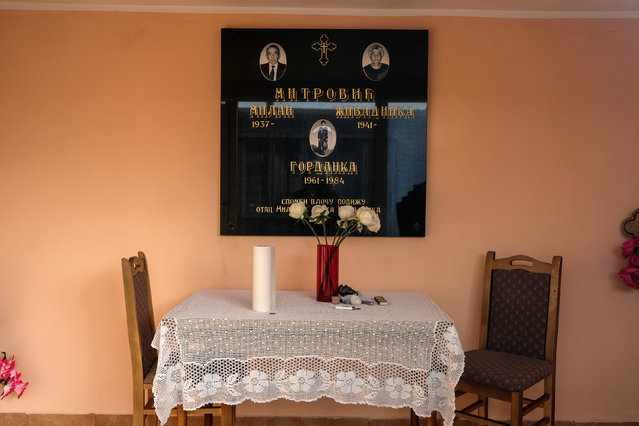
Pictures of deceased people are seen inside a chapel at a cemetery in the village of Smoljinac, Serbia, October 25, 2016. (Photo by Marko Djurica/Reuters)

Pictures of deceased people are seen inside a chapel at a cemetery in the village of Smoljinac, Serbia, October 25, 2016. From a distance, the cemetery in the eastern Serbian village of Smoljinac looks like a residential neighbourhood eerily placed among graves. But once inside the grounds, after passing a section with the usual stone slabs, visitors find rows of small bungalows painted in pastel colours. They have one or two rooms, large windows and ornate plaques – some inside, some outside – memorialising the deceased. These are the burial chapels of Smoljinac, cosy cabins with a furnished room inside, a storage place for wreaths and funeral paraphernalia, and the family crypt below. Some even have electric power inside. (Photo by Marko Djurica/Reuters)
Details
12 Nov 2016 10:37:00
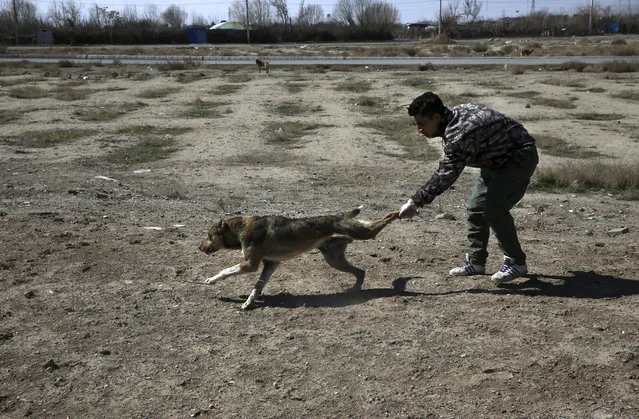
In this picture taken on Sunday, March 5, 2017, a Tehran's urban animal control worker catches a stray dog after being shot with his anesthetic dart on the outskirts of the capital Tehran, Iran. (Photo by Vahid Salemi/AP Photo)

In this picture taken on Sunday, March 5, 2017, a Tehran's urban animal control worker catches a stray dog after being shot with his anesthetic dart on the outskirts of the capital Tehran, Iran. The shelter has been hired by the Tehran city government to take a new, more humane approach to deal with the burgeoning problem of stray dogs in the capital. It’s a sign of changing attitudes among officials in a country where Islamic authorities long saw dogs as “un-Islamic” and would at times confiscate them from people who kept them as pets. (Photo by Vahid Salemi/AP Photo)
Details
17 Mar 2017 00:03:00