Loading...
Done
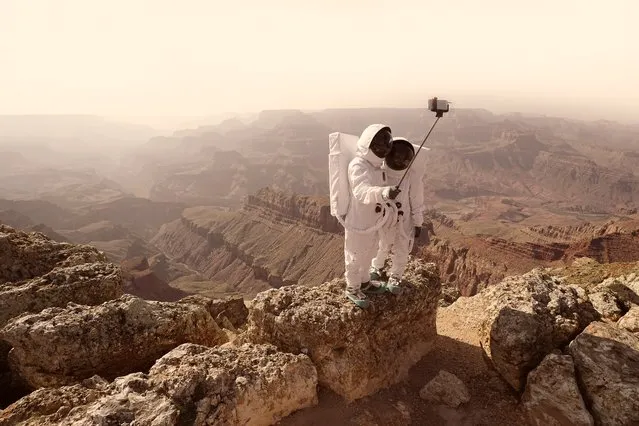
Professional conceptual category winner. Greetings from Mars, by Julien Mauve, France. Mauve says: “I have always wondered what it would be like to discover a totally different world ... and to photograph it for the first time as if I was Ansel Adams. So I came up with this project, which is about space exploration and discovery. But it’s also about our behavior in front of landscapes and how we create pictures that will share our personal story with the world”. (Photo by Julien Mauve)

Professional conceptual category winner. Greetings from Mars, by Julien Mauve, France. Mauve says: “I have always wondered what it would be like to discover a totally different world ... and to photograph it for the first time as if I was Ansel Adams. So I came up with this project, which is about space exploration and discovery. But it’s also about our behavior in front of landscapes and how we create pictures that will share our personal story with the world”. (Photo by Julien Mauve)
Details
23 Apr 2016 13:57:00
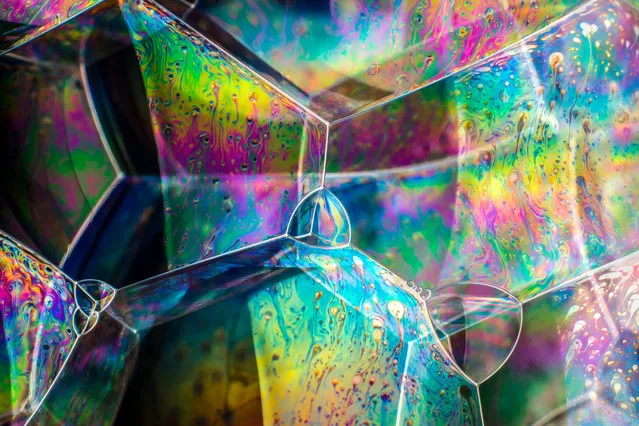
Soap Bubble Structures by Kym Cox. Bubbles optimise space and minimise their surface area for a given volume of air. This phenomenon makes them a useful tool in many areas of research, in particular, materials science and ‘packing’ – how things fit together. Bubble walls drain under gravity, thin at the top, thick at the bottom, which interferes with travelling lightwaves to create bands of colour. Black spots show the wall is too thin for interference colours, indicating the bubble is about to burst. (Photo by Kym Cox/2019 Science Photographer of the Year/RPS)

Soap Bubble Structures by Kym Cox. Bubbles optimise space and minimise their surface area for a given volume of air. This phenomenon makes them a useful tool in many areas of research, in particular, materials science and “packing” – how things fit together. Bubble walls drain under gravity, thin at the top, thick at the bottom, which interferes with travelling lightwaves to create bands of colour. Black spots show the wall is too thin for interference colours, indicating the bubble is about to burst. (Photo by Kym Cox/2019 Science Photographer of the Year/RPS)
Details
15 Aug 2019 00:03:00
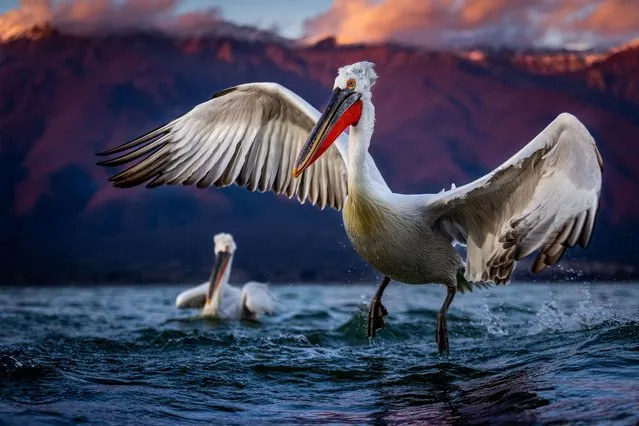
Dalmatian pelicans on Lake Kerkini in Greece captured over the space of one week (16-21 January 2023) by tour guide photographer Sean Weekly. The Dalmatian pelicans resemble the winged dinosaur pterodactyl as they swoop, splash and feed in the waters of Lake Kerkini in Greece. With wings outstretched, and colourful faces and beaks on display, the birds appear to be in paradise, with the awe-inspiring Kerkini mountains as a mesmerising backdrop. (Photo by Sean Weekly/Animal News Agency)

Dalmatian pelicans on Lake Kerkini in Greece captured over the space of one week (16-21 January 2023) by tour guide photographer Sean Weekly. The Dalmatian pelicans resemble the winged dinosaur pterodactyl as they swoop, splash and feed in the waters of Lake Kerkini in Greece. With wings outstretched, and colourful faces and beaks on display, the birds appear to be in paradise, with the awe-inspiring Kerkini mountains as a mesmerising backdrop. (Photo by Sean Weekly/Animal News Agency)
Details
05 Feb 2023 05:57:00
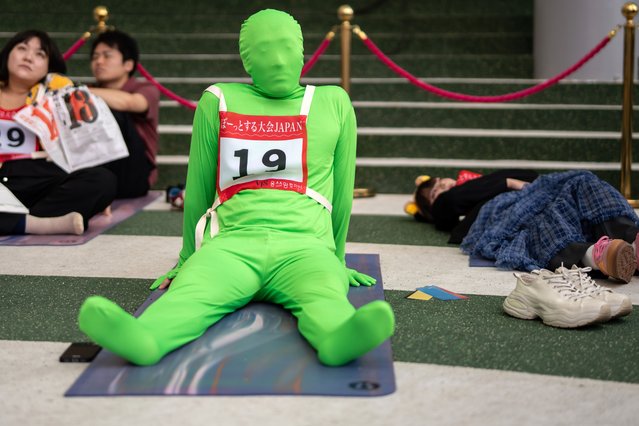
Participants compete to do nothing during the Space-out competition at World Expo 2025 on September 27, 2025 in Osaka, Japan. For 90 minutes, participants sat in silence, trying to remain in a dazed state without distraction. The winner was determined not by activity but by calmness maintaining the most stable heart rate amid the lively crowds of the Osaka Expo site. (Photo by Tomohiro Ohsumi/Getty Images)

Participants compete to do nothing during the Space-out competition at World Expo 2025 on September 27, 2025 in Osaka, Japan. For 90 minutes, participants sat in silence, trying to remain in a dazed state without distraction. The winner was determined not by activity but by calmness maintaining the most stable heart rate amid the lively crowds of the Osaka Expo site. (Photo by Tomohiro Ohsumi/Getty Images)
Details
25 Nov 2025 05:19:00
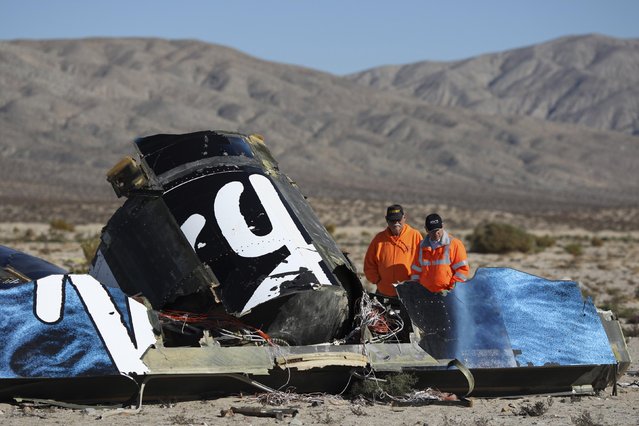
Sheriffs' deputies look at wreckage from the crash of Virgin Galactic's SpaceShipTwo near Cantil, California November 2, 2014. A suborbital passenger spaceship being developed by Richard Branson's Virgin Galactic company crashed during a test flight on Friday at the Mojave Air and Space Port in California, killing one crew member and seriously injuring the other, officials said. (Photo by David McNew/Reuters)

Sheriffs' deputies look at wreckage from the crash of Virgin Galactic's SpaceShipTwo near Cantil, California November 2, 2014. A suborbital passenger spaceship being developed by Richard Branson's Virgin Galactic company crashed during a test flight on Friday at the Mojave Air and Space Port in California, killing one crew member and seriously injuring the other, officials said. (Photo by David McNew/Reuters)
Details
03 Nov 2014 12:33:00
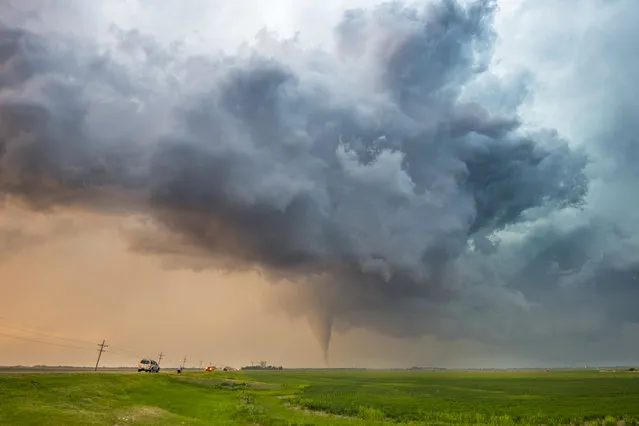
“The Sunsetter”. An EF-4 tornado rips through the open space of farmland near Rozel, Kansas. This tornado moves slowly but powerful towards the setting sun an gets its beautiful color right before sunset. Storm Chasers are spotting on the left side. Photo location: Rozel, Kansas. (Photo and caption by Dennis Oswald/National Geographic Photo Contest)

“The Sunsetter”. An EF-4 tornado rips through the open space of farmland near Rozel, Kansas. This tornado moves slowly but powerful towards the setting sun an gets its beautiful color right before sunset. Storm Chasers are spotting on the left side. Photo location: Rozel, Kansas. (Photo and caption by Dennis Oswald/National Geographic Photo Contest)

ATTENTION! All pictures are presented in high resolution. To see Hi-Res images – just TWICE click on any picture. In other words, click small picture – opens the BIG picture. Click BIG picture – opens VERY BIG picture.
Details
01 Dec 2013 11:03:00
On August 31, 2012, a long filament of solar material that had been hovering in the sun's atmosphere, the corona, erupted out into space at 4:36 p.m. EDT. The coronal mass ejection, or CME, traveled at over 900 miles per second. The CME did not travel directly toward Earth, but did connect with Earth's magnetic environment, or magnetosphere, causing aurora to appear on the night of Monday, September 3. (Photo by NASA/GSFC/SDO)

On August 31, 2012, a long filament of solar material that had been hovering in the sun's atmosphere, the corona, erupted out into space at 4:36 p.m. EDT. The coronal mass ejection, or CME, traveled at over 900 miles per second. The CME did not travel directly toward Earth, but did connect with Earth's magnetic environment, or magnetosphere, causing aurora to appear on the night of Monday, September 3. (Photo by NASA/GSFC/SDO via The Atlantic)
Details
14 Sep 2012 09:01:00
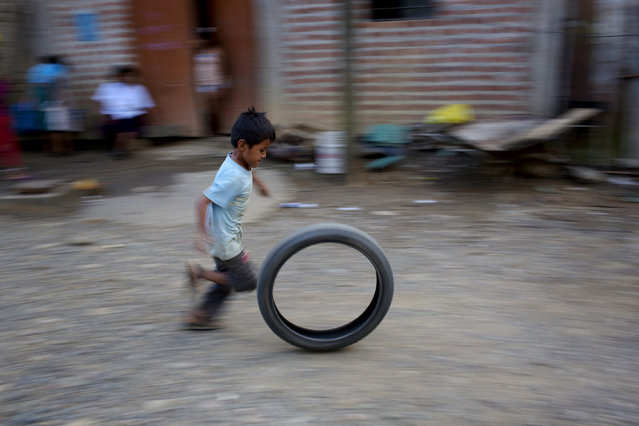
In this Saturday, June 20, 2015 photo, a boy runs while playing with a motorcycle wheel in Samugari, Ayacucho, Peru. (Photo by Rodrigo Abd/AP Photo)

In a simpler time all a child or an adult needed to enjoy the outdoors was a ball and a stick. Or maybe an old tire tied to a high branch to fashion a swing. And the only instruction given to children was to “be home before dark”. Now there are iPads and computers and television screens and shrinking safe public spaces. But despite the distractions and limitations of space, these images show the charm of kicking a ball or skipping rope endures. Sometimes with modifications as a nod to changing times. Here: in this Saturday, June 20, 2015 photo, a boy runs while playing with a motorcycle wheel in Samugari, Ayacucho, Peru. (Photo by Rodrigo Abd/AP Photo)
Details
20 Jul 2015 10:26:00