Loading...
Done
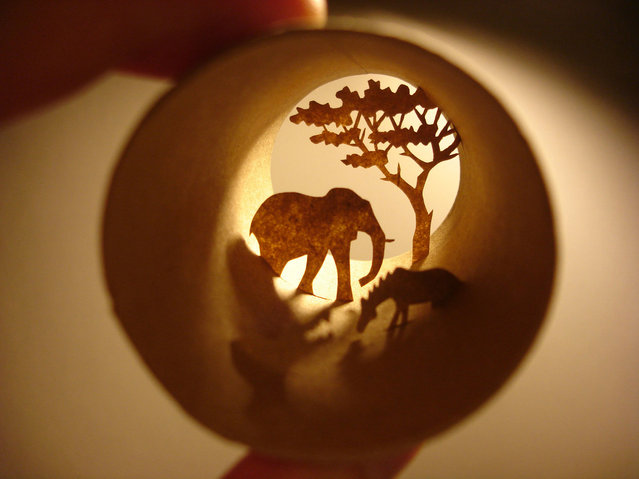
Toilet paper roll art of African wildlife. (Photo by Anastassia Elias/Caters News)

Anastassia Elias spends hours painstakingly cutting out tiny shapes to make detailed models – and then fits them inside used toilet rolls. Elias, 37, uses paper the same color as the cardboard tubes to build up the intricate scenes from wildlife to construction sites. Photo: Toilet paper roll art of African wildlife. (Photo by Anastassia Elias/Caters News)
Details
18 Jul 2013 08:08:00


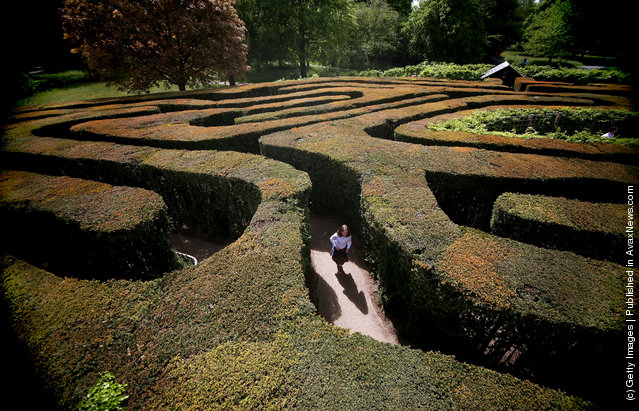
A young girl navigates her way around Hampton Court maze in the spring sunshine on May 2, 2009 in London, England. The Hampton Court maze is one of the most famous hedge mazes in the world and was planted between 1689 and 1695 by George London and Henry Wise. (Photo by Dan Kitwood/Getty Images)
Details
12 Jun 2011 09:31:00
A man and his broomstick are bringing magic to Instagram with these uplifting snaps. Daisuke Kujiraoka, 36, from Tokyo, Japan, snapped himself levitating across the country and uploaded them to the social media site. The quirky artist has posed with aeroplanes and cars appearing to float in mid-air Harry Potter-style. (Photo by Daisuke Kujiraoka/Caters News/Mercury Press)

A man and his broomstick are bringing magic to Instagram with these uplifting snaps. Daisuke Kujiraoka, 36, from Tokyo, Japan, snapped himself levitating across the country and uploaded them to the social media site. The quirky artist has posed with aeroplanes and cars appearing to float in mid-air Harry Potter-style. (Photo by Daisuke Kujiraoka/Caters News/Mercury Press)
Details
21 May 2015 12:39:00
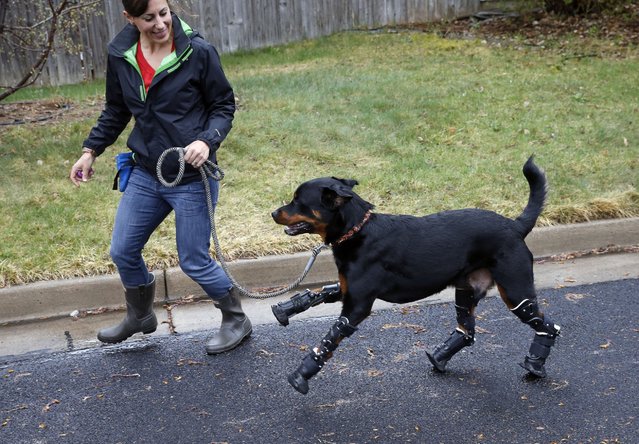
In this April 2, 2015 photo, dog owner Laura Aquilina strolls with her two year old Rottweiler Brutus, who was recently fitted with prosthetics on all four paws, and is currently learning to use them, near Aquilina's home in Loveland, Colo. Brutus lost all four paws to frostbite as a puppy while under care of a breeder, and Aquilina began caring for him about a year ago. (Photo by Brennan Linsley/AP Photo)

In this April 2, 2015 photo, dog owner Laura Aquilina strolls with her two year old Rottweiler Brutus, who was recently fitted with prosthetics on all four paws, and is currently learning to use them, near Aquilina's home in Loveland, Colo. Brutus lost all four paws to frostbite as a puppy while under care of a breeder, and Aquilina began caring for him about a year ago. (Photo by Brennan Linsley/AP Photo)
Details
11 Apr 2015 10:03:00
1924:  Vladimir Ilyich Lenin lying in state in the Kremlin

Photo: Vladimir Ilyich Lenin (1870 – 1924) lying in state in the Kremlin. (Photo by Hulton Archive/Getty Images). 1924

Important! For the same article in Russian language click here.

Something quite intriguing is happening within Russian-speaking internet during the last few – should you type a fully academic inquiry (at least, according to Russian academic requirements) in national search engines for "Lenin's mausoleum" – the first thing you get (even in top 10 searches) is website pages talking about black magic and occult. Website authors view this construction differently, but unconditionally agree on one thing: the mausoleum of the "leader of the world proletariat” – the essence of a magical artifact, a sort of “energy vampire”. It was built with a certain purpose: to drain the energy out of miserable Soviet citizens on one hand; and to poison the anthroposphere of one-sixth part of the earth with its vibes (the exact territory that was occupied by the former Soviet Union), depriving the Russian people of will to resist on the other hand. Complete nonsense? No doubt. Nevertheless, an intriguing one. Well, probably because some oddities do exist in mausoleum's history. These oddities are the thing we are going to discuss this time. First, let me refresh you memory on the subject.
Details
16 Oct 2011 11:27:00
Israeli soldiers detain a protester during a demonstration by Palestinians protesting against the Israeli-built West Bank separation barrier and calling for the right of return for Palestinian refugees, in the northern West Bank city of Tulkarem, on May 31, 2014. (AP Photo/Nasser Ishtayeh)

Israeli soldiers detain a protester during a demonstration by Palestinians protesting against the Israeli-built West Bank separation barrier and calling for the right of return for Palestinian refugees, in the northern West Bank city of Tulkarem, on May 31, 2014. (AP Photo/Nasser Ishtayeh)
Details
02 Jun 2014 05:44:00
A quirky cartoonist challenged his own creation to a fight – but he could only draw. US artist Alex Solis, 31, from Chicago, Illinois, drew his skull t-shirt-wearing alter ego, who he calls Chuck, smashing his phone and stabbing his finger in his Inkteraction pictures. But Alex got his own back with a punch to Chucks jaw before squashing him against the bottom of the page. (Photo by Alex Solis/Caters News)

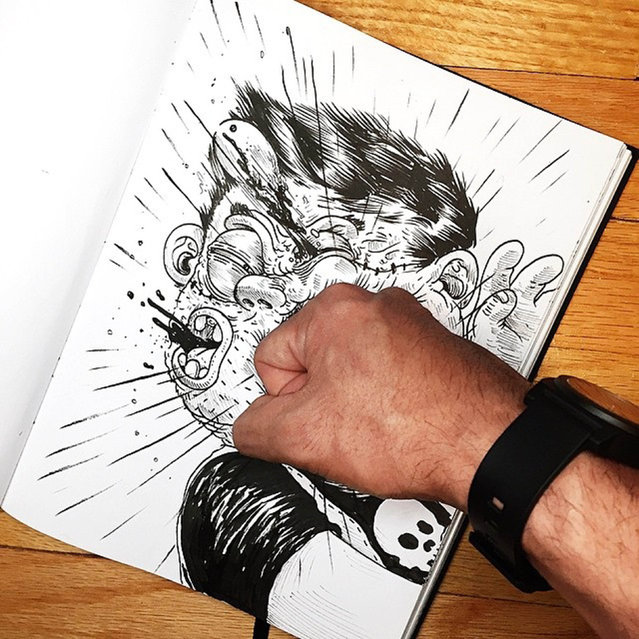
A quirky cartoonist challenged his own creation to a fight – but he could only draw. US artist Alex Solis, 31, from Chicago, Illinois, drew his skull t-shirt-wearing alter ego, who he calls Chuck, smashing his phone and stabbing his finger in his Inkteraction pictures. But Alex got his own back with a punch to Chucks jaw before squashing him against the bottom of the page. The ink man tried to get under Chucks skin to win the fight by stretching and pulling the cartoons face as the drawings became more bloody. (Photo by Alex Solis/Caters News)
Details
23 Feb 2015 12:39:00
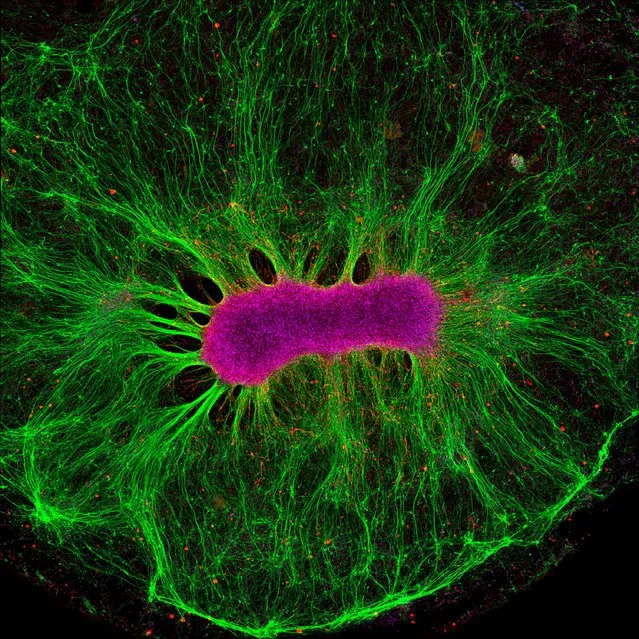
Brain-on-a-chip. Dazzling in green and magenta this image shows the nerve fibres (in green) produced by neural stem cells (in magenta) as they grow on a synthetic gel. Captured by a technique known as confocal microscopy, the image is part of research shedding light on how tinkering with the environment can affect the way in which nerve fibres grow. (Photo by Collin Edington and Iris Lee/Massachusetts Institute of Technology/Wellcome Images)

Brain-on-a-chip. Dazzling in green and magenta this image shows the nerve fibres (in green) produced by neural stem cells (in magenta) as they grow on a synthetic gel. Captured by a technique known as confocal microscopy, the image is part of research shedding light on how tinkering with the environment can affect the way in which nerve fibres grow. (Photo by Collin Edington and Iris Lee/Massachusetts Institute of Technology/Wellcome Images)
Details
17 Mar 2017 00:01:00