Loading...
Done
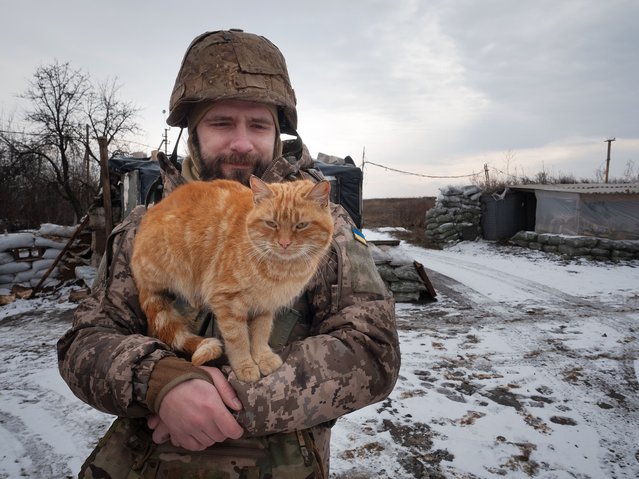
Ukrainian Serviceman Oleksii Hodzenko, aka Godzilla, was a civilian journalist. His father, Sergeant chief Dmytro "Godzilla" Godzenko was killed on March 31, 2016 at 6 a.m. in a mortar attack near the village of Zaitsevo near Horlivka in the Donetsk region. Since then Godzilla "junior" has joined the army, at a frontline position held by Ukraine's 503rd Detached Marine Battalion on February 7, 2022 near Verkhnotoretske, Ukraine. Regional tensions remain high as Russia continues to amass soldiers and military equipment along its border with Ukraine, where large swaths of the Luhansk and Donetsk regions are held by Russian-backed separatists. Russia has also moved roughly 30,000 troops into Belarus, which borders Ukraine to the north. American and European officials say they do not whether Russian President Vladimir Putin has made a decision to invade Ukraine, but have issued a series of warnings about the country's assertive military posture. (Photo by Gaelle Girbes/Getty Images)

Ukrainian Serviceman Oleksii Hodzenko, aka Godzilla, was a civilian journalist. His father, Sergeant chief Dmytro "Godzilla" Godzenko was killed on March 31, 2016 at 6 a.m. in a mortar attack near the village of Zaitsevo near Horlivka in the Donetsk region. Since then Godzilla "junior" has joined the army, at a frontline position held by Ukraine's 503rd Detached Marine Battalion on February 7, 2022 near Verkhnotoretske, Ukraine. Regional tensions remain high as Russia continues to amass soldiers and military equipment along its border with Ukraine, where large swaths of the Luhansk and Donetsk regions are held by Russian-backed separatists. Russia has also moved roughly 30,000 troops into Belarus, which borders Ukraine to the north. American and European officials say they do not whether Russian President Vladimir Putin has made a decision to invade Ukraine, but have issued a series of warnings about the country's assertive military posture. (Photo by Gaelle Girbes/Getty Images)
Details
13 Mar 2022 04:03:00
Concept Design Home Reversible Destiny Lofts MITAKA: In Memory Of Helen Keller By Reversible Destiny Foundation and Shusaku Arakawa

“The Reversible Destiny Lofts – Mitaka (In Memory of Helen Keller) is a nine-unit multiple dwelling. It was first completed example of procedural architecture put to residential use. These lofts reflexively articulate the residents’ operative tendencies and coordinating skills essential to and determinative of human thought and behavior; which means to say, the lofts manage, by virtue of how they are constructed, to reveal to their residents the ins and outs of what makes a person, in this case the resident. This is the same set of tendencies and skills to which Arakawa and Madeline Gins gave diagrammatic form in their decades-long research project The Mechanism of Meaning”. – Wikipedia

Photo: The exterior of the concept design home “Reversible Destiny Lofts MITAKA: In Memory of Helen Keller” is seen on October 27, 2005 in Tokyo, Japan. (Photo by Koichi Kamoshida/Getty Images)
Details
30 Nov 2011 11:58:00
Blaine stands inside the apparatus, surrounded by a million volts of electric currents streamed by tesla coils. The stunt, sponsored by Intel, is the latest of daredevil endeavors by the magician whose previous stunts included being encased in ice for over 60 hours in Times Square, on October 5, 2012. (Photo by John Minchillo/Associated Press)

“Magician David Blaine's latest stunt boasts lots of high-voltage snap, crackle and pop – but experts say he'll be safe from electrocution as long as he wears his chain-mail suit and metal headgear”. – NBC News. Photo: Blaine stands inside the apparatus, surrounded by a million volts of electric currents streamed by tesla coils. The stunt, sponsored by Intel, is the latest of daredevil endeavors by the magician whose previous stunts included being encased in ice for over 60 hours in Times Square, on October 5, 2012. (Photo by John Minchillo/Associated Press)
Details
06 Oct 2012 08:06:00
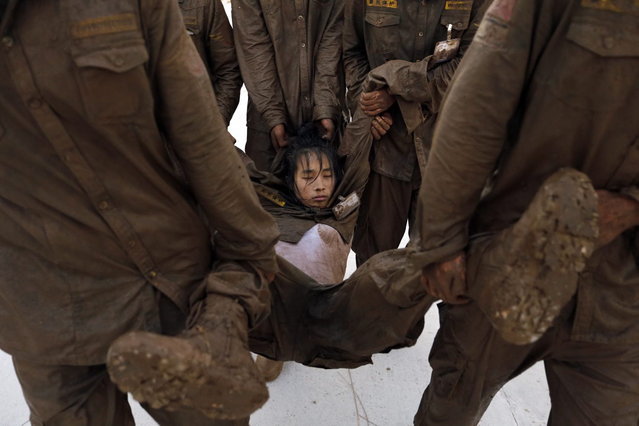
Students carry a female trainee who has fallen into a stupor during high intensity training at Tianjiao Special Guard/Security Consultant camp on the outskirts of Beijing December 1, 2013. (Photo by Jason Lee/Reuters)

Students carry a female trainee who has fallen into a stupor during high intensity training at Tianjiao Special Guard/Security Consultant camp on the outskirts of Beijing December 1, 2013. Former Chinese soldier Chen Yongqing has big ambitions for his bodyguard training school Tianjiao, which he says is China's first professional academy to train former soldiers and others as personal security guards. Chen charges 500,000 yuan ($82,400) a year for each protector as China's rich and famous look to bolster their safety and sense of importance. (Photo by Jason Lee/Reuters)
Details
19 Dec 2013 11:51:00
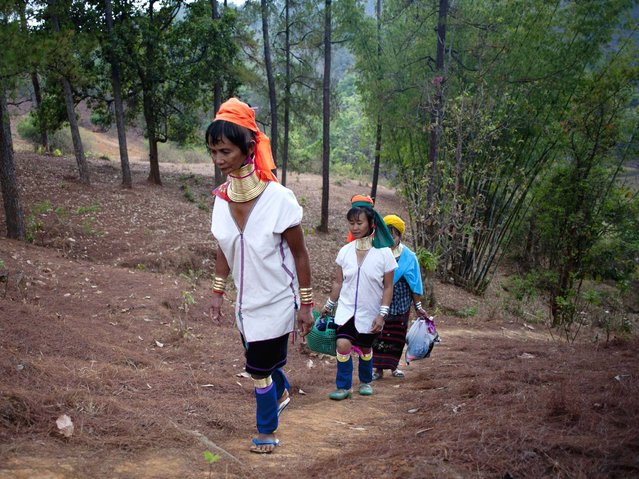
One of the theories says that the coils originate from the desire to look more attractive by exaggerating sexual dimorphism, as women have more slender necks than men. (Photo by Ye Aung Thu/AFP Photo)

This photo taken on April 16, 2014 shows ethnic Kayan women wearing traditional clothes and bronze rings around tbeir neck in Panpet village, Demoso township in Kayah state, eastern Myanmar. Some ethnic Kayan women, also known as Padaung, begin wearing the bronze rings on their neck and legs from a young age. Usually they start wearing six to ten rings when they are five to ten-years-old and then they put on one more ring a year for years after then. (Photo by Ye Aung Thu/AFP Photo)
Details
23 Apr 2014 08:56:00
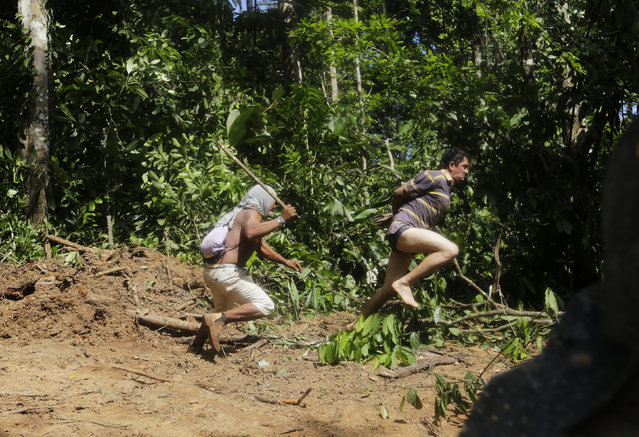
A Ka'apor Indian warrior (L) chases a logger who tried to escape after they captured him during a jungle expedition to search for and expel loggers from the Alto Turiacu Indian territory, near the Centro do Guilherme municipality in the northeast of Maranhao state in the Amazon basin, August 7, 2014. (Photo by Lunae Parracho/Reuters)

A Ka'apor Indian warrior (L) chases a logger who tried to escape after they captured him during a jungle expedition to search for and expel loggers from the Alto Turiacu Indian territory, near the Centro do Guilherme municipality in the northeast of Maranhao state in the Amazon basin, August 7, 2014. Tired of what they say is a lack of sufficient government assistance in keeping loggers off their land, the Ka'apor Indians, who along with four other tribes are the legal inhabitants and caretakers of the territory, have sent their warriors out to expel all loggers they find and set up monitoring camps in the areas that are being illegally exploited. (Photo by Lunae Parracho/Reuters)
Details
05 Sep 2014 11:41:00
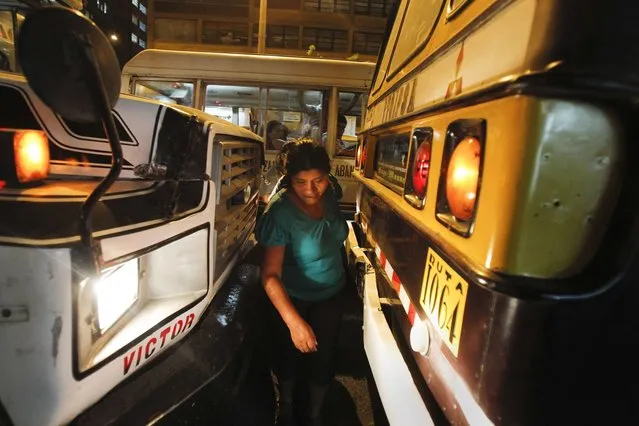
A woman squeezes between two public buses in downtown Lima, March 17, 2014. Bogota and two other Latin American capitals – Mexico City, and Lima in Peru – were named as the three capitals with the least safe transport systems for women in the Thomson Reuters Foundation poll of more than 6,550 women and gender and city planning experts. (Photo by Enrique Castro-Mendivil/Reuters)

A woman squeezes between two public buses in downtown Lima, March 17, 2014. Bogota and two other Latin American capitals – Mexico City, and Lima in Peru – were named as the three capitals with the least safe transport systems for women in the Thomson Reuters Foundation poll of more than 6,550 women and gender and city planning experts. Women in Latin America say they face a wide range of daily threats on public transport, and not enough is done to ensure their safety. (Photo by Enrique Castro-Mendivil/Reuters)
Details
04 Nov 2014 12:00:00
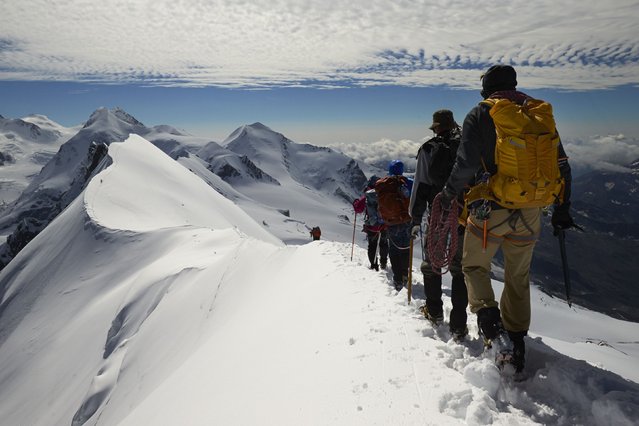
Roped up climbers leave the summit of Breithorn at 4,164 metres (13,661 feet) on the ridge marking the border with Switzerland (left) and Italy in the Alpine resort of Zermatt August 4, 2014. Switzerland will vote on November 30 on an initiative from the group Ecopop which proposes a cap on the number of immigrants. (Photo by Denis Balibouse/Reuters)

Roped up climbers leave the summit of Breithorn at 4,164 metres (13,661 feet) on the ridge marking the border with Switzerland (left) and Italy in the Alpine resort of Zermatt August 4, 2014. Switzerland will vote on November 30 on an initiative from the group Ecopop which proposes a cap on the number of immigrants. The group says it is motivated by concerns about a lack of living space exerting too much pressure on the land and natural resources, rather than by opposition to foreigners. (Photo by Denis Balibouse/Reuters)
Details
04 Nov 2014 14:29:00