Loading...
Done
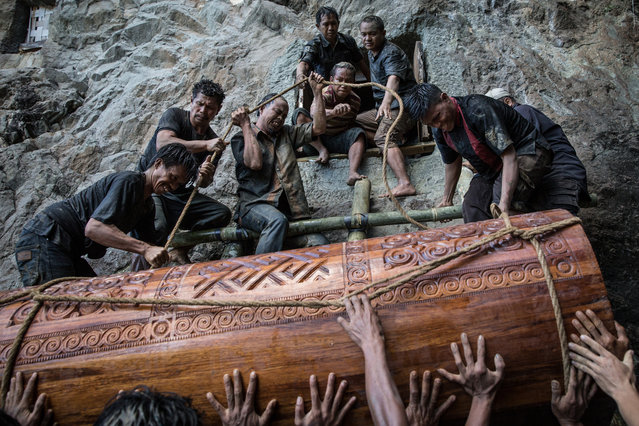
It is said that Torajans are people who “live to die”. For this Indonesian ethnic group, funerals are such extravagant events that they sometimes attract tourists. Families can postpone burials years (and the deceased are considered sick and hosted at home until the funeral) until the family can raise enough money and gather as many relatives as possible. And then it’s a jubilant multiday social event with a parade, dances and animal sacrifices. Agung Parameswara photographed these funerary practices when he traveled to South Sulawesi province, where the Torajans live. But often, their funeral isn’t the last time the dead are seen. In August, crypts are opened, coffins are slid back out and bodies delicately unsheathed. This tender ritual is known as Ma’Nene, which is customarily performed every few years. (Photo by Agung Parameswara/The Washington Post)

It is said that Torajans are people who “live to die”. For this Indonesian ethnic group, funerals are such extravagant events that they sometimes attract tourists. Families can postpone burials years (and the deceased are considered sick and hosted at home until the funeral) until the family can raise enough money and gather as many relatives as possible. And then it’s a jubilant multiday social event with a parade, dances and animal sacrifices. Agung Parameswara photographed these funerary practices when he traveled to South Sulawesi province, where the Torajans live. (Photo by Agung Parameswara/The Washington Post)
Details
06 Oct 2016 09:15:00
Nguyen Manh Quan (top), 26, a civil servant, carries a girl using his throat area as he performs during a showcase of the traditional Thien Mon Dao kung fu at Du Xa Thuong village, southeast of Hanoi, Vietnam May 10, 2015. (Photo by Reuters/Kham)

Nguyen Manh Quan (top), 26, a civil servant, carries a girl using his throat area as he performs during a showcase of the traditional Thien Mon Dao kung fu at Du Xa Thuong village, southeast of Hanoi, Vietnam May 10, 2015. Thien Mon Dao, a traditional Vietnamese martial art, was formed by 18th century villagers in Du Xa Thuong village, who believed the art form could help improve health as well as fight against foreign invaders. There are currently about 3,000 practitioners including farmers, industry workers and state servants. These practitioners say they are able to bend metal against their bodies and carry heavy objects using their throats, eyes or tongues, as well as run across the surface of a river, according to Thien Mon Dao kung fu master Nguyen Khac Phan. (Photo by Reuters/Kham)
Details
11 May 2015 12:27:00
A bullied student with vitiligo is celebrating learning to love her skin by turning it into art  making a world map, flowers and even a Van Gogh painting. Ashley Soto, 21, from Orlando in Florida, USA, has found turning her white patches of skin into art has empowered her and helped her to embrace her vitiligo. Here are some of the art pieces Ashleys made to celebrate and embrace her vitiligo from a world map to simply tracing her vitiligo and also Van Goghs Starry Night. (Photo by Ashley Soto/Caters News Agency)

A bullied student with vitiligo is celebrating learning to love her skin by turning it into art making a world map, flowers and even a Van Gogh painting. Ashley Soto, 21, from Orlando in Florida, USA, has found turning her white patches of skin into art has empowered her and helped her to embrace her vitiligo. Here are some of the art pieces Ashleys made to celebrate and embrace her vitiligo from a world map to simply tracing her vitiligo and also Van Goghs Starry Night. (Photo by Ashley Soto/Caters News Agency)
Details
16 Mar 2017 00:02:00
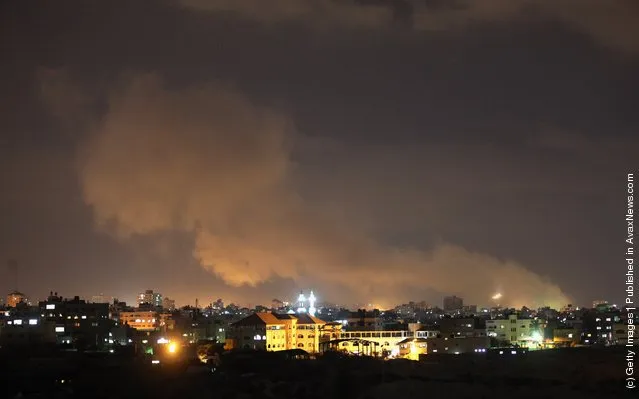
A plume of smoke rises above Gaza City as Israeli air strikes hit on August 18, 2011 in Gaza City, Gaza

A plume of smoke rises above Gaza City as Israeli air strikes hit on August 18, 2011 in Gaza City, Gaza. The airstrikes came hours after attacks by militants killing Israelis in a cross border operation near Eilat, Southern Israel. (Photo by Christopher Furlong/Getty Images)
Details
19 Aug 2011 09:23:00
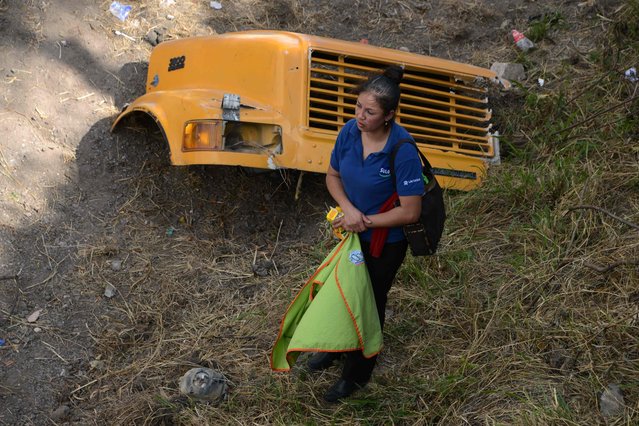
A woman watches rescue operations after a bus and a truck crashed on the road that links the Honduran capital with the south of the country, near Germania, 11 km south of Tegucigalpa on February 5, 2017. At least 12 people were killed and 35 injured of some 70 who were on board the bus. (Photo by Orlando Sierra/AFP Photo)

A woman watches rescue operations after a bus and a truck crashed on the road that links the Honduran capital with the south of the country, near Germania, 11 km south of Tegucigalpa on February 5, 2017. At least 12 people were killed and 35 injured of some 70 who were on board the bus. (Photo by Orlando Sierra/AFP Photo)
Details
07 Feb 2017 00:00:00
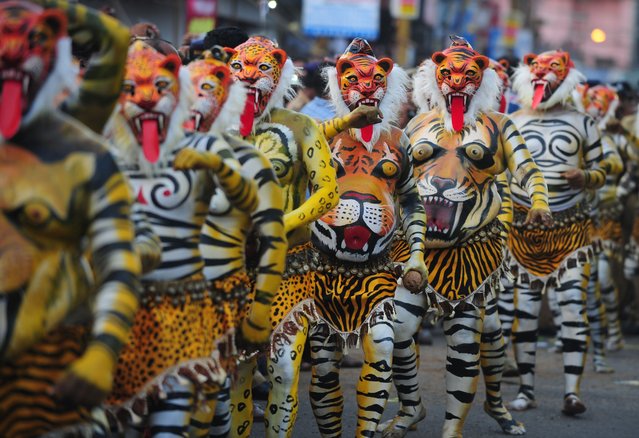
Indian performers painted as tigers take part in the “Pulikali”, or Tiger Dance, in Thrissur on September 17, 2016. The folk-art event is held every year in the town during the “Onam” festival. (Photo by Arun Sankar/AFP Photo)

Indian performers painted as tigers take part in the “Pulikali”, or Tiger Dance, in Thrissur on September 17, 2016. The folk-art event is held every year in the town during the “Onam” festival. (Photo by Arun Sankar/AFP Photo)
Details
19 Sep 2016 09:13:00
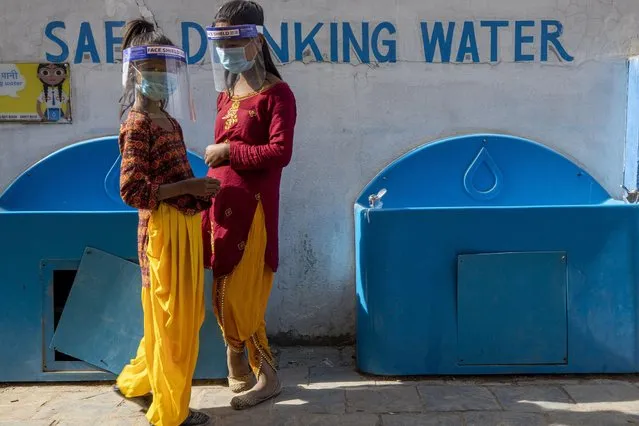
Students of Yuba Pratibha School, wearing a face shield and masks at school during a coronavirus pandemic in Kathmandu, Nepal, 26 November 2020. The head Teacher of Yuba Pratibha School, Yanga Raj Dahal, started to conduct classes for students, who can’t afford and attend online classes, with strict sanitary regime, providing also free face masks and shields for students. However majority of schools have been conducting online classes in Nepal from 19 March 2020 as part of precautionary measures against the spread of the coronavirus Covid-19. (Photo by Narendra Shrestha/EPA/EFE)

Students of Yuba Pratibha School, wearing a face shield and masks at school during a coronavirus pandemic in Kathmandu, Nepal, 26 November 2020. The head Teacher of Yuba Pratibha School, Yanga Raj Dahal, started to conduct classes for students, who can’t afford and attend online classes, with strict sanitary regime, providing also free face masks and shields for students. However majority of schools have been conducting online classes in Nepal from 19 March 2020 as part of precautionary measures against the spread of the coronavirus Covid-19. (Photo by Narendra Shrestha/EPA/EFE)
Details
16 Dec 2020 00:05:00
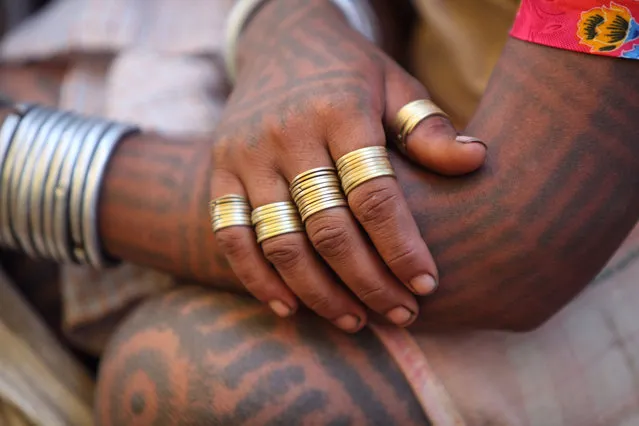
Once applied, the designs are washed using warm water and cow dung. Herbs are applied to promote faster healing. (Photo by Ronny Sen/WaterAid/The Guardian)

For more than 2,000 years, women from the Baiga tribe in the highland district of Dindori, in central India’s Madhya Pradesh state, have been tattooed. Sumintra, 25, from Bona village, has the markings across her forehead, legs and arms. The women who work as tattoo artists are knowledgable about the different types of designs and pigments preferred by various tribes, and their meanings are passed to them by their mothers. The tattooing ‘season’ begins with the approach of winter. (Photo by Ronny Sen/WaterAid/The Guardian)
Details
19 Aug 2017 08:48:00