Loading...
Done
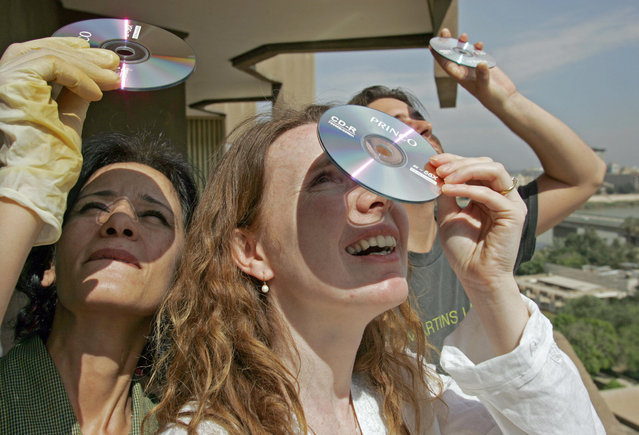
An Iraqi woman and foreigners use  pair of compact discs as a filter to watch the partial solar eclipse in war-torn Baghdad, 29 March 2006. Without access to proper equipment to protect their eyes from the sun's rays, eclipse watchers in Iraq used makeshift filters.  The moon blotted out the sun over northwest Africa early Wednesday, turning day into night in a total solar eclipse as it swept a shadowy path from the outer tip of Brazil to the steppes of Mongolia. (Photo by Hassan Ammar/AFP Photo)

An Iraqi woman and foreigners use pair of compact discs as a filter to watch the partial solar eclipse in war-torn Baghdad, 29 March 2006. Without access to proper equipment to protect their eyes from the sun's rays, eclipse watchers in Iraq used makeshift filters. The moon blotted out the sun over northwest Africa early Wednesday, turning day into night in a total solar eclipse as it swept a shadowy path from the outer tip of Brazil to the steppes of Mongolia. (Photo by Hassan Ammar/AFP Photo)
Details
25 Jul 2017 09:31:00
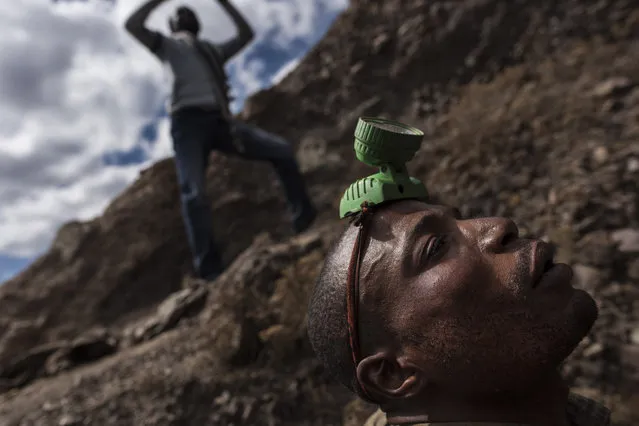
A “creuseur”, or digger, a plastic lantern on his head, readies to enter a copper and cobalt mine in Kawama, Democratic Republic of Congo on June 8, 2016. Cobalt is used in the batteries for electric cars and mobile phones. Working conditions are dangerous, often with no safety equipment or structural support for the tunnels. The diggers say they are paid on average US$2-3/day. (Photo by Michael Robinson Chavez/The Washington Post)

A “creuseur”, or digger, a plastic lantern on his head, readies to enter a copper and cobalt mine in Kawama, Democratic Republic of Congo on June 8, 2016. Cobalt is used in the batteries for electric cars and mobile phones. Working conditions are dangerous, often with no safety equipment or structural support for the tunnels. The diggers say they are paid on average US$2-3/day. (Photo by Michael Robinson Chavez/The Washington Post)
Details
30 Dec 2016 10:29:00
Students learn how to use an airsoft gun from Taiwanese military instructors at Kaohsiung Municipal Sanmin Senior High School in Kaohsiung on January 11, 2024. Kaohsiung City launched a national defence education program using digital technology for all its high school students. The program also promotes drug prevention in cooperation with the Taiwan defense ministry. (Photo by Yasuyoshi Chiba/AFP Photo)

Students learn how to use an airsoft gun from Taiwanese military instructors at Kaohsiung Municipal Sanmin Senior High School in Kaohsiung on January 11, 2024. Kaohsiung City launched a national defence education program using digital technology for all its high school students. The program also promotes drug prevention in cooperation with the Taiwan defense ministry. (Photo by Yasuyoshi Chiba/AFP Photo)
Details
14 Mar 2025 04:07:00
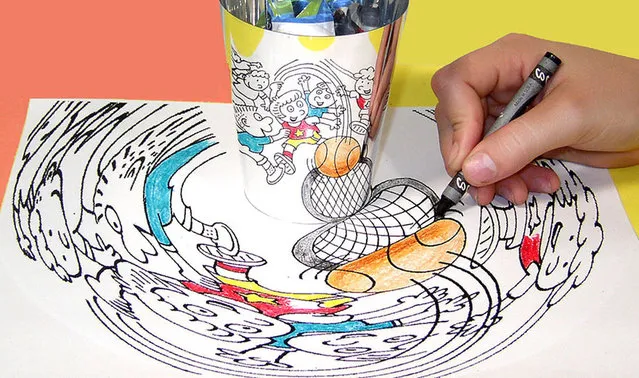
Anamorphic Art By Jonty Hurwitz

The truth can never be seen right away. Only by looking from a certain angle can we view the true nature of things. At other times, only with the help of some special object can we discern order in chaos. Anamorphosis is a form of art that allows us to see an object only by viewing it from a certain angle or by using cylindrical or conical mirror. Unsurprisingly, the first person in history to ever use this type of technique was the Leonardo Da Vinci. During late Renaissance period this technique was popularized as a children’s toy. Now, however, few people use this form of imagery due to its intricacy. Istvan Orosz, born in 1951, is one of the few people who specialize in anamorphosis. In our opinion, his most stunning piece of art is the one where a shipwreck scene turns into a portrait when viewed through a cylindrical mirror. (Photo by Jonty Hurwitz)
Details
05 Jan 2015 13:07:00
A boy uses remnants of ordnance as he prepares dough inside Abu Khaled's shop in the Douma neighborhood of Damascus April 28, 2015. Abu Khaled opened a shop for making “barley bread” using remnants of weapons including rockets, tank shells and other ordnance fired by forces loyal to Syria's President Bashar al-Assad. (Photo by Amer Almohibany/Reuters)

A boy uses remnants of ordnance as he prepares dough inside Abu Khaled's shop in the Douma neighborhood of Damascus April 28, 2015. Abu Khaled opened a shop for making “barley bread” using remnants of weapons including rockets, tank shells and other ordnance fired by forces loyal to Syria's President Bashar al-Assad. (Photo by Amer Almohibany/Reuters)
Details
09 Aug 2015 11:13:00
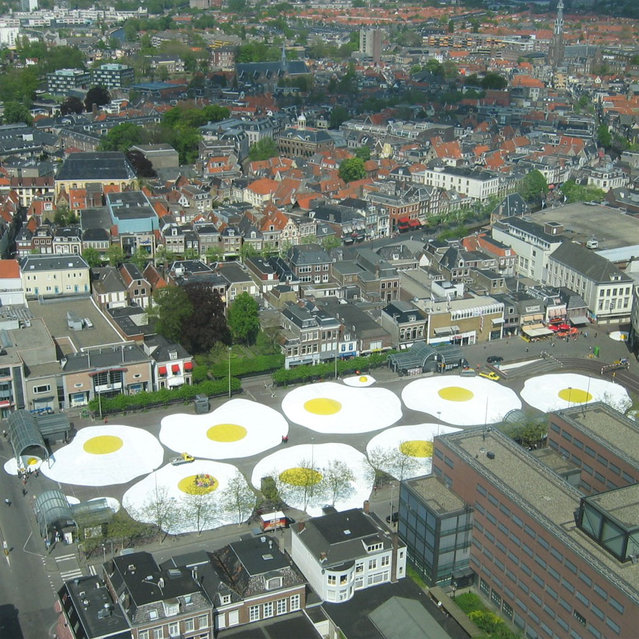
Art Eggcident By Henk Hofstra

With "Art Eggcident," Dutch artist Henk Hofstra demonstrates what it would look like if God threw giant eggs down at us. The eight large, sunny side up eggs measure almost 100 feet wide in diameter. The installation took place in Leeuwarden, a city in the north of the Netherlands.
"I hope it becomes a meeting place with room for art," says Henk. "Art that is different than a framed picture on the wall or a boring bronze sculpture. Art that shows us a different look, surprises us, or makes us angry or happy. Art that allows photographers to grab their cameras and arouses journalists. Art that evokes emotion, or provokes wild laughter."
Details
07 May 2014 10:54:00
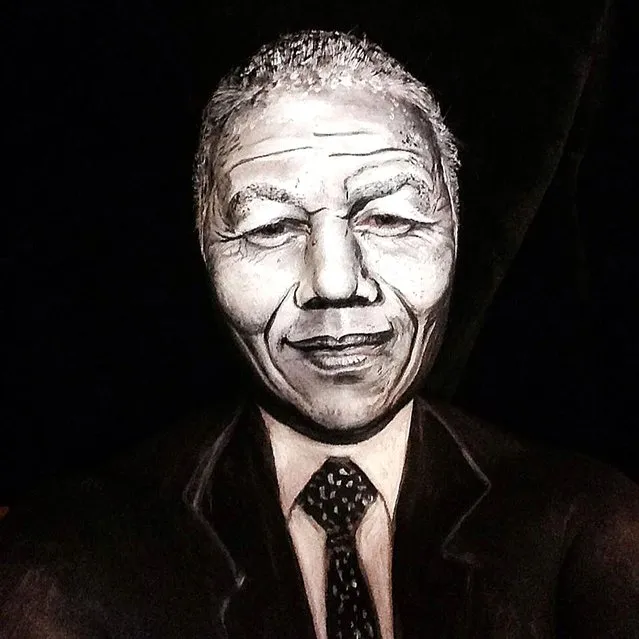
Nelson Mandela make up complete. 40-year-old London-based makeup artist, Maria Malone-Guerbaa has the ability to transform herself into any celebrity or creature using only her basic makeup essentials. Maria used only make up and face paints to create the illusion of Nelson Mandela, Britain's Queen Elizabeth II, and many other A-list celebrities. (Photo by Maria Malone-Guerbaa/Rex Features USA)

Nelson Mandela make up complete. 40-year-old London-based makeup artist, Maria Malone-Guerbaa has the ability to transform herself into any celebrity or creature using only her basic makeup essentials. Maria used only make up and face paints to create the illusion of Nelson Mandela, Britain's Queen Elizabeth II, and many other A-list celebrities. (Photo by Maria Malone-Guerbaa/Rex Features USA)
Details
20 Jun 2014 12:18:00
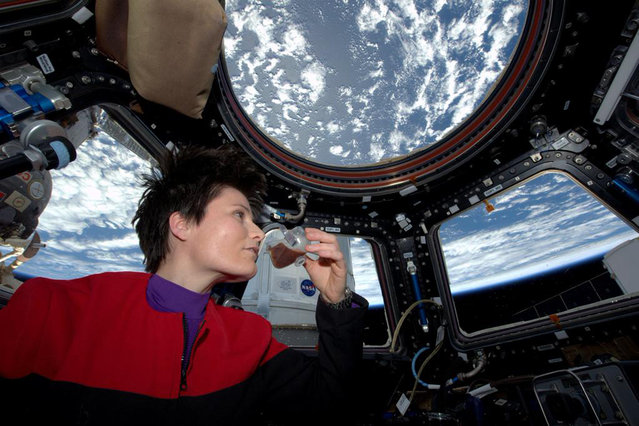
In this photo posted on Twitter, Sunday, May 3, 2015, and provided by NASA, Italian astronaut Samantha Cristoforetti sips espresso from a cup designed for use in zero-gravity, on the International Space Station. Cristoforetti, the first Italian woman in space, fired up the first espresso machine in space, which uses small capsules, or pods, of espresso coffee. (Photo by AP Photo/NASA)

In this photo posted on Twitter, Sunday, May 3, 2015, and provided by NASA, Italian astronaut Samantha Cristoforetti sips espresso from a cup designed for use in zero-gravity, on the International Space Station. Cristoforetti, the first Italian woman in space, fired up the first espresso machine in space, which uses small capsules, or pods, of espresso coffee. (Photo by AP Photo/NASA)
Details
09 May 2015 12:26:00