Loading...
Done
An officer reviews members of the honor guard as they line up before a welcoming ceremony for visiting Mozambique's President Filipe Jacinto Nyusi at the Great Hall of the People in Beijing, Wednesday, May 18, 2016. (Photo by Mark Schiefelbein/AP Photo)

An officer reviews members of the honor guard as they line up before a welcoming ceremony for visiting Mozambique's President Filipe Jacinto Nyusi at the Great Hall of the People in Beijing, Wednesday, May 18, 2016. (Photo by Mark Schiefelbein/AP Photo)
Details
19 May 2016 11:56:00
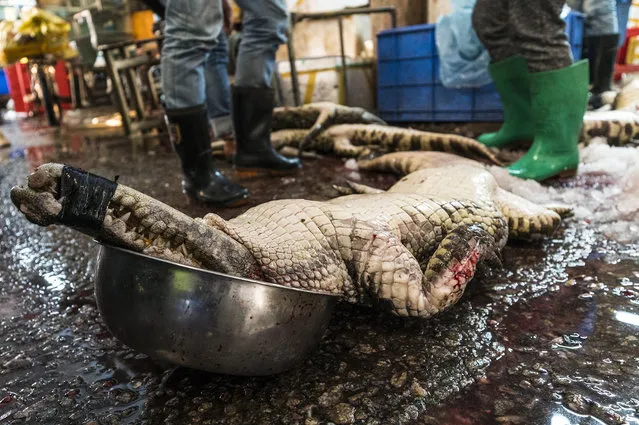
A dead crocodile is seen on Huangsha Seafood Market in Guangzhou, Guandong Province, China, 22 January 2018. Tsukiji Market of China or Huangsha Seafood Market is biggest one in Southern China and one of the biggest in China, as there are literally hundreds of different varieties of fish and seafood scattered throughout the market. Since the proximity of the fish market is so close to the Zhujiang River, it's quite easy for the large fishing vessels and fishermen to unload their fresh catch right at the market, which ensures that the fish and seafood remain fresh. Fish and other seafood are coming there from all around the globe. Seafood Market is full of different kinds of live fish, live shellfish, and live seafood on display in crystal clear tanks and it's common to see 5-star chefs, retailers and expats to source for fresh and high-quality seafood supplies for reasonable prices. While it is a wholesale fish market, since many Guangzhou restaurants and businesses come to purchase their seafood here, the public is welcome to come and even purchase. Many local Chinese have the vendors slice up fresh salmon fillets to take home or carry seafood into one of the nearby specialty restaurants, where they will cook if for them and serve it with vegetables and other side dishes of their choice. One of the biggest attractions for both, tourists and buyers, on market are crocodiles, which are brought there alive in wooden cases with taped jaws so they can?t accidentally bite. They are from crocodile farms from Guangdong, China and from Vietnam. Crocodile meat is popular in most Asian countries and it is consider as delicate one. Crocodiles weight from 10 to 25 kg and bigger ones are about 2 years old. They cost about 70 RMB (8.90 EURO) when bout as whole, or if you buy as parts most expensive and appreciated parts are paws 120 RMB (15.26 EURO) per kg, and tail 100 RMB (12.72 EURO) per kg. (Photo by Aleksandar Plavevski/EPA/EFE)

A dead crocodile is seen on Huangsha Seafood Market in Guangzhou, Guandong Province, China, 22 January 2018. Tsukiji Market of China or Huangsha Seafood Market is biggest one in Southern China and one of the biggest in China, as there are literally hundreds of different varieties of fish and seafood scattered throughout the market. (Photo by Aleksandar Plavevski/EPA/EFE)
Details
17 Apr 2020 00:05:00
Ai (R) and Hamuka dressed in “Lolita fashion”, influenced by Victorian style, pose for a photographs at  Harajuku shopping district in Tokyo, Japan March 15, 2018. (Photo by Kim Kyung-Hoon/Reuters)

Ai (R) and Hamuka dressed in “Lolita fashion”, influenced by Victorian style, pose for a photographs at Harajuku shopping district in Tokyo, Japan March 15, 2018. (Photo by Kim Kyung-Hoon/Reuters)
Details
16 Mar 2018 06:53:00
(L-R) Models Kylie Jenner and Kendall Jenner pose during the Universal, NBC, Focus Features, E! Entertainment Golden Globes After Party Sponsored by Chrysler held at the Beverly Hilton Hotel on January 8, 2017. (Photo by Christopher Polk/NBC/NBCU Photo Bank via Getty Images)

(L-R) Models Kylie Jenner and Kendall Jenner pose during the Universal, NBC, Focus Features, E! Entertainment Golden Globes After Party Sponsored by Chrysler held at the Beverly Hilton Hotel on January 8, 2017. (Photo by Christopher Polk/NBC/NBCU Photo Bank via Getty Images)
Details
10 Jan 2017 14:03:00
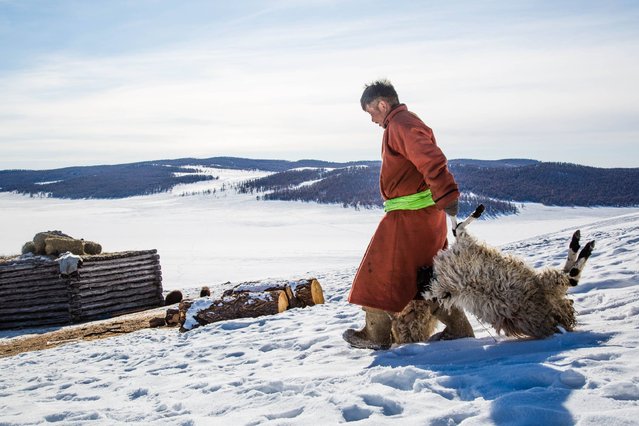
This handout photo taken on February 12, 2017 and released on February 16 by the International Federation of Red Cross and Red Crescent Societies (IFRC) shows Mongolian herder Munkhbat Bazarragchaa (C) dragging two sheep – which recently died due to the weather - to a pile of dead animals behind his “ger” in Khuvsgul province, northern Mongolia. Thousands of Mongolian herders face disastrous livestock losses from dreaded severe weather  known as the “dzud”, the Red Cross said on February 16, 2017 in launching an international emergency aid appeal. (Photo by Mirva Helenius/AFP Photo/IFRC)

This handout photo taken on February 12, 2017 and released on February 16 by the International Federation of Red Cross and Red Crescent Societies (IFRC) shows Mongolian herder Munkhbat Bazarragchaa (C) dragging two sheep – which recently died due to the weather - to a pile of dead animals behind his “ger” in Khuvsgul province, northern Mongolia. Thousands of Mongolian herders face disastrous livestock losses from dreaded severe weather known as the “dzud”, the Red Cross said on February 16, 2017 in launching an international emergency aid appeal. (Photo by Mirva Helenius/AFP Photo/IFRC)
Details
17 Feb 2017 11:40:00
A girl is splashed with water by boys following a Polish Wet Easter Monday tradition, in Wilamowice, Poland, Monday, April. 17, 2017. (Photo by Jarek Praszkiewicz/AP Photo)

A girl is splashed with water by boys following a Polish Wet Easter Monday tradition, in Wilamowice, Poland, Monday, April. 17, 2017. (Photo by Jarek Praszkiewicz/AP Photo)
Details
18 Apr 2017 09:30:00
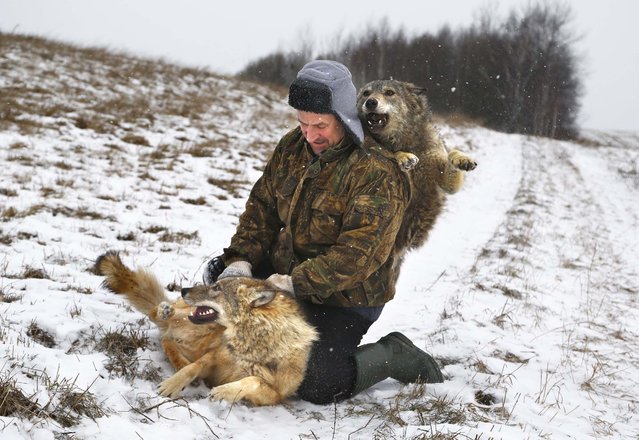
Belarusian Sergei Selekh plays with his 6-month-old tamed wolves on the outskirts of the village of Gaina, 45 kilometers (28 miles) north of Belarus capital Minsk, Wednesday, December 31, 2014. Selekh owns a farmstead, where sheep, wolves and an ethnographic museum serve as entertainment for guests. (Photo by Sergei Grits/AP Photo)

Belarusian Sergei Selekh plays with his 6-month-old tamed wolves on the outskirts of the village of Gaina, 45 kilometers (28 miles) north of Belarus capital Minsk, Wednesday, December 31, 2014. Selekh owns a farmstead, where sheep, wolves and an ethnographic museum serve as entertainment for guests. (Photo by Sergei Grits/AP Photo)
Details
03 Jan 2015 12:51:00
Chinese paramilitary guards monitoring passengers as they head to their train to travel to their hometowns for the “Spring Festival” or Lunar New Year at Nantong Railway Station in Jiangsu province, near Shanghai Travellers taking part in the world' s largest annual human migration must be home by January 27 to usher in the new year on January 28. (Photo by AFP Photo/Stringer)

Chinese paramilitary guards monitoring passengers as they head to their train to travel to their hometowns for the “Spring Festival” or Lunar New Year at Nantong Railway Station in Jiangsu province, near Shanghai Travellers taking part in the world' s largest annual human migration must be home by January 27 to usher in the new year on January 28. (Photo by AFP Photo/Stringer)
Details
27 Jan 2017 11:57:00