Loading...
Done
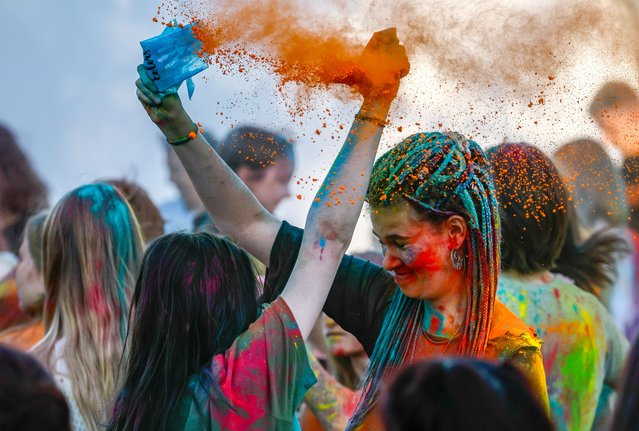
Visitors throw colored powder over each other as they attend the 9th annual festival Day of India in Moscow, Russia, 15 August 2024. The festival Day of India is a colorful celebration of Indian culture. The event kicked off on India's Independence Day and will continue until 18 August 2024. India declared its independence from British rule on 15 August 1947.  (Phoot by Yuri Kochetkov/EPA)

Visitors throw colored powder over each other as they attend the 9th annual festival Day of India in Moscow, Russia, 15 August 2024. The festival Day of India is a colorful celebration of Indian culture. The event kicked off on India's Independence Day and will continue until 18 August 2024. India declared its independence from British rule on 15 August 1947. (Phoot by Yuri Kochetkov/EPA)
Details
20 Dec 2025 11:53:00
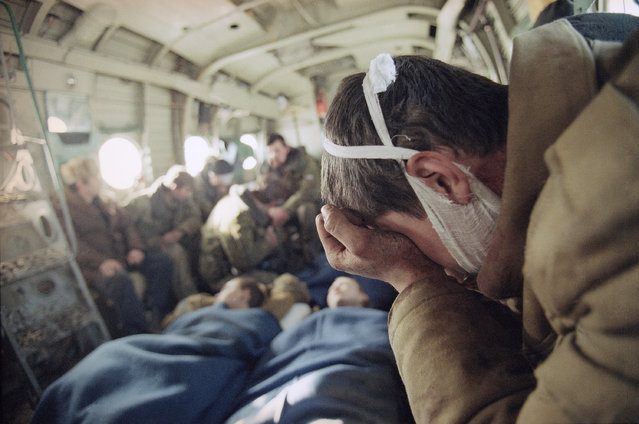
A wounded Russian soldier, who has been evacuated with his comrades, weeps in a helicopter on his way out of Grozny on Friday, February 3, 1995, as the fighting in the Chechen capital continues. The massive Russian force that invaded Chechnya has taken very heavy losses against a small but determined guerrilla force. (Photo by Karsten Thielker/AP Photo/File)

Karsten Thielker, a Pulitzer Prize-winning German photographer with The Associated Press who covered human suffering in conflict zones around the globe, has died at the age of 54. Thielker died on October 3 in Berlin of esophageal cancer, his wife Janna Ressel said. Here: A wounded Russian soldier, who has been evacuated with his comrades, weeps in a helicopter on his way out of Grozny on Friday, February 3, 1995, as the fighting in the Chechen capital continues. The massive Russian force that invaded Chechnya has taken very heavy losses against a small but determined guerrilla force. (Photo by Karsten Thielker/AP Photo/File)
Details
11 Oct 2020 00:05:00
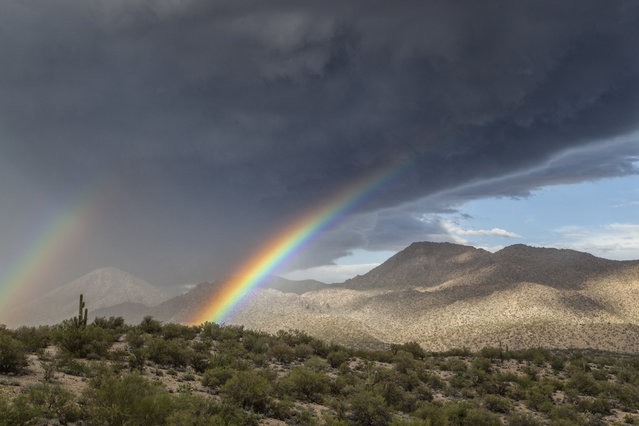
Two rainbows emerge from a black storm above the mountains, on August 19, 2014, in Kingman, Arizona.  Double tornadoes, lightning storms and rotating supercells – this is what it's like to chase storms for a year.(Photo by Roger Hill/Barcroft Media)

Two rainbows emerge from a black storm above the mountains, on August 19, 2014, in Kingman, Arizona. Double tornadoes, lightning storms and rotating supercells – this is what it's like to chase storms for a year. These dramatic images show apocalyptic weather throughout 2014 from a lightning storm to a pair of rainbows. Roger Hill, 57, has been chasing storms in the United States for thirty years and runs a tour operation with his wife Caryn. His favourite photograph of the year was also one of the most difficult to get – as two violent tornadoes tore through Pilger, Nebraska on June 16. The spiraling winds killed a five-year-old girl and injured at least 19 others, and as Roger tried to get the perfect shot debris began to rain down on his car. (Photo by Roger Hill/Barcroft Media)
Details
25 Feb 2015 09:27:00
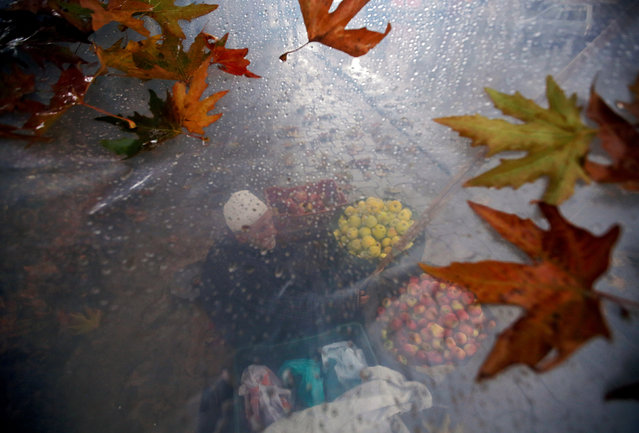
A roadside vendor selling apples is seen through a plastic sheet that he uses to cover himself from rain, in Srinagar November 14, 2018. (Photo by Danish Ismail/Reuters)

A roadside vendor selling apples is seen through a plastic sheet that he uses to cover himself from rain, in Srinagar, Indian state of Jammu and Kashmir on November 14, 2018. (Photo by Danish Ismail/Reuters)
Details
29 Nov 2018 00:05:00
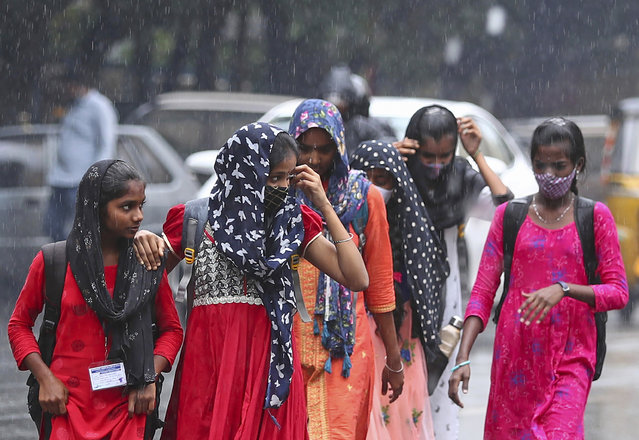
People walk in the rain in Hyderabad, India, Saturday, November 20, 2021. (Photo by Mahesh Kumar A./AP Photo)

People walk in the rain in Hyderabad, India, Saturday, November 20, 2021. More than a dozen people have died and dozens are reported missing in the southern Indian state of Andhra Pradesh after days of heavy rains, authorities said. (Photo by Mahesh Kumar A./AP Photo)
Details
27 Nov 2021 07:40:00
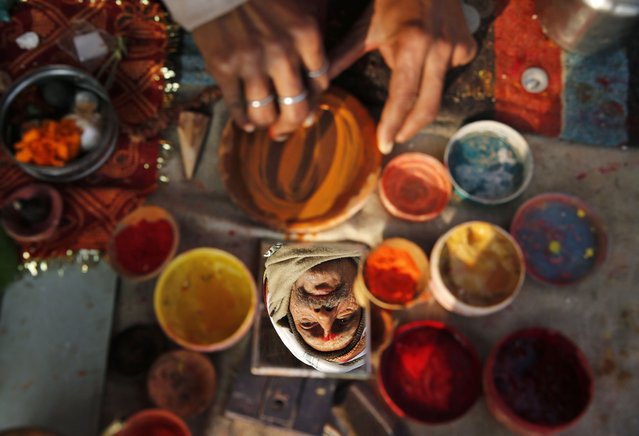
A Hindu holy man is reflected on a mirror as he prepares a bowl of vermillion powder for devotees near “Sangam”, the confluence of holy rivers of Ganges, Yamuna and the mythical Saraswati, during the annual traditional fair of Magh Mela in Allahabad, in the northern Indian state of Uttar Pradesh, India, Tuesday, January 6, 2015. (Photo by Rajesh Kumar Singh/AP Photo)

A Hindu holy man is reflected on a mirror as he prepares a bowl of vermillion powder for devotees near “Sangam”, the confluence of holy rivers of Ganges, Yamuna and the mythical Saraswati, during the annual traditional fair of Magh Mela in Allahabad, in the northern Indian state of Uttar Pradesh, India, Tuesday, January 6, 2015. Hundreds of thousands of devout Hindus are expected to take holy dips at the confluence during the astronomically auspicious period of over 45 days celebrated as Magh Mela. (Photo by Rajesh Kumar Singh/AP Photo)
Details
07 Jan 2015 13:41:00
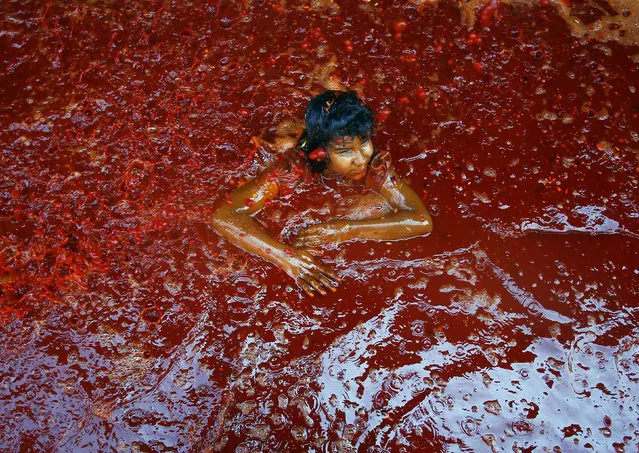
A child lies in a puddle of coloured water during “Huranga” at Dauji temple near the northern Indian city of Mathura, March 7, 2015. “Huranga” is a game played between men and women a day after Holi, the festival of colours, during which men drench women with liquid colours and women tear off the clothes of the men. (Photo by Anindito Mukherjee/Reuters)

A child lies in a puddle of coloured water during “Huranga” at Dauji temple near the northern Indian city of Mathura, March 7, 2015. “Huranga” is a game played between men and women a day after Holi, the festival of colours, during which men drench women with liquid colours and women tear off the clothes of the men. (Photo by Anindito Mukherjee/Reuters)
Details
14 Mar 2015 13:46:00
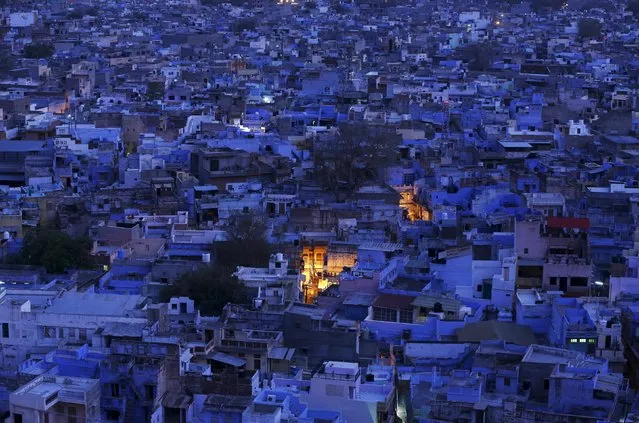
A general view of the residential area is pictured during dusk at Jodhpur in Rajasthan, April 5, 2015. Jodhpur, also known as the blue city in the desert Indian state of Rajasthan, which residents say originally, was used to show where the highest caste of priestly Hindus live, who wanted to set them apart from the rest of the population. Later the rest of the population followed suit. Another reason for the city to be blue is to keep the buildings cool during the summers, local residents said. (Photo by Adnan Abidi/Reuters)

A general view of the residential area is pictured during dusk at Jodhpur in Rajasthan, April 5, 2015. Jodhpur, also known as the blue city in the desert Indian state of Rajasthan, which residents say originally, was used to show where the highest caste of priestly Hindus live, who wanted to set them apart from the rest of the population. Later the rest of the population followed suit. Another reason for the city to be blue is to keep the buildings cool during the summers, local residents said. (Photo by Adnan Abidi/Reuters)
Details
12 Apr 2015 08:27:00