Loading...
Done


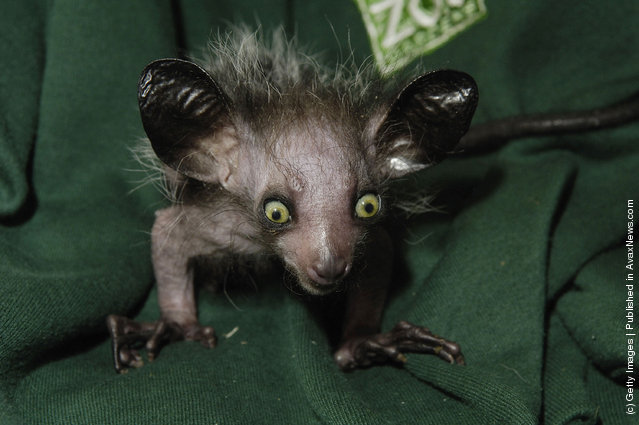
“The aye-aye (Daubentonia madagascariensis) is a lemur, a strepsirrhine primate native to Madagascar that combines rodent-like teeth and a special thin middle finger to fill the same ecological niche as a woodpecker. It is the world's largest nocturnal primate, and is characterized by its unusual method of finding food; it taps on trees to find grubs, then gnaws holes in the wood and inserts its narrow middle finger to pull the grubs out. The only other animal species known to find food in this way is the striped possum. From an ecological point of view the aye-aye fills the niche of a woodpecker as it is capable of penetrating wood to extract the invertebrates within”. – Wikipedia

Photo: In this handout image from Bristol Zoo is seen the first captive bred aye-aye in the UK named “Kintana” (meaning star in Malagasy) April 15, 2005 at Bristol Zoo Gardens, England. The zoo announced today only the second baby aye-aye to be hand-reared in the world (the first was in Jersey Zoo) and has now made his first public appearance since his birth on 11 February 2005. (Photo by Rob Cousins/Bristol Zoo via Getty Images)
Details
13 Apr 2011 13:33:00
The Bajau people of Malaysia live their lives completely at sea, living in wooden huts and spending their days fishing. Sailing over crystal clear waters, the Bajau people of Malaysia live their lives almost entirely at sea. (Photo by Ng Choo Kia/Hotspot Media/SIPA Press)

The Bajau people of Malaysia live their lives completely at sea, living in wooden huts and spending their days fishing. Sailing over crystal clear waters, the Bajau people of Malaysia live their lives almost entirely at sea. Photographer Ng Choo Kia joined the Bajau people on their pirogues, which are long narrow canoes made from single tree trunks, and documented their daily life in a series of pictures. (Photo by Ng Choo Kia/Hotspot Media/SIPA Press)
Details
05 May 2015 10:49:00
A woman poses next to two mailboxes along a street in Taipei on August 11, 2015 that were reportedly bent by strong winds brought by Typhoon Soudelor over the weekend. The two iron mailboxes have become an unlikely attraction, drawing thousands of snap-happy visitors and have even become a backdrop to a wedding photo shoot. (Photo by Benjamin Yeh/AFP Photo)

A woman poses next to two mailboxes along a street in Taipei on August 11, 2015 that were reportedly bent by strong winds brought by Typhoon Soudelor over the weekend. The two iron mailboxes have become an unlikely attraction, drawing thousands of snap-happy visitors and have even become a backdrop to a wedding photo shoot. The typhoon, which hit in the early hours of August 8 and was billed as the most powerful typhoon this year, uprooted trees, brought down electricity poles, knocking out power to a record 4.3 million households, while leaving eight dead and four missing. (Photo by Benjamin Yeh/AFP Photo)
Details
12 Aug 2015 13:44:00
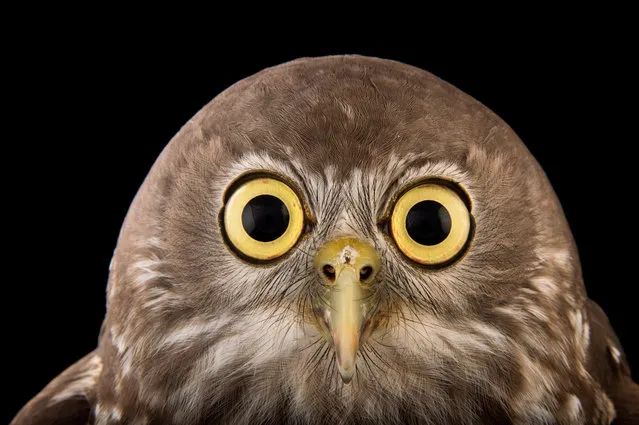
The National Geographic Photo Ark is a travelling exhibition of photographer Joel Sartore’s quest to create a photo archive of biodiversity around the world. So far, Sartore has captured studio portraits of more than 6,000 species – a number that he hopes to double. On 1 July, the ark will open at Melbourne zoo – the first time it has been exhibited in the southern hemisphere. More than 50 portraits will be on display, including many of Australian endangered animals being protected by programs at the zoo itself. These captions have been edited from text supplied by Melbourne zoo. Here: Barking owl. So-named because its call sounds like a barking dog, these birds are native to Australia, Indonesia and Papua New Guinea. In Victoria they are listed as an endangered species, and in 2003 there were estimated to be fewer than 50 breeding pairs. The main threat to the species in Victoria is loss of habitat, especially large trees with hollows in which they can nest and on which many of their prey depend. Apart from a bark, they may utter a chilling scream when they feel threatened. (Photo by Joel Sartore/National Geographic Photo Ark/The Guardian)

The National Geographic Photo Ark is a travelling exhibition of photographer Joel Sartore’s quest to create a photo archive of biodiversity around the world. So far, Sartore has captured studio portraits of more than 6,000 species – a number that he hopes to double. On 1 July, the ark will open at Melbourne zoo – the first time it has been exhibited in the southern hemisphere. More than 50 portraits will be on display, including many of Australian endangered animals being protected by programs at the zoo itself. These captions have been edited from text supplied by Melbourne zoo. Here: Barking owl. (Photo by Joel Sartore/National Geographic Photo Ark/The Guardian)
Details
01 Jul 2017 07:45:00
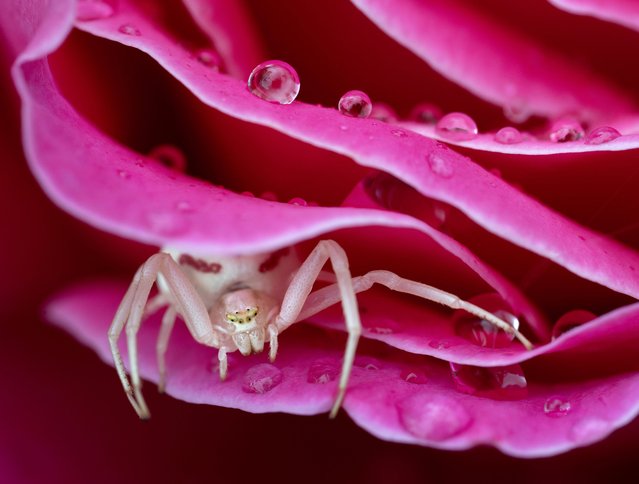
A white crab spider hides between the petals of a rain spotted rose blossom in the garden of a home near Oakland in southwestern Oregon on August 23, 2024. Crab spiders are ambush predators and wait patiently for their prey to approach. (Photo by Robin Loznak/ZUMA Press Wire/Rex Features/Shutterstock)

A white crab spider hides between the petals of a rain spotted rose blossom in the garden of a home near Oakland in southwestern Oregon on August 23, 2024. Crab spiders are ambush predators and wait patiently for their prey to approach. (Photo by Robin Loznak/ZUMA Press Wire/Rex Features/Shutterstock)
Details
31 Aug 2024 03:16:00
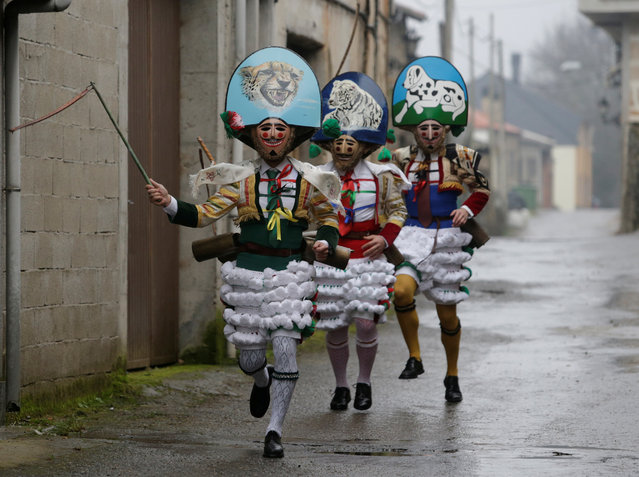
Carnival revellers dressed as “Peliqueiros” run along a street in the village of Laza, Spain February 11, 2018. “Peliqueiros”, or ancient tax collectors, pursued villagers through the streets ringing their cowbells and hitting villagers with their sticks. (Photo by Miguel Vidal/Reuters)

Carnival revellers dressed as “Peliqueiros” run along a street in the village of Laza, Spain February 11, 2018. “Peliqueiros”, or ancient tax collectors, pursued villagers through the streets ringing their cowbells and hitting villagers with their sticks. (Photo by Miguel Vidal/Reuters)
Details
12 Feb 2018 07:41:00
Nico Martin with a Mini Electric wrapped in thousands of Christmas fairy lights, at Greenfield Farm in Christmas Common, Oxfordshire on November 9, 2021. Nico, from Bracknell in Berkshire, has wrapped his own Mini in lights for the last two years, raising money for the MS Trust and for Duchenne UK. This year Mini are supporting Nico, providing him with a Mini Electric wrapped in thousands of Christmas lights ready for him to take out on the road. (Photo by Jacob King/PA Images via Getty Images)

Nico Martin with a Mini Electric wrapped in thousands of Christmas fairy lights, at Greenfield Farm in Christmas Common, Oxfordshire on November 9, 2021. Nico, from Bracknell in Berkshire, has wrapped his own Mini in lights for the last two years, raising money for the MS Trust and for Duchenne UK. This year Mini are supporting Nico, providing him with a Mini Electric wrapped in thousands of Christmas lights ready for him to take out on the road. (Photo by Jacob King/PA Images via Getty Images)
Details
15 Dec 2021 08:54:00
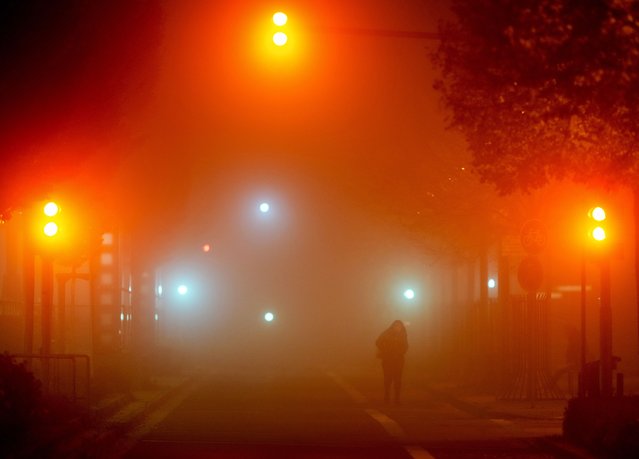
A woman crosses the street on a foggy morning in Frankfurt, Germany, Friday, October 29, 2021. (Photo by Michael Probst/AP Photo)

A woman crosses the street on a foggy morning in Frankfurt, Germany, Friday, October 29, 2021. (Photo by Michael Probst/AP Photo)
Details
01 Jan 2022 08:53:00