Loading...
Done
A man tries to stop two bulls from locking horns during a bullfight in the eastern emirate of Fujairah October 17, 2014. There are no matadors or picadors, but bulls locking horns with each other draw big crowds to bullfights in the United Arab Emirates (UAE). (Photo by Ahmed Jadallah/Reuters)

A man tries to stop two bulls from locking horns during a bullfight in the eastern emirate of Fujairah October 17, 2014. There are no matadors or picadors, but bulls locking horns with each other draw big crowds to bullfights in the United Arab Emirates (UAE). An hour's drive from the dancing water fountains of Dubai's glitzy downtown, hundreds of fans gather in Fujairah to watch bulls fighting, or perhaps more accurately head butting, with honour rather than money at stake. The UAE sport involves two bulls locking horns in a three-to-four minute Sumo-wrestling-like fight that usually ends with no bloodshed. (Photo by Ahmed Jadallah/Reuters)
Details
06 Nov 2014 09:26:00
Floralis Generica - Buenos Aires

Floralis Genérica is a sculpture made of steel and aluminum located in Plaza de las Naciones Unidas, Avenida Figueroa Alcorta, Buenos Aires, a gift to the city by the Argentine architect Eduardo Catalano. Catalano once said that the flower "is a synthesis of all the flowers and is both a hope that is reborn every day to open." It was created in 2002. The sculpture moves closing its petals in the evening and opening them in the morning, although this mechanism is currently disabled. The sculpture is located in the center of a park of four acres of wooded boundaries, surrounded by paths that get closer and provide different perspectives of the monument, and placed above a reflecting pool, which apart from fulfilling its aesthetic function, protects it. It represents a large flower made of stainless steel with aluminum skeleton and reinforced concrete, which looks at the sky, extending to it its six petals. Weighs eighteen tons and is 23 meters high.
Details
20 Oct 2013 18:32:00
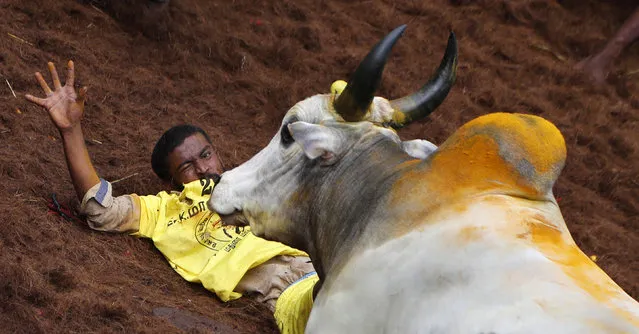
In this Thursday, January 17, 2019, photo, an Indian tamer reacts as a bull charges towards him during a traditional bull-taming festival called Jallikattu, in the village of Allanganallur, near Madurai, Tamil Nadu state, India. (Photo by Aijaz Rahi/AP Photo)

In this Thursday, January 17, 2019, photo, an Indian tamer reacts as a bull charges towards him during a traditional bull-taming festival called Jallikattu, in the village of Allanganallur, near Madurai, Tamil Nadu state, India. Jallikattu involves releasing a bull into a crowd of people who are expected to hang on to the animal's hump for a stipulated distance or hold on to the hump for a minimum of three jumps made by the bull. The sport, performed during the four-day “Pongal” or winter harvest festival, is hugely popular in Tamil Nadu. (Photo by Aijaz Rahi/AP Photo)
Details
21 Jan 2019 00:01:00
Heads of love dolls are seen on the shelf on March 9, 2017 in Tokyo, Japan. Japan's oldest and largest “love doll” maker Orient Industry, has been producing silicone love dolls since 1977, and has seen there is a trend for intimate relationships with silicone dolls in Japan. The Orient Industry's factory produces approximately 500 life size hand-made per year, and one doll, costs up to 600,000JPY (approx. 6,000 USD), takes four to five weeks to be finished. Originally, the company was marketing love dolls for disabled people, and the company continues to support the community by providing discounts and consulting their sexual urges. (Photo by Taro Karibe/Getty Images)

Heads of love dolls are seen on the shelf on March 9, 2017 in Tokyo, Japan. Japan's oldest and largest “love doll” maker Orient Industry, has been producing silicone love dolls since 1977, and has seen there is a trend for intimate relationships with silicone dolls in Japan. (Photo by Taro Karibe/Getty Images)
Details
18 Mar 2017 10:32:00
“I’m not scared of breaking the fourth wall”, Wallace has said of the photos where the subject is clearly aware of him taking the shot. “If they are looking at you in a photograph most photographers will think, oh, that’s not a good image. (But) people like to be involved and in the picture. You can see what they are thinking, see them talking”. (Photo by Dougie Wallace/The Guardian)

In Dougie Wallace’s photos of Mumbai taxis, the chatter, yelling, and constant horns of the city are almost audible. A selection of his images is on show at Gayfield Creative Spaces, Edinburgh, as part of the Retina photography festival until 30 July. For four years, the Glasgow-born Wallace focused his photos on one kind of taxi in particular: the Premier Padmini, a 1960s workhorse painted in black and yellow. Locally known as “Kaali-Peeli”, there were once more than 60,000 of them in the Indian city. But thanks to laws restricting pollution, the cars now are fast disappearing from Mumbai’s streets. (Photo by Dougie Wallace/The Guardian)
Details
13 Jul 2016 13:50:00
In this photograph taken on December 14, 2016, an Indian craftsman works on unfinished cricket bats in a factory in Meerut, some 70 kms north- east of New Delhi. As Indian factory worker Jitender Singh carves out another big- hitting slab of thick willow he insists MCC proposals to limit the size of cricket bats won' t tame Twenty20 marauders. “I don' t think the thickness matters. It' s more about the balance of the bat and the talent of the batsman”, says Singh, who has made bats for many stars, including South Africa's AB de Villiers. The World Cricket committee of the MCC, the guardians of the game, recommended in December 2016 that limitations be placed on the width and depth of bats because it had become too easy to smash fours and sixes. (Photo by Dominique Faget/AFP Photo)

In this photograph taken on December 14, 2016, an Indian craftsman works on unfinished cricket bats in a factory in Meerut, some 70 kms north- east of New Delhi. (Photo by Dominique Faget/AFP Photo)
Details
11 Jan 2017 14:32:00
A woman poses next to two mailboxes along a street in Taipei on August 11, 2015 that were reportedly bent by strong winds brought by Typhoon Soudelor over the weekend. The two iron mailboxes have become an unlikely attraction, drawing thousands of snap-happy visitors and have even become a backdrop to a wedding photo shoot. (Photo by Benjamin Yeh/AFP Photo)

A woman poses next to two mailboxes along a street in Taipei on August 11, 2015 that were reportedly bent by strong winds brought by Typhoon Soudelor over the weekend. The two iron mailboxes have become an unlikely attraction, drawing thousands of snap-happy visitors and have even become a backdrop to a wedding photo shoot. The typhoon, which hit in the early hours of August 8 and was billed as the most powerful typhoon this year, uprooted trees, brought down electricity poles, knocking out power to a record 4.3 million households, while leaving eight dead and four missing. (Photo by Benjamin Yeh/AFP Photo)
Details
12 Aug 2015 13:44:00
Christian Balderosdasco, 31, is being pulled up a mud pit after diving for 3 hours to look for gold on March 22, 2017 in Paracale, Philippines. (Photo by Jes Aznar/Getty Images)

Christian Balderosdasco, 31, is being pulled up a mud pit after diving for 3 hours to look for gold on March 22, 2017 in Paracale, Philippines. Apart from tunneling and sifting sand, locals dive down murky swamps with the aid of a compressor with air flowing in a small tube for breathing, as they blindly swim under the mud for up to four hours to look for tiny rocks containing gold particles. For decades, local residents at Paracale town work in hazardous conditions scavenging under the earth and diving into tunnels filled with mud using only makeshift tools to mine for gold, often placing their health and lives at risk. (Photo by Jes Aznar/Getty Images)
Details
06 Apr 2017 09:21:00