Loading...
Done
Mud-covered tourists pretend to be trapped inside a mud prison at the Daecheon Beach Mud Plaza in the city of Boryeong on South Korea's west coast, July 17, as they take part in the Boryeong Mud Festival, which opened that day and runs through July 26. Boryeong mud is rich in natural mineral component and is considered to prevent skin aging. (Photo by EPA/Yonhap)

Mud-covered tourists pretend to be trapped inside a mud prison at the Daecheon Beach Mud Plaza in the city of Boryeong on South Korea's west coast, July 17, as they take part in the Boryeong Mud Festival, which opened that day and runs through July 26. Boryeong mud is rich in natural mineral component and is considered to prevent skin aging. (Photo by EPA/Yonhap)
Details
18 Jul 2015 13:33:00
Bottlenose dolphins swim over visitors in water tank at the Hakkeijima Sea Paradise aquarium-amusement park complex in Yokohama, southwest of Tokyo, Tuesday, July 21, 2015. Temperatures in Tokyo's metropolitan area neared around 96 degree Fahrenheit, or 35 degree Celsius, on Tuesday. (Photo by Shuji Kajiyama/AP Photo)

Bottlenose dolphins swim over visitors in water tank at the Hakkeijima Sea Paradise aquarium-amusement park complex in Yokohama, southwest of Tokyo, Tuesday, July 21, 2015. Temperatures in Tokyo's metropolitan area neared around 96 degree Fahrenheit, or 35 degree Celsius, on Tuesday. (Photo by Shuji Kajiyama/AP Photo)
Details
22 Jul 2015 12:33:00
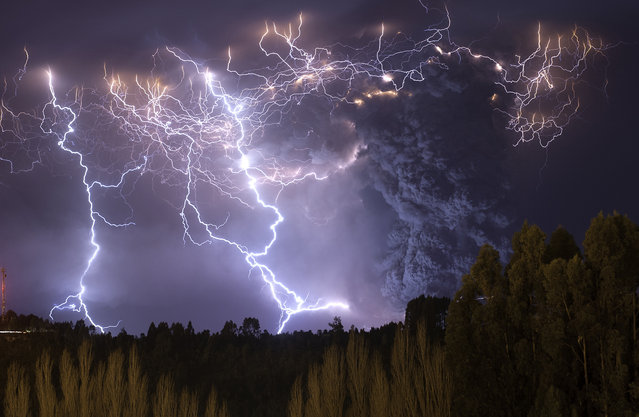
The eruption of Cordon Caulle began on June 4, 2011, located in the Region of Los Rios in Chile. For about 12 months, people and animals became accustomed to living with the daily fall of ash, which also caused problems in the air traffic in South America. The explosions and lightning during first days of the eruption could be seen from hundreds of miles around. This photograph was taken on the second night of eruption from the town of Lago Ranco. (Photo and caption by Francisco Negroni/National Geographic Traveler Photo Contest)

The eruption of Cordon Caulle began on June 4, 2011, located in the Region of Los Rios in Chile. For about 12 months, people and animals became accustomed to living with the daily fall of ash, which also caused problems in the air traffic in South America. The explosions and lightning during first days of the eruption could be seen from hundreds of miles around. This photograph was taken on the second night of eruption from the town of Lago Ranco. (Photo and caption by Francisco Negroni/National Geographic Traveler Photo Contest)

ATTENTION! All pictures are presented in high resolution. To see Hi-Res images – just TWICE click on any picture. In other words, click small picture – opens the BIG picture. Click BIG picture – opens VERY BIG picture.
Details
23 Jun 2013 11:24:00
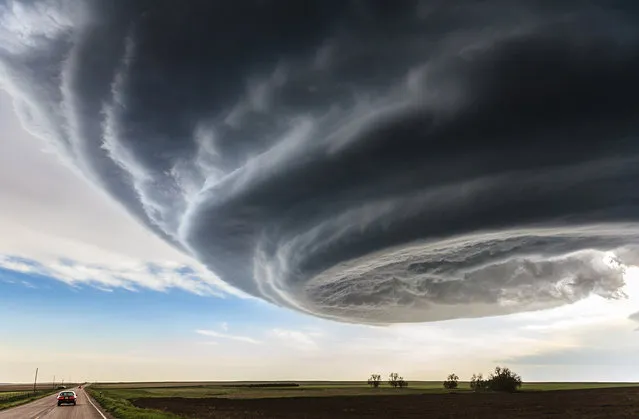
“The Independence day”. While on storm chasing expeditions in the Tornado Alley in USA I have encountered many photogenic supercell storms. This photograph was taken while we were approaching the storm near Julesburg, Colorado on My 28th, 2013. The storm was tornado warned for more than one hour, but stayed an LP storm through all its cycles and never produced a tornado, just occasional brief funnels, large hail and some rain. Photo location: Julesburg, Colorado, USA. (Photo and caption by Marko Korošec/National Geographic Photo Contest)

“The Independence day”. While on storm chasing expeditions in the Tornado Alley in USA I have encountered many photogenic supercell storms. This photograph was taken while we were approaching the storm near Julesburg, Colorado on My 28th, 2013. The storm was tornado warned for more than one hour, but stayed an LP storm through all its cycles and never produced a tornado, just occasional brief funnels, large hail and some rain. Photo location: Julesburg, Colorado, USA. (Photo and caption by Marko Korošec/National Geographic Photo Contest)
Details
24 Jun 2014 12:29:00
Mongolia's Olympic wrestler Battsetseg Soronzonbold (front) fights with her training partner during a daily training session at the Mongolia Women’s National Wrestling Team training centre in Bayanzurkh district of Ulaanbaatar, Mongolia, July 1, 2016. Battsetseg Soronzonbold became a national hero in her native Mongolia after winning wrestling bronze at the London Olympics and is determined to turn the medal into gold in Rio next month. (Photo by Jason Lee/Reuters)

Mongolia's Olympic wrestler Battsetseg Soronzonbold (front) fights with her training partner during a daily training session at the Mongolia Women’s National Wrestling Team training centre in Bayanzurkh district of Ulaanbaatar, Mongolia, July 1, 2016. Battsetseg Soronzonbold became a national hero in her native Mongolia after winning wrestling bronze at the London Olympics and is determined to turn the medal into gold in Rio next month. (Photo by Jason Lee/Reuters)
Details
07 Jul 2016 11:54:00
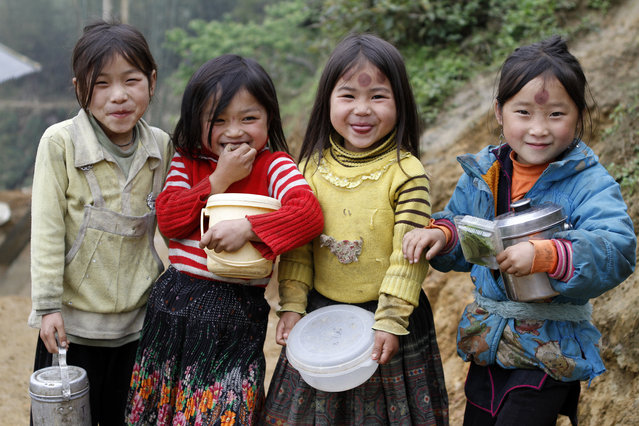
“Kids of Sapa”. Four little beautiful Hmong girls from Lao Chai Village, near Sapa, Vietnam. (Photo and caption by Felipe Hanower/National Geographic Traveler Photo Contest)

“Kids of Sapa”. Four little beautiful Hmong girls from Lao Chai Village, near Sapa, Vietnam. (Photo and caption by Felipe Hanower/National Geographic Traveler Photo Contest)
Details
15 Jul 2013 09:14:00
Firefighters pull a pig as they try to rescue it from a well at a pig farm in Huanghua township of Leqing, Zhejiang province, April 25, 2014. Seven local firefighters successfully rescued a 300 kg (661 lbs) pig which fell down a well on Friday morning, local media reported. (Photo by Reuters/China Daily)

Firefighters pull a pig as they try to rescue it from a well at a pig farm in Huanghua township of Leqing, Zhejiang province, April 25, 2014. Seven local firefighters successfully rescued a 300 kg (661 lbs) pig which fell down a well on Friday morning, local media reported. (Photo by Reuters/China Daily)
Details
26 Apr 2014 12:44:00
On August 31, 2012, a long filament of solar material that had been hovering in the sun's atmosphere, the corona, erupted out into space at 4:36 p.m. EDT. The coronal mass ejection, or CME, traveled at over 900 miles per second. The CME did not travel directly toward Earth, but did connect with Earth's magnetic environment, or magnetosphere, causing aurora to appear on the night of Monday, September 3. (Photo by NASA/GSFC/SDO)

On August 31, 2012, a long filament of solar material that had been hovering in the sun's atmosphere, the corona, erupted out into space at 4:36 p.m. EDT. The coronal mass ejection, or CME, traveled at over 900 miles per second. The CME did not travel directly toward Earth, but did connect with Earth's magnetic environment, or magnetosphere, causing aurora to appear on the night of Monday, September 3. (Photo by NASA/GSFC/SDO via The Atlantic)
Details
14 Sep 2012 09:01:00