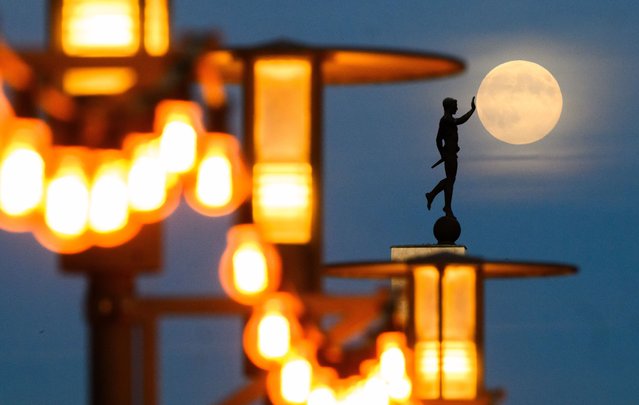
The moon rises on the behind the “Torchbearer” statue in Hannover, Germany, Wednesday, November 5, 2025. (Photo by Julian Stratenschulte/dpa via AP Photo)
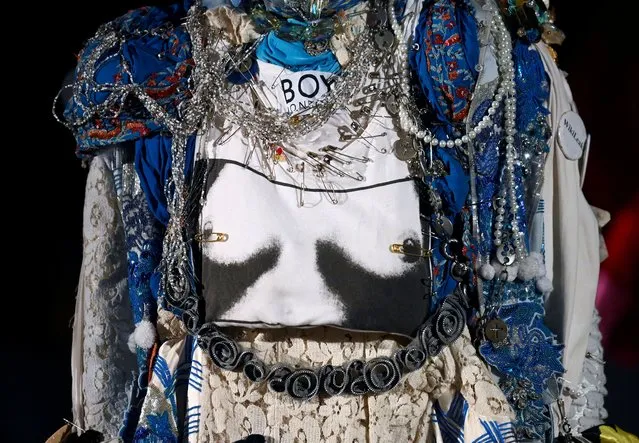
A sculptural artwork creation is displayed as part of the “Fashion in Motion: Daniel Lismore” exhibition by British multidisciplinary artist Daniel Lismore, at the Victoria and Albert Museum in London, Britain on August 5, 2022. (Photo by Toby Melville/Reuters)
Norway's Karsten Warholm celebrates winning the men's 400m hurdles at the Diamond League in London, July 21, 2018. (Photo by Andrew Boyers/Action Images via Reuters)
A sеx worker performs in a mobile peep show to protest against the decision that sеx workers are not yet allowed to return to work, in The Hague, The Netherlands. 02 March 2021. The Dutch cabinet stipulated that all contact professions could return to work after a lockdown, but excluded sеx workers from resuming their work. (Photo by Sem van der Wal/EPA/EFE)
The two Pulis Quastie and Gin-Gin run in the snow in their garden in Lautertal, southern Germany, Thursday, January 5, 2017. (Photo by Michael Probst/AP Photo)
Steven de Costa of France, top, and Kalvis Kalnins of Latvia react during the men's kumite -67kg elimination round for Karate at the 2020 Summer Olympics, Thursday, August 5, 2021, in Tokyo, Japan. (Photo by Vincent Thian/AP Photo)
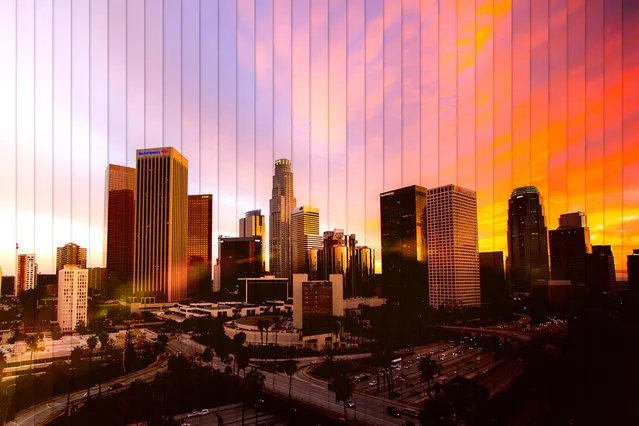
A photographer is using a unique method to show the shift from day to night across famous cities in spectacular images. Daniel Marker-Moors' take on time-lapse photography – which he calls time slice – sees the photographer snap image after image, before combining them to create beautiful, vibrant works. His images usually focus on a point in the day with the most dramatic change in light, such as sunrise or sunset. Marker-Moors, from Los Angeles, begins by shooting hundreds and sometimes thousands of images from the same spot. Here: Chicago – 35 photographs, 15 minutes. (Photo by Daniel Marker-Moors/Caters News)