Loading...
Done


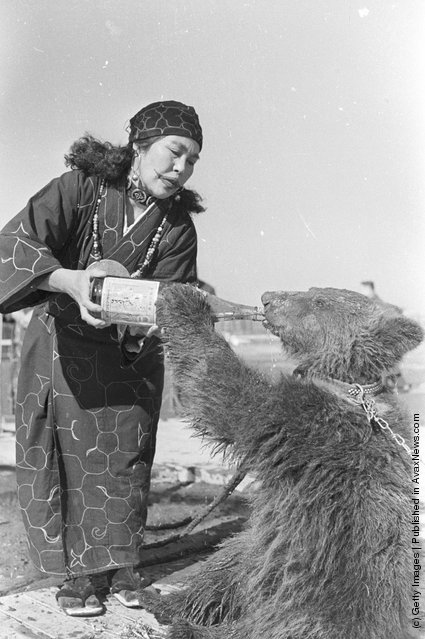
“The Ainu (アイヌ?), also called Aynu, Aino (アイノ), and in historical texts Ezo (蝦夷), are indigenous people or groups in Japan and Russia. Historically they spoke the Ainu language and related varieties and lived in Hokkaidō, the Kuril Islands, and much of Sakhalin. Most of those who identify themselves as Ainu still live in this same region, though the exact number of living Ainu is unknown. This is due to ethnic issues in Japan resulting in those with Ainu backgrounds hiding their identities and confusion over mixed heritages. In Japan, because of intermarriage over many years with Japanese, the concept of a 'pure Ainu' ethnic group is no longer feasible. Official estimates of the population are of around 25,000, while the unofficial number is upwards of 200,000 people”. – Wkipedia

Photo: A captive bear drinking from a large bottle held by an Ainu tribeswoman. (Photo by Evans/Three Lions/Getty Images). Circa 1955
Details
24 Mar 2011 14:01:00


In this 2003 photo provided by the U.S. Army Soldier Systems Center, a model wears the Scorpion Ensemble developmental battle dress expected to be field-ready in the year 2011 in Natick, Massachusetts. The uniform and gear, including armor and night vision, communication and body sensing equipment, is expected to weigh only 40 to 50 pounds. (Photo by Sarah Underhill/U.S. Army Soldier Systems Center/Getty Images)

P.S. Somebody knows – this piece have really created?
Details
01 Jul 2011 12:11:00
Sleeveface

“Sleeveface is an internet phenomenon wherein one or more persons obscure or augment body parts with record sleeve(s), causing an illusion. Sleeveface has become popular on social networking sites”. – Wikipedia

Photo: “Doggy Style” (Photo by Samuel and Marco van Bergen via SleeveFace.com)
Details
26 Apr 2012 14:26:00
Beard Bird Inca Tern

The Inca Tern is a seabird in the family Sternidae. It is the only member of the genus Larosterna. This uniquely plumaged bird breeds on the coasts of Peru and Chile, and is restricted to the Humboldt current. It can be identified by its dark grey body, white moustache on the both sides of its head, and red-orange beak and feet.
Details
21 Apr 2013 17:02:00
Relatives of the crashed AirAsia plane passengers pray at Juanda Airport, in Surabaya, Indonesia, 31 December 2014. Indonesian rescuers retrieved three more bodies from the sea on 31 December but the search to recover more victims from the AirAsia plane crash was hampered by bad weather, the recue chief said. (Photo by Made Nagi/EPA)

Relatives of the crashed AirAsia plane passengers pray at Juanda Airport, in Surabaya, Indonesia, 31 December 2014. Indonesian rescuers retrieved three more bodies from the sea on 31 December but the search to recover more victims from the AirAsia plane crash was hampered by bad weather, the recue chief said. AirAsia Indonesia flight QZ8501 crashed into the Java Sea on 28 December, about halfway through a two-hour flight between Surabaya, Indonesia's second largest city, and Singapore. (Photo by Made Nagi/EPA)
Details
01 Jan 2015 13:26:00
A man dressed as “El Chapulin Colorado”, a character by screenwriter Roberto Gomez Bolanos, performs for fans and media as they wait for the arrival of the funeral van carrying the body of Bolanos, at Mexican media company Televisa in Mexico City November 29, 2014. (Photo by Carlos Jasso/Reuters)

A man dressed as “El Chapulin Colorado”, a character by screenwriter Roberto Gomez Bolanos, performs for fans and media as they wait for the arrival of the funeral van carrying the body of Bolanos, at Mexican media company Televisa in Mexico City November 29, 2014. Mexican actor and screenwriter Roberto Gomez Bolanos, one of Latin America's most beloved comedians, whose slapstick acts charmed fans from Spain to Argentina for over four decades, died on Friday at the age 85. Known as “Chespirito”, a word play on “Little Shakespeare” for his diminutive stature and his prolific scripts, Gomez Bolanos created some of the region's most enduring comic characters. (Photo by Carlos Jasso/Reuters)
Details
01 Dec 2014 13:50:00
A woman cries as she watches the coffin containing the body of Venezuela's late President Hugo Chavez be taken from the hospital, where he died on Tuesday, to a military academy in Caracas, Venezuela, Wednesday, March 6, 2013. Seven days of mourning were declared, all schools were suspended for the week and friendly heads of state were expected for an elaborate funeral on Friday. (Photo by Rodrigo Abd/AP Photo)

A woman cries as she watches the coffin containing the body of Venezuela's late President Hugo Chavez be taken from the hospital, where he died on Tuesday, to a military academy in Caracas, Venezuela, Wednesday, March 6, 2013. Seven days of mourning were declared, all schools were suspended for the week and friendly heads of state were expected for an elaborate funeral on Friday. (Photo by Rodrigo Abd/AP Photo)
Details
07 Mar 2013 12:01:00
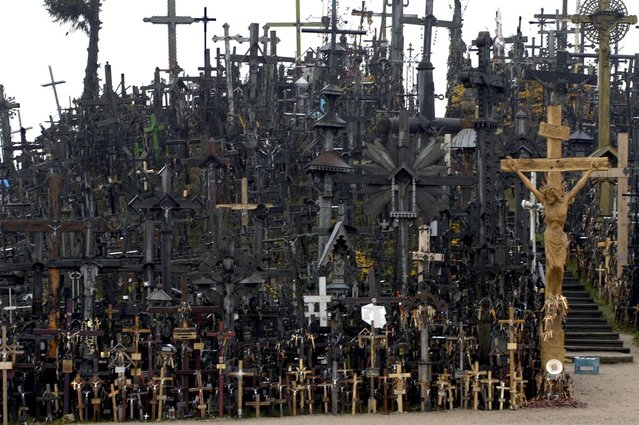
In 1831 an unsuccessful uprising against the Russian czar left many rebels dead. Relatives of the dead rebels, with no bodies to bury, instead left crosses, according to the Daily Mail. (Photo by Richard Gardner/Rex USA)

The phenomenon of the Hill of Crosses in northern Lithuania began when people started leaving crosses there hundreds of years ago – and continues to this day. These photos of a hill covered in crosses show the amazing sight it has become. Photo: In 1831 an unsuccessful uprising against the Russian czar left many rebels dead. Relatives of the dead rebels, with no bodies to bury, instead left crosses, according to the Daily Mail. (Photo by Richard Gardner/Rex USA)
Details
06 Jun 2013 09:56:00