Loading...
Done
A member of the Indian company Margi Kathakali theatre performs during “Kijote Kathakali”, a Kathakali recital based on the Spanish classic “Don Quixote”, at the Niemeyer Center in Aviles, northern Spain, July 29, 2016. The performance and text captured the essence of the novel while sticking to the format of Kathakali. Kathakali is one of the major forms of classical Indian dance. It is another “story play” genre of art, but one distinguished by its elaborately colorful make-up, costumes and face masks wearing actor-dancers, who have traditionally been all males. (Photo by Eloy Alonso/Reuters)

A member of the Indian company Margi Kathakali theatre performs during “Kijote Kathakali”, a Kathakali recital based on the Spanish classic “Don Quixote”, at the Niemeyer Center in Aviles, northern Spain, July 29, 2016. The performance and text captured the essence of the novel while sticking to the format of Kathakali. Kathakali is one of the major forms of classical Indian dance. (Photo by Eloy Alonso/Reuters)
Details
31 Jul 2016 11:02:00
Isabel Schmalenbach, an environmental scientist with the Helgoland Biological Institute (Biologische Anstalt Helgoland), part of the Alfred Wegener Institute for Polar and Marine Research, holds a one-year old baby European lobster (Homarus gammarus) raised at the institute on August 3, 2013 on Helgoland Island, Germany. (Photo by Sean Gallup/Getty Images)

Isabel Schmalenbach, an environmental scientist with the Helgoland Biological Institute (Biologische Anstalt Helgoland), part of the Alfred Wegener Institute for Polar and Marine Research, holds a one-year old baby European lobster (Homarus gammarus) raised at the institute on August 3, 2013 on Helgoland Island, Germany. Later in the day Schmalenbach and her colleagues released a total of 415 one-year old lobsters into the North Sea as part of an effort to repopulate the lobster population around Helgoland (also called Heligoland). In the 19th century local fishermen caught up to 80,000 lobsters a year in the surrounding waters, combined with the heavy allied bombing of the island during and after World War II, as well as other environmental factors, decimated the lobster population. (Photo by Sean Gallup)
Details
05 Aug 2013 08:39:00
Tridacna Gigas, or Giant Clams

“The giant clam, Tridacna gigas (known as pā’ua in Cook Islands Māori), is the largest living bivalve mollusc. T. gigas is one of the most endangered clam species. It was mentioned as early as 1825 in scientific reports. One of a number of large clam species native to the shallow coral reefs of the South Pacific and Indian oceans, they can weigh more than 200 kilograms (440 lb) measure as much as 120 cm (47 in) across, and have an average lifespan in the wild of 100 years or more”. – Wikipedia

Photo: Tridacna Gigas, or Giant Clams spew water as a traditional fisherman passes by a small sanctuary on January 23, 2004 near Bolinao in the Northern Philippines. The clams, prime builders for coral reefs and providing shelter for spawning fish and other marine life, are exposed by low tides in the sanctuary. Overfishing and pollution throughout the country are not only threatening food security, but are also starting to choke one of the few working clam sanctuaries in the world. (Photo by David Greedy/Getty Images)
Details
01 Oct 2011 13:10:00
Nice's Youcef Atal, left, and PSG's Juan Bernat challenge for the ball during the French League One soccer match between Paris Saint-Germain and Nice at the Parc des Princes stadium in Paris, France, Saturday, May 4, 2019. (Photo by Christophe Ena/AP Photo)

Nice's Youcef Atal, left, and PSG's Juan Bernat challenge for the ball during the French League One soccer match between Paris Saint-Germain and Nice at the Parc des Princes stadium in Paris, France, Saturday, May 4, 2019. (Photo by Christophe Ena/AP Photo)
Details
06 May 2019 00:05:00
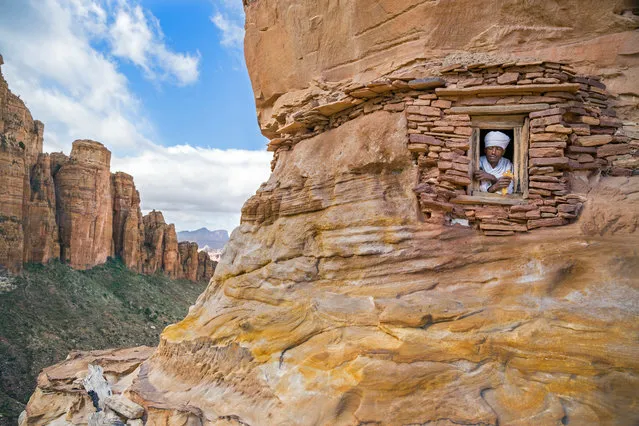
A priest is seen looking out of Abuna Yemata church’s only window. Priests cheerfully tell visitors that pregnant women, babies and old people attend Sunday services and no one has fallen off. (Photo by Ethiopia – The Living Churches of an Ancient Kingdom/The American University in Cairo Press/The Guardian)

A priest is seen looking out of Abuna Yemata church’s only window. Priests cheerfully tell visitors that pregnant women, babies and old people attend Sunday services and no one has fallen off. (Photo by Ethiopia – The Living Churches of an Ancient Kingdom/The American University in Cairo Press/The Guardian)
Details
15 Dec 2017 06:19:00
Tourists ride a cable car in the form a of a Chiva, a bus used to serve rural routes, in Pitalito, Colombia, Tuesday, April 5, 2017. The ride called “La Chiva Voladora” costs about $0.70 and you zip along about 800 meters from one side of a hill to another. (Photo by Fernando Vergara/AP Photo)

Tourists ride a cable car in the form a of a Chiva, a bus used to serve rural routes, in Pitalito, Colombia, Tuesday, April 5, 2017. The ride called “La Chiva Voladora” costs about $0.70 and you zip along about 800 meters from one side of a hill to another. (Photo by Fernando Vergara/AP Photo)
Details
21 Dec 2017 06:51:00
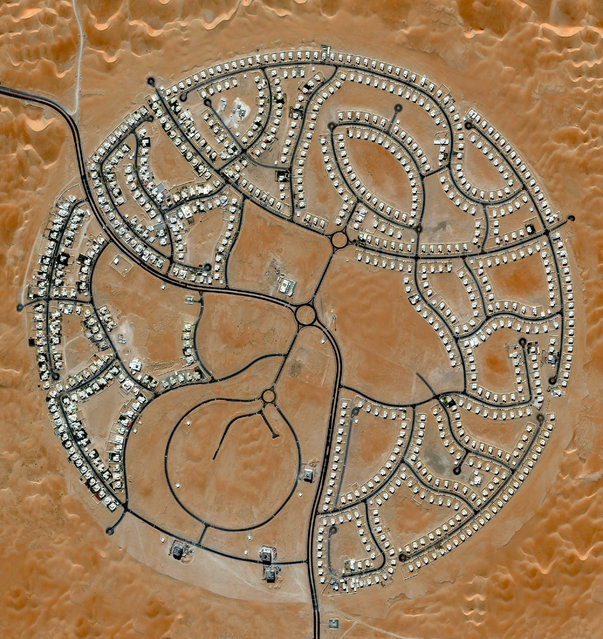
The villas of Marabe Al Dhafra in Abu Dhabi, United Arab Emirates are home to approximately 2,000 people. Located in one of the hottest regions of the world, the record high temperature here is 49.2C° (120.6F°). (Photo by Benjamin Grant/Penguin Random House)

The villas of Marabe Al Dhafra in Abu Dhabi, United Arab Emirates are home to approximately 2,000 people. Located in one of the hottest regions of the world, the record high temperature here is 49.2C° (120.6F°). (Photo by Benjamin Grant/Penguin Random House)
Details
21 Sep 2016 10:04:00
Tibetan pilgrims walk outside the Sera Monastery in Lhasa, Tibet Autonomous Region, China, 11 September 2016. Sera Monastery is known as one of the “great three” Gelug university monasteries of Tibet founded in 1419. (Photo by How Hwee Young/EPA)

Tibetan pilgrims walk outside the Sera Monastery in Lhasa, Tibet Autonomous Region, China, 11 September 2016. Sera Monastery is known as one of the “great three” Gelug university monasteries of Tibet founded in 1419. (Photo by How Hwee Young/EPA)
Details
22 Sep 2016 09:59:00