Loading...
Done
“Aurora over a glacier lagoon”. A vivid green overheaded aurrora pictured in Iceland's Vatnajokull National Park reflected almost symetrically in Jokulsrlon Glacier lagoon. A complete lack of wind and currrent combin in this sheltred lagoon scene to crete an arresting mirror effect giving the image a sensation of utter stillness. Despite theis there is motion on a suprising scale, as the loops and arcs of the aurora are shaped by the shifting forces of the Earth's magnetic field. (Photo by  James Woodend/The Astronomy Photographer of the Year 2014 Contest)

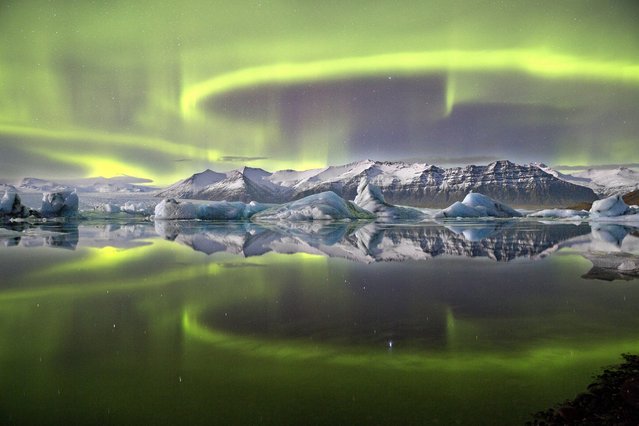
“Aurora over a glacier lagoon”. A vivid green overheaded aurrora pictured in Iceland's Vatnajokull National Park reflected almost symetrically in Jokulsrlon Glacier lagoon. A complete lack of wind and currrent combin in this sheltred lagoon scene to crete an arresting mirror effect giving the image a sensation of utter stillness. Despite theis there is motion on a suprising scale, as the loops and arcs of the aurora are shaped by the shifting forces of the Earth's magnetic field. James Woodend of Great Britain won the grand prize with the image, beating out more than 2,500 other entries. The Astronomy Photographer of the Year 2014 contest is judged by the Royal Observatory Greenwich and BBC Sky at Night magazine. (Photo by James Woodend/The Astronomy Photographer of the Year 2014 Contest)
Details
26 Sep 2014 13:39:00
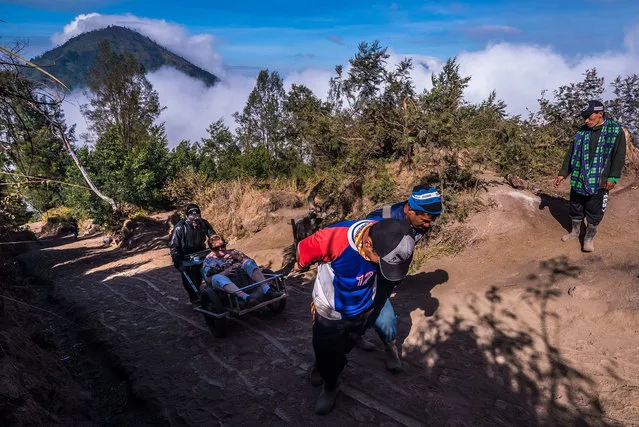
Miners pulling up lazy tourists to the rim of Kawah Ijen (Ijen Volcano), East Java, Indonesia on September 21, 2017. They will earn as much as they would bring down a load of sulfur. Nomadic Explorer, Cultural Lifestyle Photographer Claudio Sieber captured striking images of miners working at Ijen volcanic range in East Java, Indonesia. The sulphur miners risk their lives daily as they climb the active volcano carrying heavy loads, which they sell to sugar refineries. Shortly after midnight curious tourists are flocking in hundreds through the gate of Ijen's foothills to be right on time, driven by the images others took before them. Kawah Ijen is the one of the world's largest acidic volcanic crater lake; famous for its turquoise color as well as the unreal atmosphere it offers during darkness. A dusty path zigzags 3 kilometers up to the crater rim. This doesn't mean anything challenging; in particular, special sights have to be deserved anyway. The irritating smell of sulfur announces the near of the crater's existence. Arriving on the crater's rim the reward for the torture becomes visible. Blue fire darts its tongues through the fumes of sulfur dioxide. Somehow, the spectacle isn't as romantic as expected, since it is also the rough working space of approx. 150 sulfur miners who start their shift at 1 am. Lately, harvesting the abundance of devil's gold received international attention. This did obviously not really improve a miner's lifestyle; neither did it contribute to a better wage. (Photo by Claudio Sieber/Barcroft Images)

Miners pulling up lazy tourists to the rim of Kawah Ijen (Ijen Volcano), East Java, Indonesia on September 21, 2017. They will earn as much as they would bring down a load of sulfur. Nomadic Explorer, Cultural Lifestyle Photographer Claudio Sieber captured striking images of miners working at Ijen volcanic range in East Java, Indonesia. The sulphur miners risk their lives daily as they climb the active volcano carrying heavy loads, which they sell to sugar refineries. (Photo by Claudio Sieber/Barcroft Images)
Details
02 Oct 2017 08:31:00
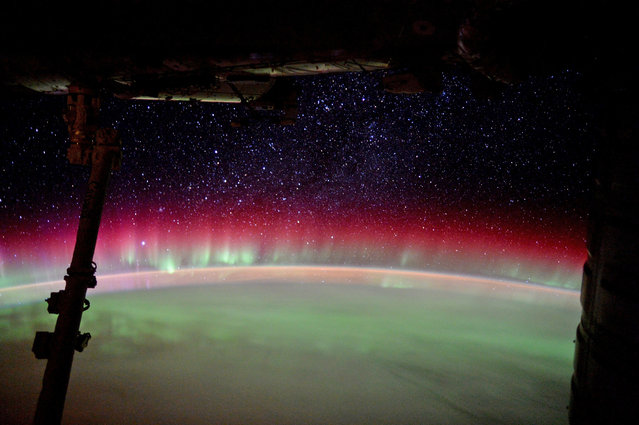
ESA astronaut Tim Peake posted this stunning image on his social media channels, commenting: “Station passed through magnificent aurora Australis last night”. Tim is set to return to Earth on 18 June 2016, bringing his six-month Principia mission to the ISS to an end. During his stay he performed more than 30 scientific experiments for ESA and taking part in numerous others from ESA's international partners. ESA and the UK Space Agency have partnered to develop many exciting educational activities around the Principia mission, aimed at sparking the interest of young children in science and space. (Photo by Tim Peake/ESA/NASA)

ESA astronaut Tim Peake posted this stunning image on his social media channels, commenting: “Station passed through magnificent aurora Australis last night”. Tim is set to return to Earth on 18 June 2016, bringing his six-month Principia mission to the ISS to an end. During his stay he performed more than 30 scientific experiments for ESA and taking part in numerous others from ESA's international partners. ESA and the UK Space Agency have partnered to develop many exciting educational activities around the Principia mission, aimed at sparking the interest of young children in science and space. (Photo by Tim Peake/ESA/NASA)
Details
31 Dec 2016 10:21:00
A Ukrainian serviceman of the 3rd Assault Brigade fires a 122mm mortar towards Russian positions at the front line, near Bakhmut, Donetsk region, Ukraine, Sunday, July 2, 2023. (Photo by Alex Babenko/AP Photo)

A Ukrainian serviceman of the 3rd Assault Brigade fires a 122mm mortar towards Russian positions at the front line, near Bakhmut, Donetsk region, Ukraine, Sunday, July 2, 2023. (Photo by Alex Babenko/AP Photo)
Details
29 Jul 2023 03:08:00
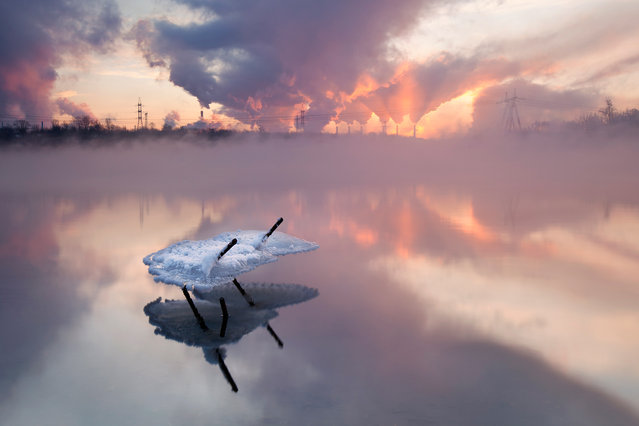
“Winter shapes, Moscow river”. Moscow river at this part is never covered by ice. When the temperature is very low it's possible to see a strong fog. Morning light and pipes of the oli factory creates a fantastic landscape. Photo location: Moscow, Russia. (Photo and caption by Sergey Rumyantsev/National Geographic Photo Contest)

“Winter shapes, Moscow river”. Moscow river at this part is never covered by ice. When the temperature is very low it's possible to see a strong fog. Morning light and pipes of the oli factory creates a fantastic landscape. Photo location: Moscow, Russia. (Photo and caption by Sergey Rumyantsev/National Geographic Photo Contest)
Details
11 Dec 2013 08:33:00
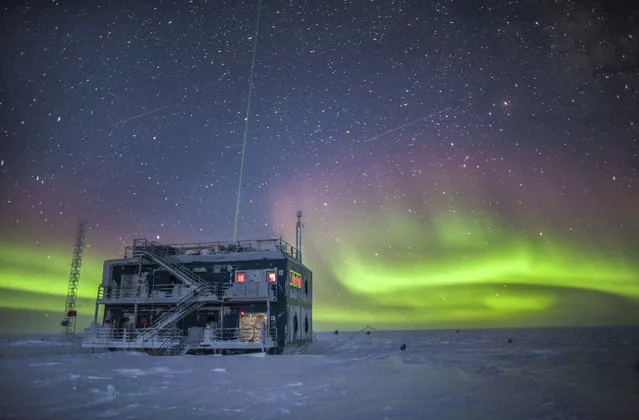
This undated photo provided by NOAA in May 2018 shows aurora australis near the South Pole Atmospheric Research Observatory in Antarctica. When a hole in the ozone formed over Antarctica, countries around the world in 1987 agreed to phase out several types of ozone-depleting chemicals called chlorofluorocarbons (CFCs). Production was banned, emissions fell and the hole shriveled. But according to a study released on Wednesday, May 16, 2018, scientists say since 2013, there’s more of a banned CFC going into the atmosphere. (Photo by Patrick Cullis/NOAA via AP Photo)

This undated photo provided by NOAA in May 2018 shows aurora australis near the South Pole Atmospheric Research Observatory in Antarctica. When a hole in the ozone formed over Antarctica, countries around the world in 1987 agreed to phase out several types of ozone-depleting chemicals called chlorofluorocarbons (CFCs). Production was banned, emissions fell and the hole shriveled. But according to a study released on Wednesday, May 16, 2018, scientists say since 2013, there’s more of a banned CFC going into the atmosphere. (Photo by Patrick Cullis/NOAA via AP Photo)
Details
15 Aug 2018 00:05:00
A large storm cloud covers the Sydney CBD on March 5, 2014 in Sydney, Australia. A severe thunderstorm warning was issued for the Sydney metropolitan area late this afternoon with heavy rainfall due to cause flash flooding in areas. (Photo by Cassie Trotter/Getty Images)

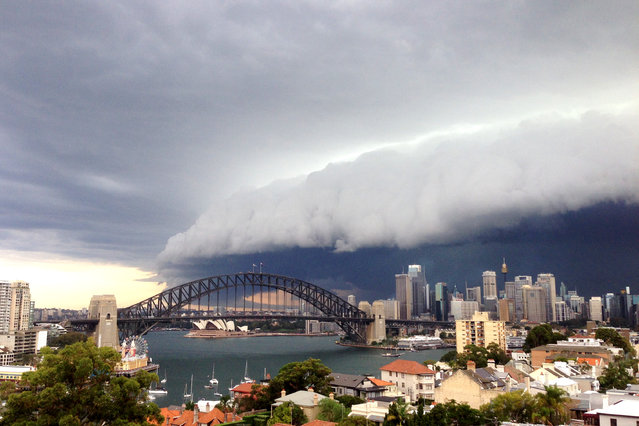
A large storm cloud covers the Sydney CBD on March 5, 2014 in Sydney, Australia. A severe thunderstorm warning was issued for the Sydney metropolitan area late this afternoon with heavy rainfall due to cause flash flooding in areas. (Photo by Cassie Trotter/Getty Images)
Details
06 Mar 2014 13:40:00
“Mr Big Dipper”, Nicholas Roemmelt (Denmark). A stargazer observes the constellation of the Big Dipper perfectly aligned with the window of the entrance to a large glacier cave in Engadin, Switzerland. This is a panorama of two pictures, and each is a stack of another two pictures: one for the stars and another one for the foreground, but with no composing or time blending. (Photo by Nicholas Roemmelt/National Maritime Museum/The Guardian)

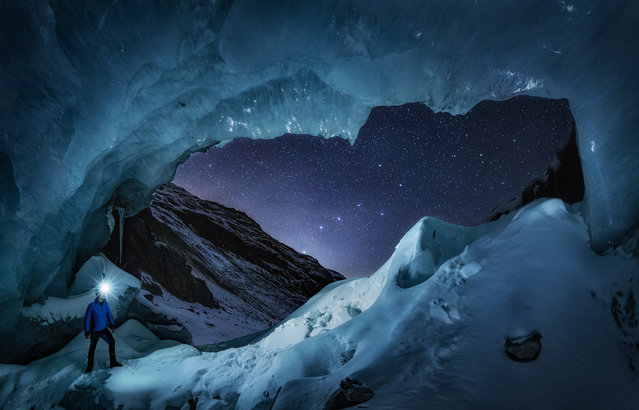
“Mr Big Dipper”, Nicholas Roemmelt (Denmark). A stargazer observes the constellation of the Big Dipper perfectly aligned with the window of the entrance to a large glacier cave in Engadin, Switzerland. This is a panorama of two pictures, and each is a stack of another two pictures: one for the stars and another one for the foreground, but with no composing or time blending. (Photo by Nicholas Roemmelt/National Maritime Museum/The Guardian)
Details
27 Jul 2017 06:50:00