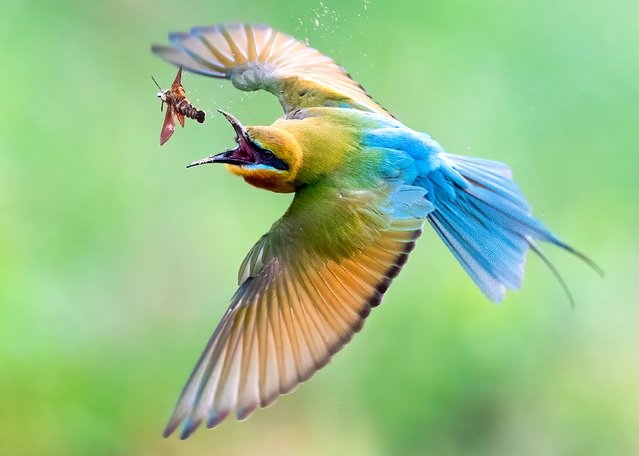
A blue-tailed bee-eater chases down its prey along the banks of the Kaveri River on the outskirts of the city of Mysore, India in the last decade of June 2025. (Photo by Nitin Jain/Solent News)
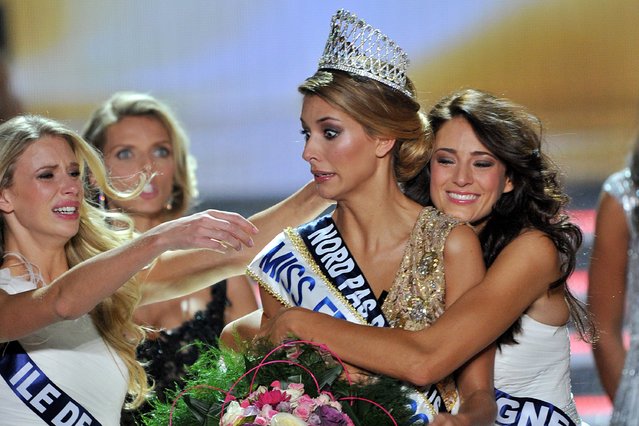
Miss Nord-Pas-de-Calais Camille Cerf (C) is congratulated by Miss Ile de France 2014 Margaux Savary (L) and Miss Auvergne 2014 Morgane Laporte after Cerf won the Miss France 2015 beauty contest on December 6, 2014 in Orleans. (Photo by Guillaume Souvant/AFP Photo)
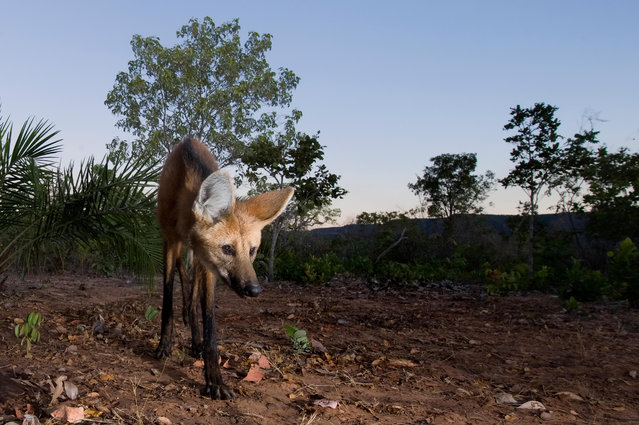
Global wildlife populations will decline by 67% by 2020 unless urgent action is taken to reduce human impact on species and ecosystems, warns the biennial Living Planet Index report from WWF (World Wide Fund for Nature) and ZSL (Zoological Society of London). From elephants to eels, here are some of the wildlife populations most affected by human activity. Here: The maned wolf is among the large mammals in the Brazilian Cerrado that are threatened by the increasing conversion of grasslands into farmland for grazing and growing crops. (Photo by Ben Cranke/Nature Picture Library/Alamy Stock Photo)
A staff member (R) looks on next to a cake, which was baked in the shape of a muscular man, for customers to try for free during a promotional event of a cake store in Shenyang, Liaoning province, China, December 6, 2015. (Photo by Reuters/Stringer)
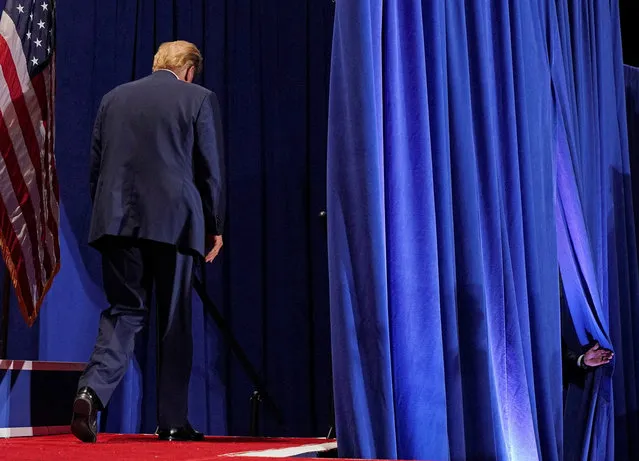
Republican presidential candidate and former U.S. President Donald Trump leaves the stage during a campaign rally in Richmond, Virginia on March 3, 2024. (Photo by Jay Paul/Reuters)
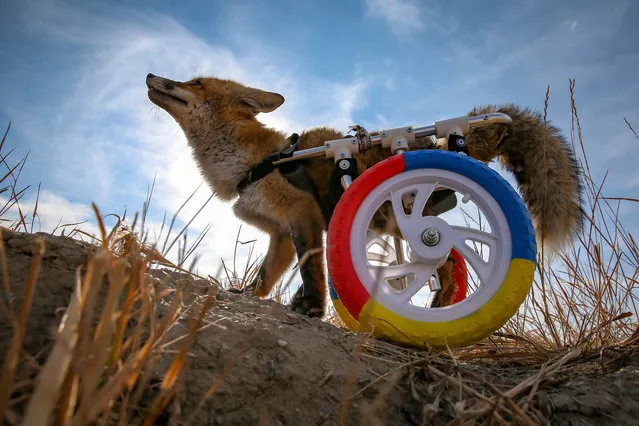
A physically disabled fox walks with its walking wheels wheelchair, developed by an animal lover by Van Yuzuncu Yil University Wildlife Conservation and Rehabilitation Center, after the fox found wounded in the urban countryside in Van, Turkey on December 05, 2020. The fox also received a physical treatment at the center. (Photo by Ozkan Bilgin/Anadolu Agency via Getty Images)