Loading...
Done
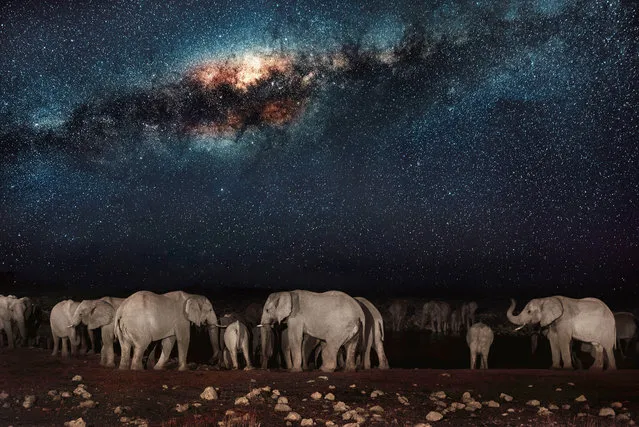
This watering hole is the social hub of the veldt; the scrubby grasslands that stretch across Namibia. The scorched earth supports sometimes fragile populations of magnificent wildlife – from endangered predators to plentiful herds of game. But these gentle giraffes and elephants need to be careful: lions don’t sleep at night, they hunt! The spectacular starscape above southern Africa is unchanged since explorers first mapped the continent. The photographer, Pietro Olivetta from Italy, said he had to be patient to capture these shots – but it was worth the wait. (Photo by Pietro Olivetta/Caters News)

This watering hole is the social hub of the veldt; the scrubby grasslands that stretch across Namibia. The scorched earth supports sometimes fragile populations of magnificent wildlife – from endangered predators to plentiful herds of game. But these gentle giraffes and elephants need to be careful: lions don’t sleep at night, they hunt! The spectacular starscape above southern Africa is unchanged since explorers first mapped the continent. The photographer, Pietro Olivetta from Italy, said he had to be patient to capture these shots – but it was worth the wait. (Photo by Pietro Olivetta/Caters News)
Details
20 Feb 2017 00:05:00
In this February 14, 2019 photo, a newlywed couple kisses while posing for photos at one of several free sets placed for newlyweds to take cell phone photos of themselves following a mass wedding ceremony on Valentine's Day in Mexico City. Hundreds of couples of all ages, many with their children, gathered to legally tie the knot in a mass ceremony in the capital's Venustiano Carranza neighborhood. (Photo by Rebecca Blackwell/AP Photo)

In this February 14, 2019 photo, a newlywed couple kisses while posing for photos at one of several free sets placed for newlyweds to take cell phone photos of themselves following a mass wedding ceremony on Valentine's Day in Mexico City. Hundreds of couples of all ages, many with their children, gathered to legally tie the knot in a mass ceremony in the capital's Venustiano Carranza neighborhood. (Photo by Rebecca Blackwell/AP Photo)
Details
16 Feb 2019 00:01:00
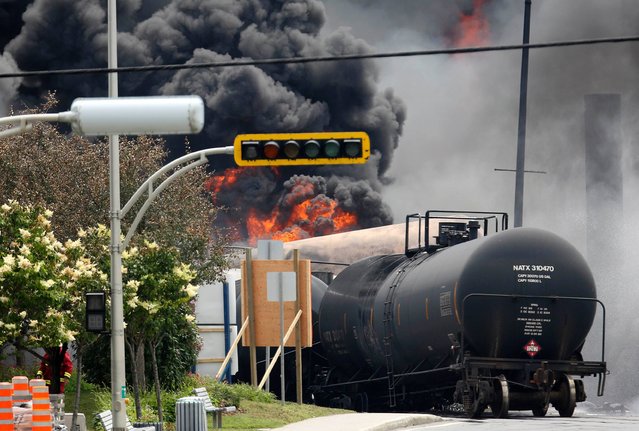
A burning train wagon is seen after an explosion at Lac Megantic, Quebec, July 6, 2013. (Photo by Mathieu Belanger/Reuters)

A burning train wagon is seen after an explosion at Lac Megantic, Quebec, July 6, 2013. A large swath of Lac Megantic was destroyed Saturday after a train carrying crude oil derailed, sparking several explosions and forcing the evacuation of up to 1,000 people. (Photo by Mathieu Belanger/Reuters)
Details
09 Jul 2013 07:16:00


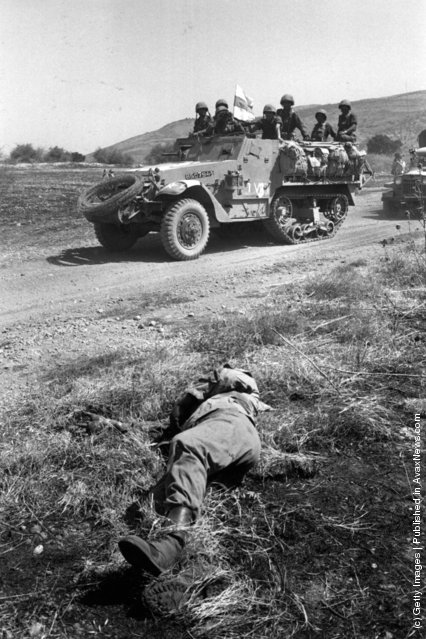
“The Six-Day War or June War, also known as the 1967 Arab-Israeli War or the Third Arab-Israeli War, was fought between June 5 and June 10, 1967, by Israel and the neighboring states of Egypt (known then as the United Arab Republic [UAR]), Jordan, and Syria. The war began with a large-scale surprise air strike by Israel on Egypt. The outcome was a swift and decisive Israeli victory. Israel took effective control of the Gaza Strip and the Sinai Peninsula from Egypt, the West Bank and East Jerusalem from Jordan, and the Golan Heights from Syria. Opinions are divided on whether Israel's attack was an act of aggression or a preemptive strike of a defensive nature”. – Wikipedia

Photo: The corpse of a soldier lying on the line of the Israeli advance into Syria during the Six-Day War. (Photo by Terry Fincher/Getty Images). 1967
Details
21 May 2011 08:29:00
Argentinian twin dancers Nicolas Filipeli and German Filipeli perform during the Tango Stage final competition at the Tango Dance World Championship in Buenos Aires on August 21, 2019. (Photo by Ronaldo Schemidt/AFP Photo)

Argentinian twin dancers Nicolas Filipeli and German Filipeli perform during the Tango Stage final competition at the Tango Dance World Championship in Buenos Aires on August 21, 2019. (Photo by Ronaldo Schemidt/AFP Photo)
Details
25 Aug 2019 00:07:00
Farmer Ash Whitney stands in the middle of a dried-up dam in a drought-effected paddock on his property located west of the town of Gunnedah in New South Wales, Australia, June 3, 2018. “I have been here all my life, and this drought is feeling like it will be around a while”, said Whitney. (Photo by David Gray/Reuters)

Farmer Ash Whitney stands in the middle of a dried-up dam in a drought-effected paddock on his property located west of the town of Gunnedah in New South Wales, Australia, June 3, 2018. “I have been here all my life, and this drought is feeling like it will be around a while”, said Whitney. (Photo by David Gray/Reuters)
Details
07 Aug 2018 00:05:00
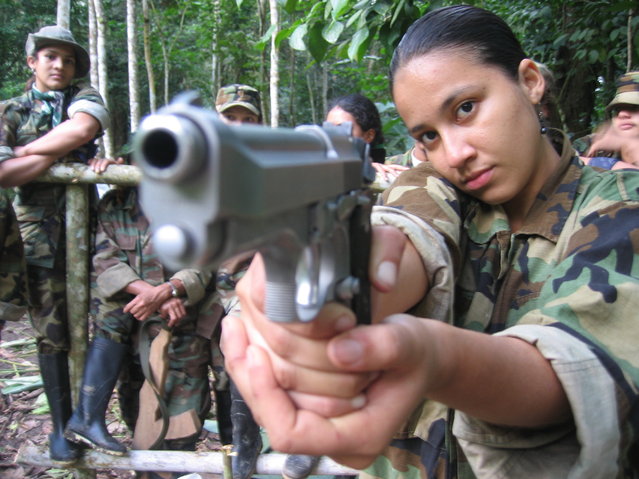
A member of the Revolutionary Armed Forces of Colombia (FARC) pose for a picture at a camp in the Colombian mountains on February 2005. (Photo by Frank Piasecki Poulsen)

A member of the Revolutionary Armed Forces of Colombia (FARC) pose for a picture at a camp in the Colombian mountains on February 2005. (Photo by Frank Piasecki Poulsen)
Details
29 Sep 2016 08:51:00
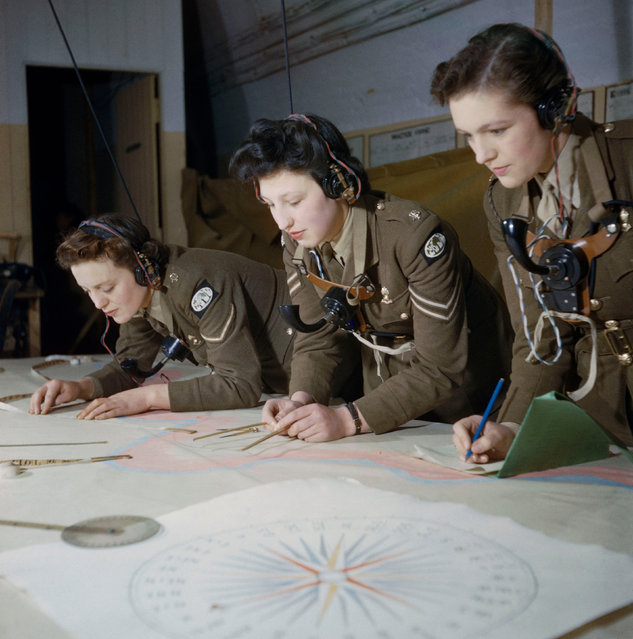
Auxiliary Territorial Service (ATS) plotters at work at Coastal Artillery Headquarters in Dover, December 1942. (Photo by Ted Dearberg/IWM/PA Wire)

Auxiliary Territorial Service (ATS) plotters at work at Coastal Artillery Headquarters in Dover, December 1942. The Auxiliary Territorial Service was the women's branch of the British Army during the Second World War. It was formed on 9 September 1938, initially as a women's voluntary service, and existed until 1 February 1949, when it was merged into the Women's Royal Army Corps. The ATS had its roots in the Women's Auxiliary Army Corps (WAAC), which was formed in 1917 as a voluntary service. During the First World War its members served in a number of jobs including clerks, cooks, telephonists and waitresses. The WAAC was disbanded after four years in 1921. (Photo by Ted Dearberg/IWM/PA Wire)
Details
13 Jul 2017 07:52:00