Loading...
Done
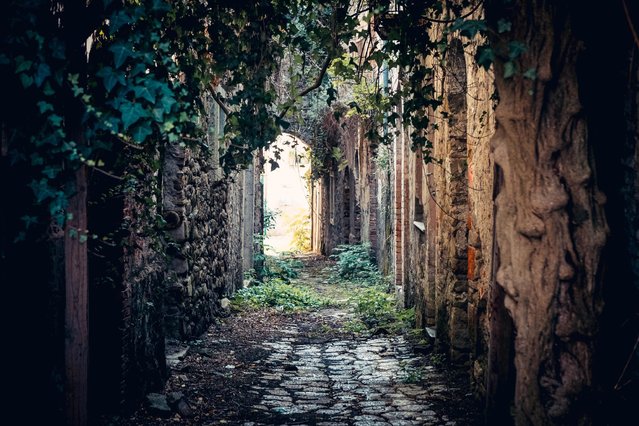
A deserted alley in the ghost town of Apice, in the province of Benevento, southern Italy, 22 November 2016. (Photo by Cesare Abbate/EPA)

A deserted alley in the ghost town of Apice, in the province of Benevento, southern Italy, 22 November 2016. After the Irpinia earthquake that took place in southern Italy on 23 November 1980, leaving at least 2,500 people dead, 8,000 injured and 250,000 homeless, the town in the heart of the Sannio area was evacuated and its residents moved into what has become the new Apice. Only recently the narrow streets and the tragically abandoned buildings have started, slowly, to repopulate. (Photo by Cesare Abbate/EPA)
Details
23 Nov 2016 11:30:00
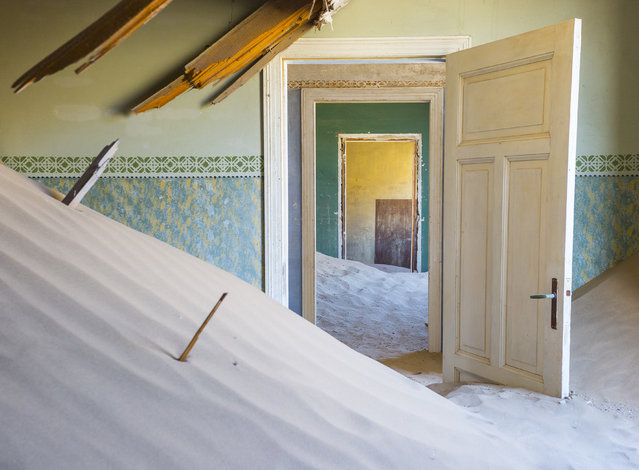
Kolmankop, an abandoned mining town in Namibia. (Photo by David Ogden/Caters News)

These sand-swept images show the ghostly remains of what was once a mineral-rich mining community. In its heyday, the town of Kolmanskop, Namibia, was home to about 700 families. Now all that remains are empty homes filled with sand, while cast-off items such as bathtubs are scattered about the surrounding area. Over time, the sand of the stunning dunes that encircle the town of Kolmanskop has been blown towards the abandoned residences, coating everything from streets to the interiors of houses and workshops. Here: Kolmankop, an abandoned mining town in Namibia. (Photo by David Ogden/Caters News)
Details
13 Mar 2016 09:31:00
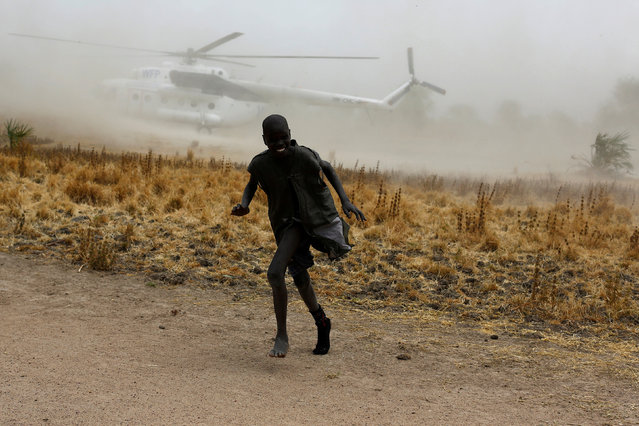
A boy moves away as a United Nations World Food Programme (WFP) helicopter lands in Rubkuai village, Unity State, northern South Sudan, February 18, 2017. (Photo by Siegfried Modola/Reuters)

A boy moves away as a United Nations World Food Programme (WFP) helicopter lands in Rubkuai village, Unity State, northern South Sudan, February 18, 2017. South Sudan on Monday declared famine in some parts of the country, with more than three years of war leaving nearly five million hungry in what aid groups called a “man-made” tragedy. (Photo by Siegfried Modola/Reuters)
Details
22 Feb 2017 00:03:00
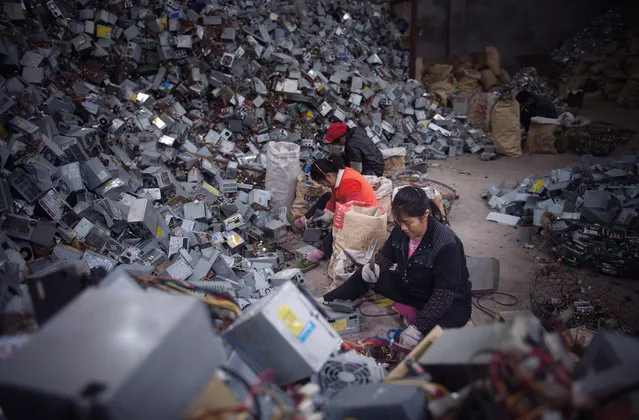
“The sustainable development goals cannot be met unless waste management is addressed as a priority”, says UK waste management charity Waste Aid. “E-waste is one of the fastest growing categories of the 7-10bn tonnes of waste produced globally every year”, adds director Mike Webster. “In our view, decent waste management is a basic right and we want governments around the world take this issue much more seriously – in 2012 only 0.2% of international aid went on improving solid waste management – it’s just not enough”. (Photo by Kai Loeffelbein/laif Agentur)

Sustainable development goal target 12.5 is to reduce waste. But with a planet increasingly dependent on technology, is that even possible? As of today, over 30m tonnes of electronic waste has been thrown out so far this year, according to the World Counts. Most e-waste is sent to landfills in Asia and Africa where it is recycled by hand, exposing the people who do it to environmental hazards. Kai Loeffelbein’s photographs of e-waste recycling in Guiyu, southern China show what happens to discarded computers. (Photo by Kai Loeffelbein/laif Agentur)
Details
19 Oct 2016 12:14:00
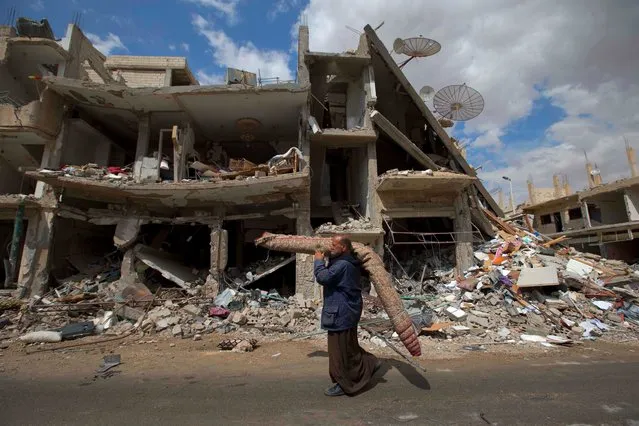
In this picture taken Thursday, April 14, 2016, a Syrian man carries a carpet as walk through a devastated part of the town of Palmyra as families load their belongings onto a bus in the central Homs province, Syria. (Photo by Hassan Ammar/AP Photo)

In this picture taken Thursday, April 14, 2016, a Syrian man carries a carpet as walk through a devastated part of the town of Palmyra as families load their belongings onto a bus in the central Homs province, Syria. Thousands of residents of this ancient town who fled Islamic State rule are returning briefly to check on their homes and salvage what they can – some carpets, blankets, a fridge or a few family mementos. There is no water or electricity in the town, and it will be at least few months before anyone can return to stay. (Photo by Hassan Ammar/AP Photo)
Details
16 Apr 2016 12:27:00
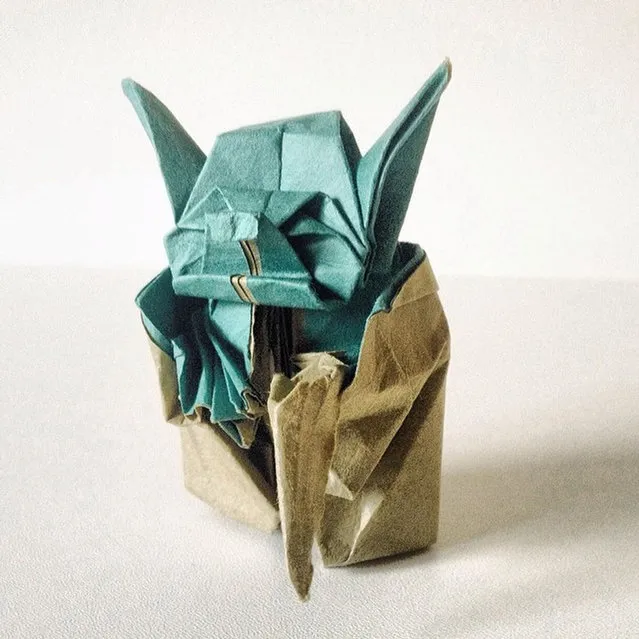
Origami By Ross Symons

As kids we have the natural desire to explore and to create. Whenever our parents would make for us a paper plane, we would become overjoyed seeing it fly across the room. However, planes are not the only thing that can be made from paper, and not only kids are fascinated by it. Some people master the art of origami and are able to create pretty much anything. You never know what’s going to come out when the artist twists and turns a piece of paper in meticulous ways. Finally, the figurine is complete, and you immediately see the striking resemblance of this piece of paper with an animal or some other creature. Ross Symons is one of those artists. He creates his figurines simply for the joy it brings him. Maybe, he uses this as a medium to enter his childhood, or maybe he has other motifs – we will never know. (Photo by Ross Symons)
Details
31 Oct 2014 12:12:00
GIF Art By James Kerr

James Kerr started his project “Scorpion Dagger” without any real direction, except for the intention to make one GIF everyday(ish) for one year. He had been making collages for some time and “Scorpion Dagger” started out to be a test of discipline and a way for him to learn how to animate. Making GIFs was a logical evolution to him. The project represents many different things to him, the works from which he draws upon are so powerful and inspirational to him, that he is now nearly obsessed with repurposing them to share his vision of the world, and perhaps inspire people to look at art differently. The project is tremendously personal to him, it’s a lot more than the humor that’s at its surface and he is still trying to work out what “Scorpion Dagger” really is.
Details
23 Dec 2013 10:39:00
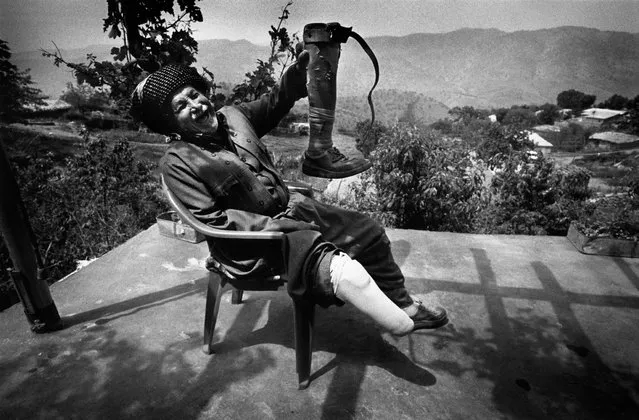
Ismail Mustafa, seen in 2007. “I was collecting mushrooms on the hill near here. I didn’t see the mine. There was a huge explosion. When I woke up I saw that both my legs were gone; I thought my life was over. My brother and another guy were with me. They made a stretcher from sticks and tied it together with clothing. It took two hours to get off the mountain. ‘My daughter has also been injured. She found a shell and brought it into the house and put it on the fire. She didn’t know what she was doing at the time – she was only three. She is blind and has lost an arm”. (Photo by Sean Sutton for the Mines Advisory Group/The Guardian)

Ismail Mustafa, seen in 2007. “I was collecting mushrooms on the hill near here. I didn’t see the mine. There was a huge explosion. When I woke up I saw that both my legs were gone; I thought my life was over. My brother and another guy were with me. They made a stretcher from sticks and tied it together with clothing. It took two hours to get off the mountain. ‘My daughter has also been injured. She found a shell and brought it into the house and put it on the fire. She didn’t know what she was doing at the time – she was only three. She is blind and has lost an arm”. (Photo by Sean Sutton for the Mines Advisory Group/The Guardian)
Details
08 Sep 2017 09:33:00