Loading...
Done
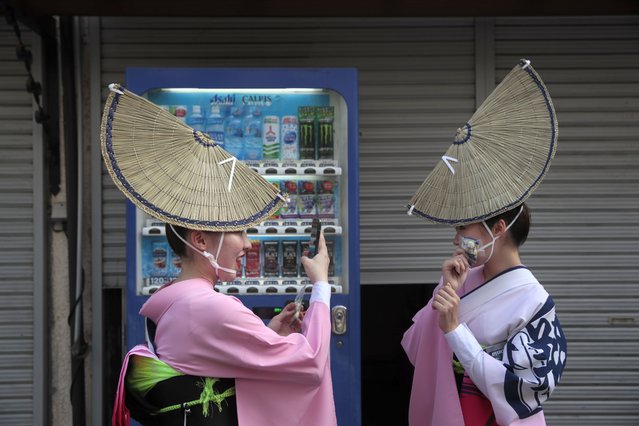
Two young dancers take pictures while waiting for the start of the Koenji Awa-Odori dance festival, in the Koenji neighborhood of Tokyo. Saturday, August 24, 2019, Started in the 1950s, the Koenji Awa-Odori has grown to be one of Tokyo's largest and most popular summer festivals an estimated 10,000 dancers participating in the dance festival. Hundreds of thousands of spectators gather in the neighborhood to watch the two-day summer spectacle. The event is held on the last weekend of August each year. (Photo by Jae C. Hong/AP Photo)

Two young dancers take pictures while waiting for the start of the Koenji Awa-Odori dance festival, in the Koenji neighborhood of Tokyo. Saturday, August 24, 2019, Started in the 1950s, the Koenji Awa-Odori has grown to be one of Tokyo's largest and most popular summer festivals an estimated 10,000 dancers participating in the dance festival. Hundreds of thousands of spectators gather in the neighborhood to watch the two-day summer spectacle. The event is held on the last weekend of August each year. (Photo by Jae C. Hong/AP Photo)
Details
20 Sep 2019 00:03:00
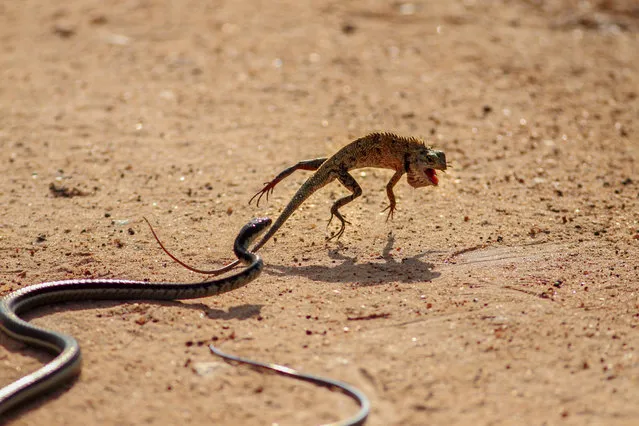
Yala national park, Sri Lanka. Category: Action. “The daylight was fading and I was scanning the bush for a leopard. Then, I saw this garden lizard and a common bronzeback snake in the road. When the snake struck, the lizard performed amazing acrobatics to avoid it. The snake didn’t enjoy the extra attention from the crowd of jeeps. The distraction gave the lizard the chance to live another day”. (Photo by Sajith Buddikha Withanage/National Geographic Traveller UK)

Yala national park, Sri Lanka. Category: Action. “The daylight was fading and I was scanning the bush for a leopard. Then, I saw this garden lizard and a common bronzeback snake in the road. When the snake struck, the lizard performed amazing acrobatics to avoid it. The snake didn’t enjoy the extra attention from the crowd of jeeps. The distraction gave the lizard the chance to live another day”. (Photo by Sajith Buddikha Withanage/National Geographic Traveller UK)
Details
25 Jan 2017 11:26:00
Sugar gliders, Candy and Popcorn, enjoy their favourite food, Nectar, at Wild Life Sydney Zoo on February 14, 2017 in Sydney, Australia. The treat made up of honey, high protein baby cereal and egg yolks is the human equivalent to chocolate to the Sugar Gliders. St. Valentine's Day or the Feast of Saint Valentine began as a celebration of the early Christian Saint Valentinus. From the 18th Century onwards it has steadily transformed into a celebration of romantic love and sentiment in many countries around the world. (Photo by James D. Morgan/Getty Images)

Sugar gliders, Candy and Popcorn, enjoy their favourite food, Nectar, at Wild Life Sydney Zoo on February 14, 2017 in Sydney, Australia. The treat made up of honey, high protein baby cereal and egg yolks is the human equivalent to chocolate to the Sugar Gliders. St. Valentine's Day or the Feast of Saint Valentine began as a celebration of the early Christian Saint Valentinus. From the 18th Century onwards it has steadily transformed into a celebration of romantic love and sentiment in many countries around the world. (Photo by James D. Morgan/Getty Images)
Details
19 Feb 2017 00:00:00
In this photo taken on Saturday, April 22, 2017, a drawing “King for a day” is made on the back of a muddy truck by artist Nikita Golubev in Moscow, Russia. The grimy trucks traversing the polluted and dusty streets of Moscow have inspired Golubev to use white vans and trucks as his canvas to create this ephemeral street art and signs his drawings Pro Boy Nick. (Photo by Pavel Golovkin/AP Photo)

In this photo taken on Saturday, April 22, 2017, a drawing “King for a day” is made on the back of a muddy truck by artist Nikita Golubev in Moscow, Russia. The grimy trucks traversing the polluted and dusty streets of Moscow have inspired Golubev to use white vans and trucks as his canvas to create this ephemeral street art and signs his drawings Pro Boy Nick. (Photo by Pavel Golovkin/AP Photo)
Details
30 Apr 2017 07:02:00
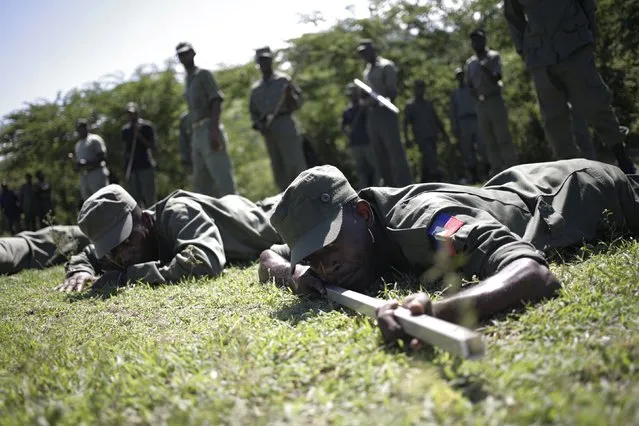
A man holds a metal bar as a weapon during a training day for former soldiers and volunteers train in a makeshift camp in the outskirts of Port-au-Prince, Haiti, October 28, 2015. Haiti disbanded its abusive armed forces two decades ago but uniformed veterans and young recruits are resurfacing to add another destabilising factor to the volatile Caribbean nation already dealing with a political vacuum. (Photo by Andres Martinez Casares/Reuters)

A man holds a metal bar as a weapon during a training day for former soldiers and volunteers train in a makeshift camp in the outskirts of Port-au-Prince, Haiti, October 28, 2015. Haiti disbanded its abusive armed forces two decades ago but uniformed veterans and young recruits are resurfacing to add another destabilising factor to the volatile Caribbean nation already dealing with a political vacuum. (Photo by Andres Martinez Casares/Reuters)
Details
15 Feb 2016 10:05:00
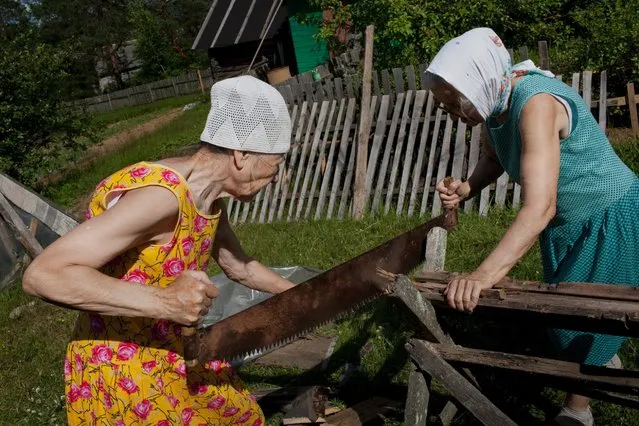
“Two-Handed Saw, 2014”. “Most of the neighbors have switched to power tools to run their households, the buzz of chain saws and weed-whackers overpowering the quieter sounds of country life, but my aunts hold on to the two-handed saw that's decades old, the sickle and scythe that need to be sharpened and polished after each use, the old axe that's becoming heavier each year. Each of these objects is familiar, holding memories of their brother, who succumbed to cancer a few years ago, of days before my grandfather lost his vision in the 50's, of busier days and longer futures”, Sablin told. (Photo by Nadia Sablin)

In northwest Russia, in a small village called Alekhovshchina, Nadia Sablin's aunts spend the warmer months together in the family home and live as the family has always lived, chopping wood to heat the house and making their own clothes. Sablin's book of photographs, “Aunties: The Seven Summers of Alevtina and Ludmila”, is published by Duke University Press. Here: “Two-Handed Saw, 2014”. (Photo by Nadia Sablin)
Details
25 Feb 2016 12:12:00
A schoolgirl is soaked with water thrown by an elephant in a preview of the upcoming Songkran Festival celebration, the Thai traditional New Year, also known as the water festival in the ancient world heritage city of Ayutthaya, Thailand, 11 April 2016. The annual elephant Songkran is held to promote the tourism industry prior the three-day Songkran Festival which starts on 13-15 April annually and is celebrated with splashing water and putting powder on each others faces as a symbolic sign of cleansing and washing away the sins from the old year. (Photo by Diego Azubel/EPA)

A schoolgirl is soaked with water thrown by an elephant in a preview of the upcoming Songkran Festival celebration, the Thai traditional New Year, also known as the water festival in the ancient world heritage city of Ayutthaya, Thailand, 11 April 2016. The annual elephant Songkran is held to promote the tourism industry prior the three-day Songkran Festival which starts on 13-15 April annually and is celebrated with splashing water and putting powder on each others faces as a symbolic sign of cleansing and washing away the sins from the old year. (Photo by Diego Azubel/EPA)
Details
12 Apr 2016 11:32:00
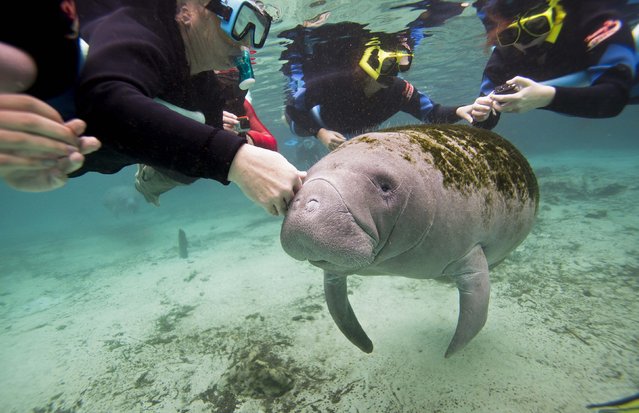
Snorkelers interact with a Florida Manatee inside of the Three Sisters Springs in Crystal River, Florida January 15, 2015. On winter days, Florida manatees flock by the hundreds to the balmy waters of Three Sisters Springs, drawing crowds of snorkelers and kayakers to the U.S. sanctuary, where people may swim with the endangered species. (Photo by Scott Audette/Reuters)

Snorkelers interact with a Florida Manatee inside of the Three Sisters Springs in Crystal River, Florida January 15, 2015. On winter days, Florida manatees flock by the hundreds to the balmy waters of Three Sisters Springs, drawing crowds of snorkelers and kayakers to the U.S. sanctuary, where people may swim with the endangered species. But as tolerant as the gentle, whiskered sea giants can be of the accidental kicks and splashes of delighted tourists, wild life regulators want to ban most canoes and paddle boards and create people-free zones to protect the wintering “sea cow”. Proposed limitations for this winter are awaiting approval by the U.S. Fish and Wildlife Service. (Photo by Scott Audette/Reuters)
Details
22 Jan 2015 13:34:00