Loading...
Done
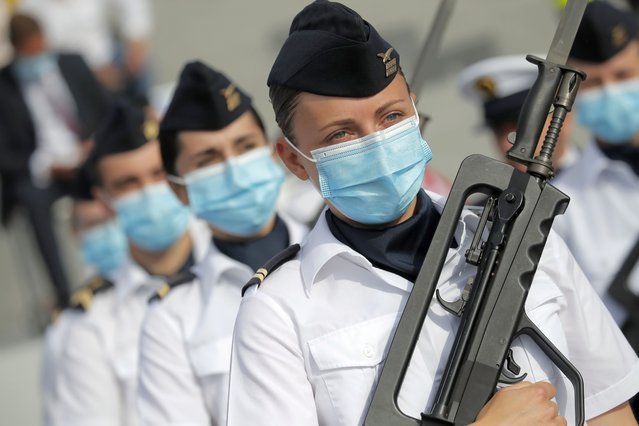
Soldier wear face masks prior to the Bastille Day parade Tuesday, July 14, 2020 on the Champs Elysees avenue in Paris. France are honoring nurses, ambulance drivers, supermarket cashiers and others on its biggest national holiday Tuesday. Bastille Day's usual grandiose military parade in Paris is being redesigned this year to celebrate heroes of the coronavirus pandemic. (Photo by Christophe Ena/AP Photo/Pool)

Soldier wear face masks prior to the Bastille Day parade Tuesday, July 14, 2020 on the Champs Elysees avenue in Paris. France are honoring nurses, ambulance drivers, supermarket cashiers and others on its biggest national holiday Tuesday. Bastille Day's usual grandiose military parade in Paris is being redesigned this year to celebrate heroes of the coronavirus pandemic. (Photo by Christophe Ena/AP Photo/Pool)
Details
16 Jul 2020 00:07:00
A man carries away an injured girl while walking through debris past in the Achrafiyeh district in the centre of Lebanon's capital Beirut on August 4, 2020, following an explosion at the nearby port of Beirut. (Photo by The Mega Agency/Stringer)

A man carries away an injured girl while walking through debris past in the Achrafiyeh district in the centre of Lebanon's capital Beirut on August 4, 2020, following an explosion at the nearby port of Beirut. (Photo by The Mega Agency/Stringer)
Details
06 Aug 2020 00:03:00
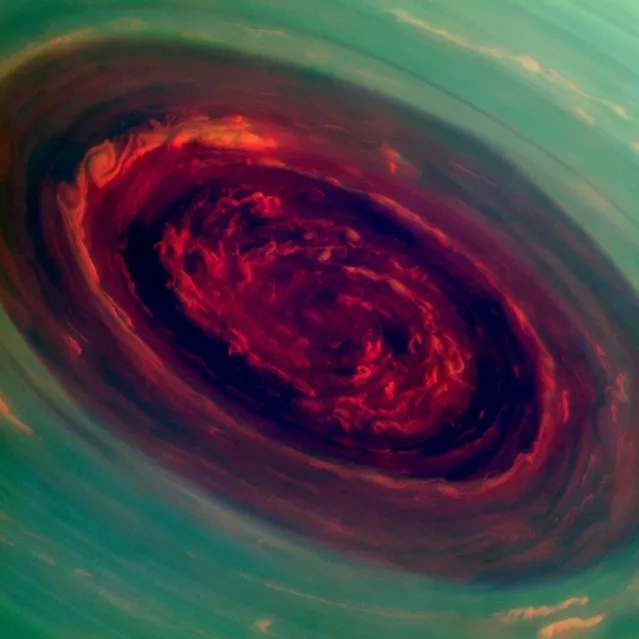
The spinning vortex of Saturn's north polar storm resembles a deep red rose of giant proportions surrounded by green foliage in this false-color image from NASA's Cassini spacecraft. (Photo by NASA/JPL-Caltech/SSI)

NASA's Cassini spacecraft has provided scientists the first close-up, visible-light views of a behemoth hurricane swirling around Saturn's north pole. In high-resolution pictures and video, scientists see the hurricane's eye is about 1,250 miles (2,000 kilometers) wide, 20 times larger than the average hurricane eye on Earth. Thin, bright clouds at the outer edge of the hurricane are traveling 330 mph(150 meters per second). The hurricane swirls inside a large, mysterious, six-sided weather pattern known as the hexagon. Photo: The spinning vortex of Saturn's north polar storm resembles a deep red rose of giant proportions surrounded by green foliage in this false-color image from NASA's Cassini spacecraft. (Photo by NASA/JPL-Caltech/SSI)
Details
31 May 2015 09:11:00
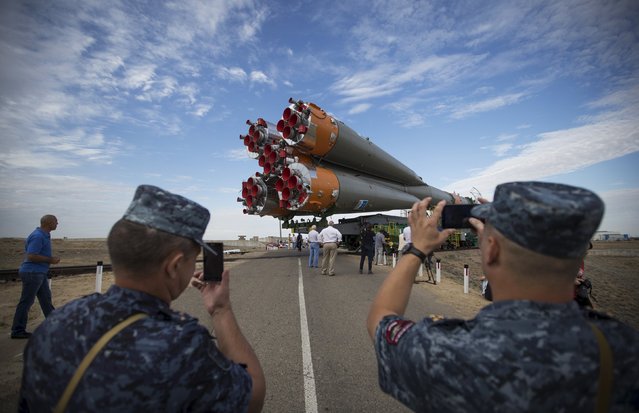
Policemen take pictures of the Soyuz TMA-17M spacecraft while it is transported from an assembling hangar to its launch pad at the Baikonur cosmodrome, Kazakhstan, July 20, 2015. (Photo by Shamil Zhumatov/Reuters)

Policemen take pictures of the Soyuz TMA-17M spacecraft while it is transported from an assembling hangar to its launch pad at the Baikonur cosmodrome, Kazakhstan, July 20, 2015. The Soyuz is scheduled to blast off with Kjell Lindgren of the U.S., Kimiya Yui of Japan and Oleg Kononenko of Russia to the International Space Station on July 23, 2015. (Photo by Shamil Zhumatov/Reuters)
Details
21 Jul 2015 11:05:00
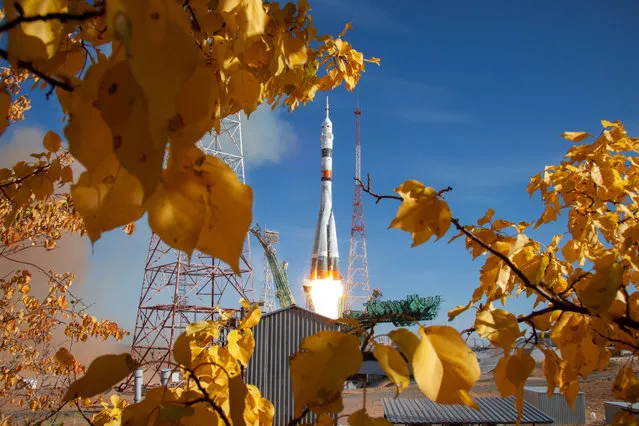
The Soyuz MS-17 spacecraft carrying the crew formed of Kathleen Rubins of NASA, Sergey Ryzhikov and Sergey Kud-Sverchkov of the Russian space agency Roscosmos blasts off to the International Space Station (ISS) from the launchpad at the Baikonur Cosmodrome, Kazakhstan on October 14, 2020. (Photo by Russian space agency Roscosmos/Handout via Reuters)

The Soyuz MS-17 spacecraft carrying the crew formed of Kathleen Rubins of NASA, Sergey Ryzhikov and Sergey Kud-Sverchkov of the Russian space agency Roscosmos blasts off to the International Space Station (ISS) from the launchpad at the Baikonur Cosmodrome, Kazakhstan on October 14, 2020. (Photo by Russian space agency Roscosmos/Handout via Reuters)
Details
12 Apr 2021 00:01:00
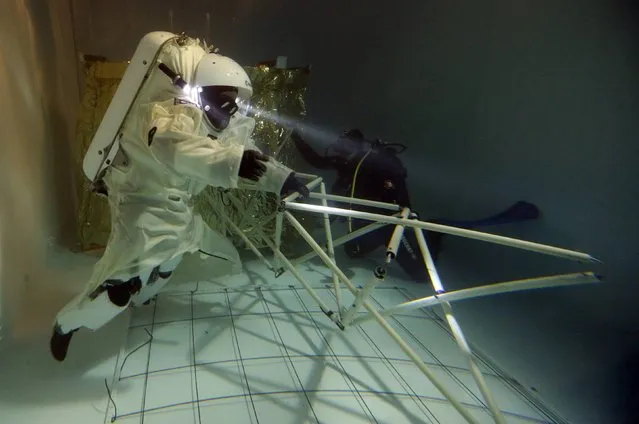
National Diving School director Jerome Vincent, wearing a Gandolfi space suit, executes training procedures in a swimming pool in Marseille October 22, 2014. (Photo by Jean-Paul Pelissier/Reuters)

National Diving School director Jerome Vincent, wearing a Gandolfi space suit, executes training procedures in a swimming pool in Marseille October 22, 2014. The underwater test session develops European expertise in spacewalk simulations under partial gravity for exploring the Moon, asteroids and Mars.The training is organised by Comex, a French company specializing in engineering and deep sea diving operations, in collaboration with the European Space Agency (ESA) and with Apollo XI “Under the sea”. (Photo by Jean-Paul Pelissier/Reuters)
Details
26 Oct 2014 12:47:00
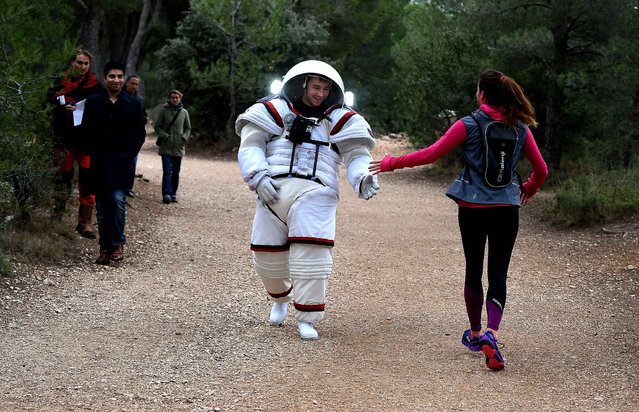
Aeronautics and Space engineer at France's Compagnie Maritime d'Expertises, or Comex, Arnaud Prost (C) meets with a jogger as he tests on the ground the “Gandolfi 2” underwater training suit for spacewalk, on January 20, 2016 in the calanques region (rocky inlets) of Marseille. The underwater training suit “Gandolfi 2”, developed with the European Space Agency (ESA), is designed for training astronauts underwater to simulate space gravity for the astronaut's extravehicular activities (EVAs). (Photo by Boris Horvat/AFP Photo)

Aeronautics and Space engineer at France's Compagnie Maritime d'Expertises, or Comex, Arnaud Prost (C) meets with a jogger as he tests on the ground the “Gandolfi 2” underwater training suit for spacewalk, on January 20, 2016 in the calanques region (rocky inlets) of Marseille. The underwater training suit “Gandolfi 2”, developed with the European Space Agency (ESA), is designed for training astronauts underwater to simulate space gravity for the astronaut's extravehicular activities (EVAs). (Photo by Boris Horvat/AFP Photo)
Details
23 Jan 2016 13:41:00
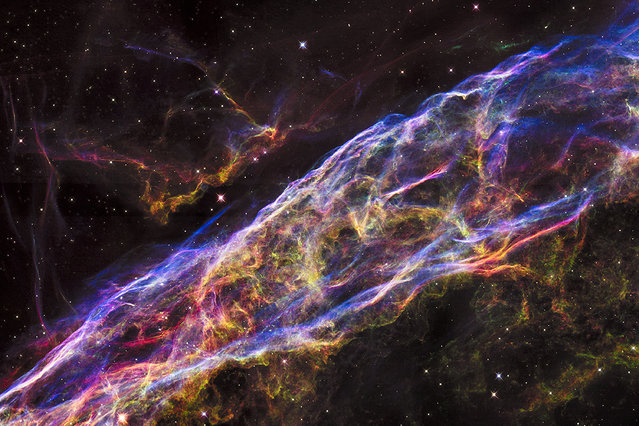
A small section of the expanding remains of the Veil Nebula, a massive star that exploded about 8,000 years ago. The entire nebula is 110 light-years across, covering six full moons on the sky as seen from Earth, and resides about 2,100 light-years away in the constellation Cygnus, the Swan. Image taken by NASA's Hubble Space Telescope. Released September 24, 2015. (Photo by Reuters/NASA/ESA/Hubble Heritage Team)

A small section of the expanding remains of the Veil Nebula, a massive star that exploded about 8,000 years ago. The entire nebula is 110 light-years across, covering six full moons on the sky as seen from Earth, and resides about 2,100 light-years away in the constellation Cygnus, the Swan. Image taken by NASA's Hubble Space Telescope. Released September 24, 2015. (Photo by Reuters/NASA/ESA/Hubble Heritage Team)
Details
10 Dec 2015 08:01:00