Loading...
Done
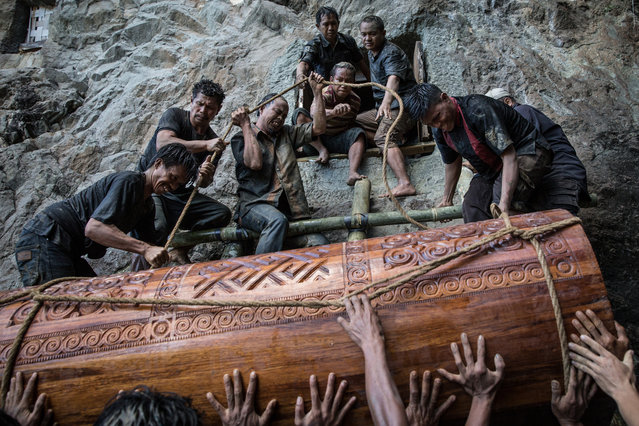
It is said that Torajans are people who “live to die”. For this Indonesian ethnic group, funerals are such extravagant events that they sometimes attract tourists. Families can postpone burials years (and the deceased are considered sick and hosted at home until the funeral) until the family can raise enough money and gather as many relatives as possible. And then it’s a jubilant multiday social event with a parade, dances and animal sacrifices. Agung Parameswara photographed these funerary practices when he traveled to South Sulawesi province, where the Torajans live. But often, their funeral isn’t the last time the dead are seen. In August, crypts are opened, coffins are slid back out and bodies delicately unsheathed. This tender ritual is known as Ma’Nene, which is customarily performed every few years. (Photo by Agung Parameswara/The Washington Post)

It is said that Torajans are people who “live to die”. For this Indonesian ethnic group, funerals are such extravagant events that they sometimes attract tourists. Families can postpone burials years (and the deceased are considered sick and hosted at home until the funeral) until the family can raise enough money and gather as many relatives as possible. And then it’s a jubilant multiday social event with a parade, dances and animal sacrifices. Agung Parameswara photographed these funerary practices when he traveled to South Sulawesi province, where the Torajans live. (Photo by Agung Parameswara/The Washington Post)
Details
06 Oct 2016 09:15:00
Members of the Guard of Honor of the Presidential Regiment from Russia perform during the “Spasskaya Tower” international military music festival at Moscow's Red Square, Russia, September 10, 2015. (Photo by Maxim Shemetov/Reuters)

Members of the Guard of Honor of the Presidential Regiment from Russia perform during the “Spasskaya Tower” international military music festival at Moscow's Red Square, Russia, September 10, 2015. The festival runs until 13 Sepember. (Photo by Maxim Shemetov/Reuters)
Details
11 Sep 2015 13:15:00
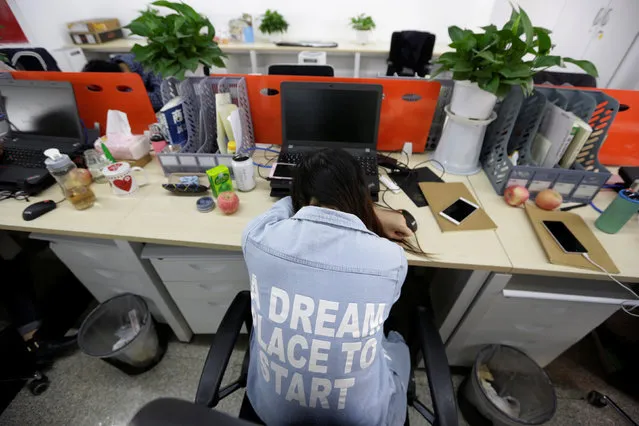
Yang Juan, an employee at Goopal Group, takes a nap in her seat after lunch, in Beijing, China, April 21, 2016. (Photo by Jason Lee/Reuters)

Yang Juan, an employee at Goopal Group, takes a nap in her seat after lunch, in Beijing, China, April 21, 2016. Office workers sleeping on the job is a common sight in China, where a surplus of cheap labour can lead to downtime at work. But in China's technology sector, where business is growing faster than many start-up firms can hire new staff, workers burn the midnight oil to meet deadlines and compete with their rivals. Some companies provide sleeping areas and beds for workers to rest during late nights. (Photo by Jason Lee/Reuters)
Details
12 May 2016 14:53:00
French firemen wearing chemical protective suits take part in a mock chemical attack exercise at the Geoffroy Guichard stadium in Saint-Etienne, France, April 4, 2016 in preparation of security measures for the UEFA 2016 European Championship. (Photo by Robert Pratta/Reuters)

French firemen wearing chemical protective suits take part in a mock chemical attack exercise at the Geoffroy Guichard stadium in Saint-Etienne, France, April 4, 2016 in preparation of security measures for the UEFA 2016 European Championship. (Photo by Robert Pratta/Reuters)
Details
07 Apr 2016 15:33:00
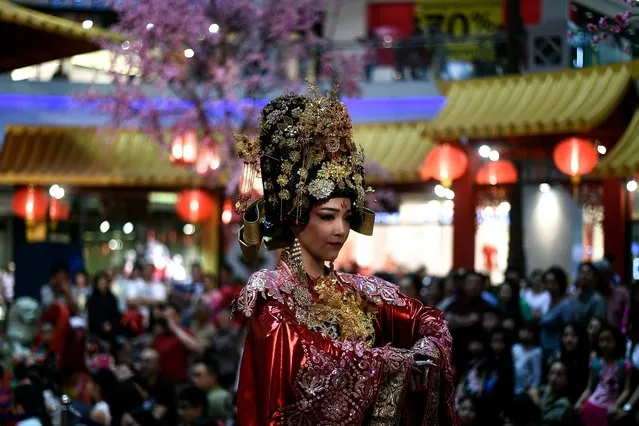
A performer dressed as Empress Huang of the China's Forbidden City takes part in a musical performance at a shopping mall in Kuala Lumpur on January 22, 2017 as part of the upcoming Lunar New Year celebrations marking the Year of the Rooster. (Photo by Manan Vatsyayana/AFP Photo)

A performer dressed as Empress Huang of the China's Forbidden City takes part in a musical performance at a shopping mall in Kuala Lumpur on January 22, 2017 as part of the upcoming Lunar New Year celebrations marking the Year of the Rooster. (Photo by Manan Vatsyayana/AFP Photo)
Details
23 Jan 2017 10:19:00
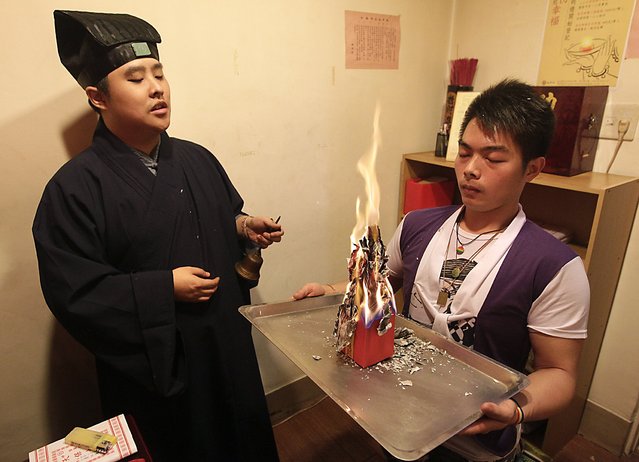
Lu Wei-ming (L), priest of the Wei-ming temple, and a worshipper burn a Taoist paper amulet during a prayer ritual at the temple in New Taipei city January 8, 2015. The shrine, down a narrow alleyway in a bustling district of the city, is dedicated to a deity who has watched over homosexuals for four centuries. (Photo by Pichi Chuang/Reuters)

Lu Wei-ming (L), priest of the Wei-ming temple, and a worshipper burn a Taoist paper amulet during a prayer ritual at the temple in New Taipei city January 8, 2015. The shrine, down a narrow alleyway in a bustling district of the city, is dedicated to a deity who has watched over homosexuals for four centuries. Priest Lu founded the temple in 2006, at a time gays were excluded from most religious ceremonies. (Photo by Pichi Chuang/Reuters)
Details
21 Jan 2015 13:06:00
The Museum of Feelings doesn't really have “exhibits" in the conventional sense; rather, visitors move from one themed alcove to another, five in total, each with its own distinctive aroma.  (Photo by Stephanie Keith/Reuters)

The Museum of Feelings doesn't really have “exhibits" in the conventional sense; rather, visitors move from one themed alcove to another, five in total, each with its own distinctive aroma. The “Optimistic Room," bathed in vivid pink and purple light, is little more than a lightshow, with patrons using small reflective panels to bounce light around the room. Here: People interact in the “optimistic” room at the Museum of Feelings, a pop-up installation in New York, December 15, 2015. (Photo by Stephanie Keith/Reuters)
Details
19 Dec 2015 08:00:00
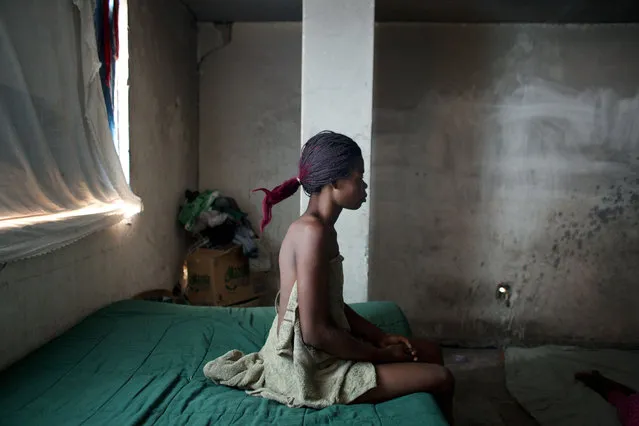
In this June 29, 2015 photo, hairdresser Loavia Bienaime, 30, sits on her bed as she prepares to begin her day in the room her family occupies in an government office building that was damaged in the 2010 earthquake in Port-au-Prince, Haiti. Bienaime's husband, Jimmy Bellefleur, used his skill as an electrician to connect the abandoned building to the power grid, and has repaired broken televisions, fans, and a blender for the family to use. (Photo by Rebecca Blackwell/AP Photo)

In this June 29, 2015 photo, hairdresser Loavia Bienaime, 30, sits on her bed as she prepares to begin her day in the room her family occupies in an government office building that was damaged in the 2010 earthquake in Port-au-Prince, Haiti. Bienaime's husband, Jimmy Bellefleur, used his skill as an electrician to connect the abandoned building to the power grid, and has repaired broken televisions, fans, and a blender for the family to use. (Photo by Rebecca Blackwell/AP Photo)
Details
05 Aug 2015 13:21:00