Loading...
Done
It is said that Torajans are people who “live to die”. For this Indonesian ethnic group, funerals are such extravagant events that they sometimes attract tourists. Families can postpone burials years (and the deceased are considered sick and hosted at home until the funeral) until the family can raise enough money and gather as many relatives as possible. And then it’s a jubilant multiday social event with a parade, dances and animal sacrifices. Agung Parameswara photographed these funerary practices when he traveled to South Sulawesi province, where the Torajans live. But often, their funeral isn’t the last time the dead are seen. In August, crypts are opened, coffins are slid back out and bodies delicately unsheathed. This tender ritual is known as Ma’Nene, which is customarily performed every few years. (Photo by Agung Parameswara/The Washington Post)

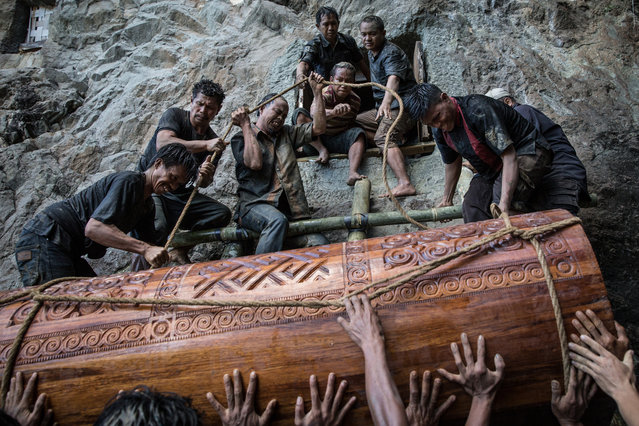
It is said that Torajans are people who “live to die”. For this Indonesian ethnic group, funerals are such extravagant events that they sometimes attract tourists. Families can postpone burials years (and the deceased are considered sick and hosted at home until the funeral) until the family can raise enough money and gather as many relatives as possible. And then it’s a jubilant multiday social event with a parade, dances and animal sacrifices. Agung Parameswara photographed these funerary practices when he traveled to South Sulawesi province, where the Torajans live. (Photo by Agung Parameswara/The Washington Post)
Details
06 Oct 2016 09:15:00
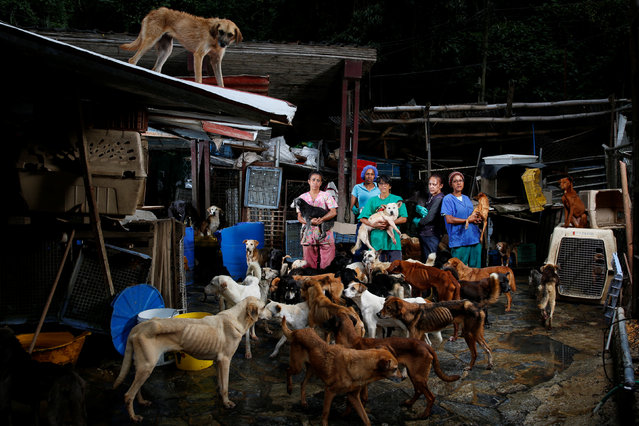
(L-R) Maria Silva, Milena Cortes, Maria Arteaga, Jackeline Bastidas and Gissy Abello pose for a picture at the Famproa dogs shelter where they work, in Los Teques, Venezuela, August 25, 2016. Venezuelans struggling to feed their families let alone their pets are dumping animals on the streets, in parks and at makeshift homes overrun with scrawny animals amid an economic crisis. An hour from Caracas in Los Teques, hundreds of dogs bark and run around the streets scavenging for food outside a makeshift shelter. People come by every few hours to hand over scrawny dogs which are fed by volunteers every day. Venezuela is undergoing a major economic and social crisis, with shortages of basic foods and medicines. Triple digit inflation is hitting everybody hard, including those who own pets. (Photo by Carlos Garcia Rawlins/Reuters)

(L-R) Maria Silva, Milena Cortes, Maria Arteaga, Jackeline Bastidas and Gissy Abello pose for a picture at the Famproa dogs shelter where they work, in Los Teques, Venezuela, August 25, 2016. Venezuelans struggling to feed their families let alone their pets are dumping animals on the streets, in parks and at makeshift homes overrun with scrawny animals amid an economic crisis. An hour from Caracas in Los Teques, hundreds of dogs bark and run around the streets scavenging for food outside a makeshift shelter. (Photo by Carlos Garcia Rawlins/Reuters)
Details
08 Sep 2016 10:01:00
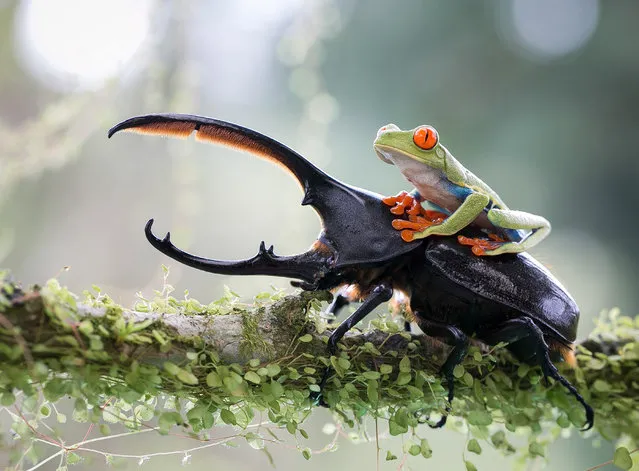
“The knight and his steed”. This picture was taken in a natural but controlled environment. There are pictures that can not be done in nature or that would imply a very high cost of both time and money, thats why photography workshops are run conducted at strategic locations and bringing EVERYONE who is interested, the basic notions (lighting, camera handling, composition, etc...) or the specimens, and afford them the opportunity to take pictures like this. (Photo and caption by Nicolas Reusens Boden (Sweden)/2014 Sony World Photography Awards)

“The knight and his steed”. This picture was taken in a natural but controlled environment. There are pictures that can not be done in nature or that would imply a very high cost of both time and money, thats why photography workshops are run conducted at strategic locations and bringing EVERYONE who is interested, the basic notions (lighting, camera handling, composition, etc...) or the specimens, and afford them the opportunity to take pictures like this. Although controlled, this shot was not prepared at all, I was performing a workshop with the agalychnis callidryas treefrog from Costa Rica when the frog managed to jump to the branch where this huge titan was sleeping... I had my gear ready so I only had to change a few settings and shoot... the rest is history. (Photo and caption by Nicolas Reusens Boden (Sweden)/2014 Sony World Photography Awards)
Details
10 Dec 2013 07:23:00
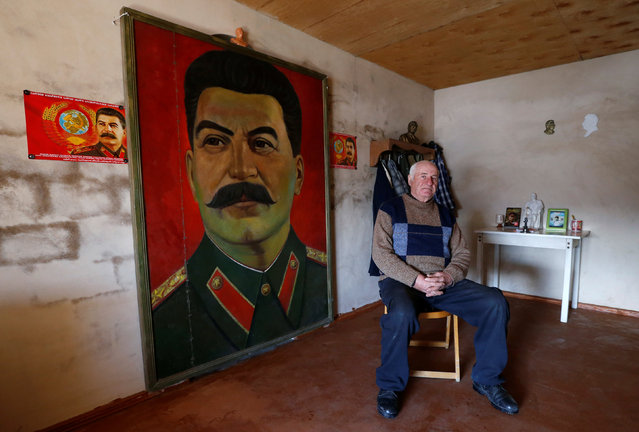
Retired builder Vasili Sidamonidze, 70, poses for a portrait at his home in Gori, Georgia, December 6, 2016. “Unfortunately, Stalin is not popular nowadays. Our people don't respect him. Only we, members of the (Communist) Party, respect him”, Sidamonidze said. “I always try to attend Stalin's birthday anniversaries in Gori. Unfortunately many people don't want to join us even if they live nearby. They look at us from their windows”. Stalin, who was born in Gori in 1878 and died in 1953, is largely reviled today in Georgia, which regained its independence during the 1991 collapse of the Soviet Union. Over the years, his memorials have been dismantled, most recently in 2010 when authorities removed a statue of the dictator from Gori's central square. But Stalin is still revered by a small group of mainly elderly supporters who stress his role in the industrialisation of the Soviet Union and in defeating Nazi Germany in World War Two. Each Dec. 21, a few dozen people mark his birthday by gathering outside a Gori museum dedicated to Stalin, where they make speeches and walk to the square where a 6-meter-high bronze statue of him once stood, calling for it to be reinstated. Opponents say it was a symbol of Moscow's still lingering shadow. In 2008, Russia fought a brief war with Georgia and recognised its breakaway regions of Abkhazia and South Ossetia as independent states. (Photo by David Mdzinarishvili/Reuters)

Retired builder Vasili Sidamonidze, 70, poses for a portrait at his home in Gori, Georgia, December 6, 2016. “Unfortunately, Stalin is not popular nowadays. Our people don't respect him. Only we, members of the (Communist) Party, respect him”, Sidamonidze said. “I always try to attend Stalin's birthday anniversaries in Gori. Unfortunately many people don't want to join us even if they live nearby. They look at us from their windows”. (Photo by David Mdzinarishvili/Reuters)
Details
17 Dec 2016 07:59:00
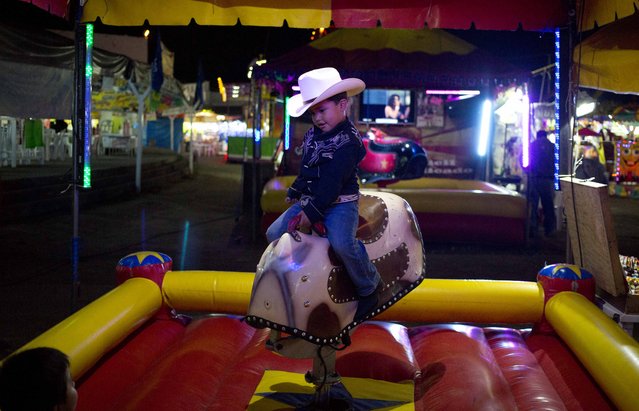
In this March 18, 2015 photo, a boy rides a mechanical bull for children at the Texcoco Fair on the outskirts of Mexico City. In Mexico, these types of fairs date back to Spanish colonial times, and in some smaller communities they are organized around the feast days of Roman Catholic saints. (Photo by Eduardo Verdugo/AP Photo)

In this March 18, 2015 photo, a boy rides a mechanical bull for children at the Texcoco Fair on the outskirts of Mexico City. In Mexico, these types of fairs date back to Spanish colonial times, and in some smaller communities they are organized around the feast days of Roman Catholic saints. (Photo by Eduardo Verdugo/AP Photo)
Details
28 Apr 2015 13:45:00
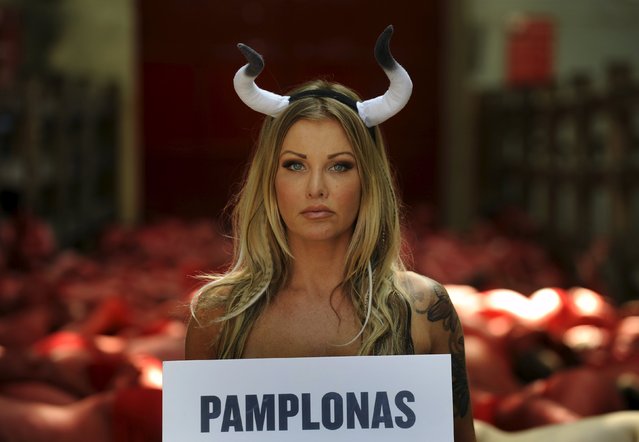
An animal rights protester demonstrates for the abolition of bull runs and bullfights, three days before the start of the famous running of the bulls San Fermin festival in Pamplona, northern Spain, July 4, 2015. (Photo by Eloy Alonso/Reuters)

An animal rights protester demonstrates for the abolition of bull runs and bullfights, three days before the start of the famous running of the bulls San Fermin festival in Pamplona, northern Spain, July 4, 2015. (Photo by Eloy Alonso/Reuters)
Details
05 Jul 2015 10:45:00
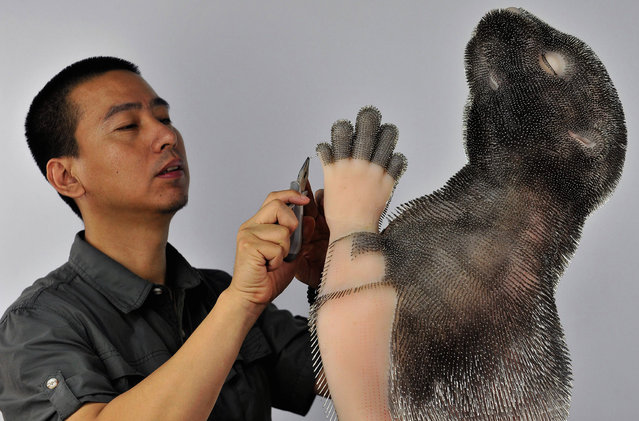
Professor Xie Yong works on an art installation of a beaver, which is made out of plastic and around 300,000 needles, in Shenyang, Liaoning province, July 23, 2013. The needles, according to Xie, represent the pain felt by animals when their fur is taken off to produce clothing. (Photo by Reuters/Stringer)

Professor Xie Yong works on an art installation of a beaver, which is made out of plastic and around 300,000 needles, in Shenyang, Liaoning province, July 23, 2013. The needles, according to Xie, represent the pain felt by animals when their fur is taken off to produce clothing. (Photo by Reuters/Stringer)
Details
27 Jul 2013 09:15:00
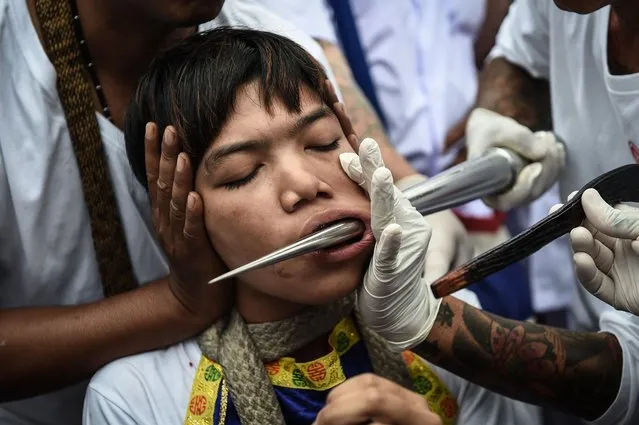
A young devotee of the Nine Emperor Gods has a large needle pushed through his cheek during the annual Phuket Vegetarian Festival in the southern province of Phuket on October 1, 2016. (Photo by Lillian Suwanrumpha/AFP Photo)

A young devotee of the Nine Emperor Gods has a large needle pushed through his cheek during the annual Phuket Vegetarian Festival in the southern province of Phuket on October 1, 2016. (Photo by Lillian Suwanrumpha/AFP Photo)
Details
04 Oct 2016 10:40:00