Loading...
Done
UK Big Brother star Chloe Khan washes her Land Rover wearing a bikini and hot pants  in Borehamwood, England on September 22, 2016. (Photo by Palace Lee)

UK Big Brother star Chloe Khan washes her Land Rover wearing a bikini and hot pants in Borehamwood, England on September 22, 2016. (Photo by Palace Lee)
Details
23 Sep 2016 09:54:00
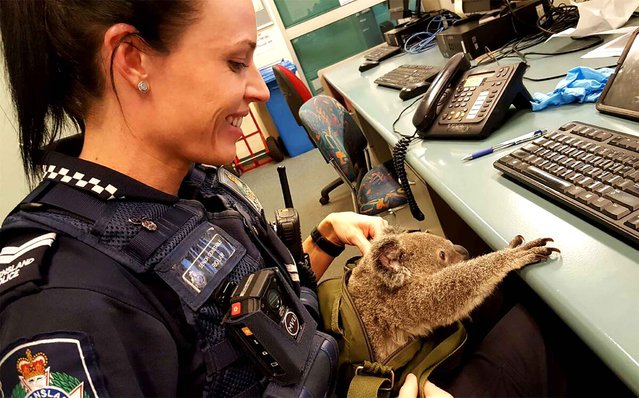
A hand out picture released by Queensland police on November 7, 2016 shows a police officer taking care of a baby koala in Brisbane Australian police made one of their more unusual finds when they uncovered a baby koala hidden in the bag of a woman they stopped in the street. (Photo by AFP Photo/Queensland Police)

A hand out picture released by Queensland police on November 7, 2016 shows a police officer taking care of a baby koala in Brisbane Australian police made one of their more unusual finds when they uncovered a baby koala hidden in the bag of a woman they stopped in the street. (Photo by AFP Photo/Queensland Police)
Details
07 Nov 2016 12:35:00
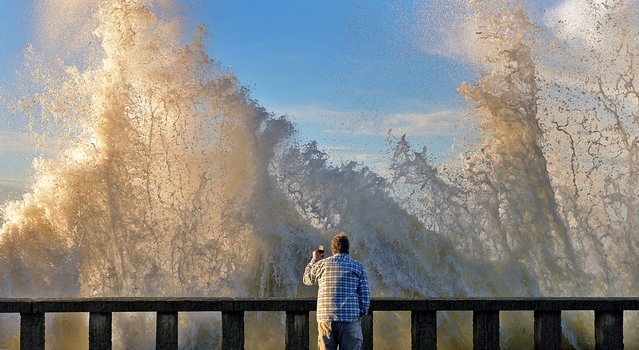
A man watches as high surf crashes into the wall and spills onto Channel Drive in Montecito, Calif., January 7, 2016. Bacteria levels can increase significantly during and after rainstorms as contaminants in the runoff enter the ocean via storm drains, creeks and rivers. (Photo by Mike Eliason/AP Photo)

A man watches as high surf crashes into the wall and spills onto Channel Drive in Montecito, Calif., January 7, 2016. Bacteria levels can increase significantly during and after rainstorms as contaminants in the runoff enter the ocean via storm drains, creeks and rivers. (Photo by Mike Eliason/AP Photo)
Details
08 Jan 2016 09:49:00
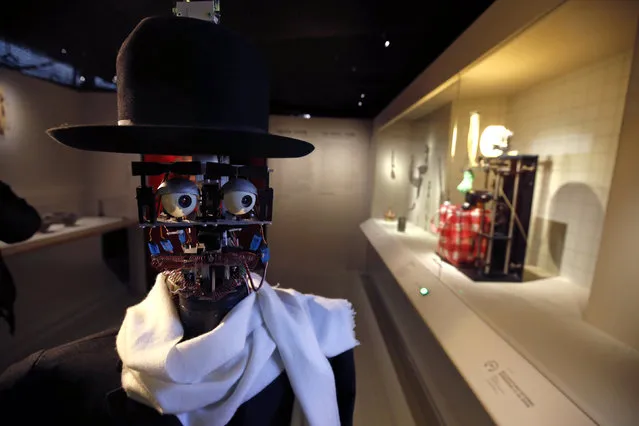
The Berenson robot strolls among visitors during the exhibition “Persona : Oddly Human” at the Quai Branly museum in Paris, France, February 23, 2016. The Berenson robot, developed in France in 2011, is the brainchild of anthropologist Denis Vidal and robotics engineer Philippe Gaussier. Its programming allows it to record reactions of museum visitors to certain pieces of art and then use the data to develop its own unique taste, which allows “Berenson” to judge whether or not it likes a certain work of art within an exhibition. (Photo by Philippe Wojazer/Reuters)

The Berenson robot strolls among visitors during the exhibition “Persona : Oddly Human” at the Quai Branly museum in Paris, France, February 23, 2016. The Berenson robot, developed in France in 2011, is the brainchild of anthropologist Denis Vidal and robotics engineer Philippe Gaussier. Its programming allows it to record reactions of museum visitors to certain pieces of art and then use the data to develop its own unique taste, which allows “Berenson” to judge whether or not it likes a certain work of art within an exhibition. (Photo by Philippe Wojazer/Reuters)
Details
25 Feb 2016 12:26:00
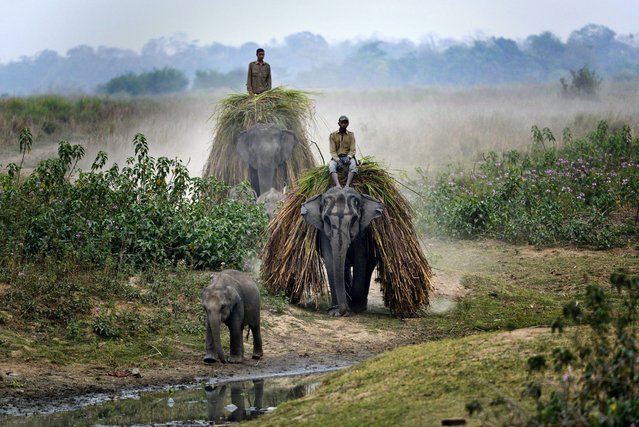
Mahouts return home with their elephants carrying grass to feed them on the eve of the rhino census in Kaziranga National Park in Assam state, India, 24 March 2015. Kaziranga will be closed to visitors for the next two days for a census of the rhinos commencing 25 March, in a previous census in 2013 in the park the population of the Indian rhinos was 2329. (Photo by EPA/Stringer)

Mahouts return home with their elephants carrying grass to feed them on the eve of the rhino census in Kaziranga National Park in Assam state, India, 24 March 2015. Kaziranga will be closed to visitors for the next two days for a census of the rhinos commencing 25 March, in a previous census in 2013 in the park the population of the Indian rhinos was 2329. (Photo by EPA/Stringer)
Details
28 Mar 2015 11:46:00
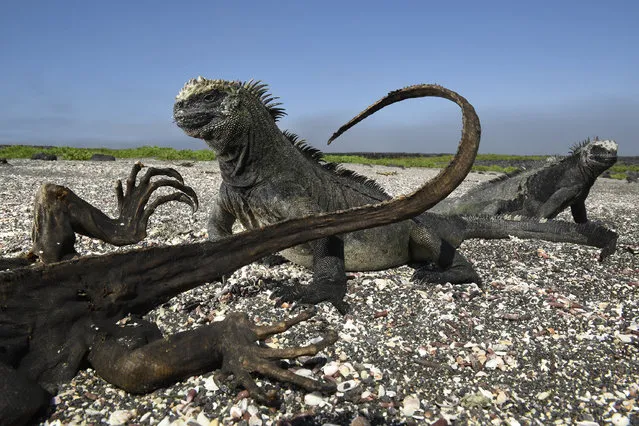
Galapagos – Rocking the Cradle: Four major ocean currents converge along the Galapagos archipelago, creating the conditions for an extraordinary diversity of animal life, April 25, 2016. The islands are home to at least 7,000 flora and fauna species, of which 97 percent of the reptiles, 80 percent of the land birds, 50 percent of the insects and 30 percent of the plants are endemic. The local ecosystem is highly sensitive to the changes in temperature, rainfall and ocean currents that characterize the climatic events known as El Niño and La Niña. These changes cause marked fluctuations in weather and food availability. Many scientists expect the frequency of El Niño and La Niña to increase as a result of climate change, making the Galapagos a possible early-warning location for its effects. (Photo by Thomas P. Peschak for National Geographic/World Press Photo)

Galapagos – Rocking the Cradle: Four major ocean currents converge along the Galapagos archipelago, creating the conditions for an extraordinary diversity of animal life, April 25, 2016. The islands are home to at least 7,000 flora and fauna species, of which 97 percent of the reptiles, 80 percent of the land birds, 50 percent of the insects and 30 percent of the plants are endemic. (Photo by Thomas P. Peschak for National Geographic/World Press Photo)

Details
16 Apr 2018 00:01:00
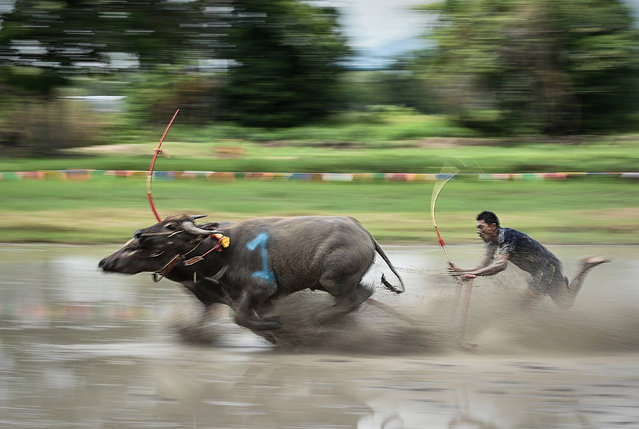
A jockey drives a buffalo in the annual water buffalo race, part of a week-long festival in homage to the animals and in celebration of the rice harvest in Chonburi, Thailand on April 1, 2016. (Photo by Vichaya Pop/Barcroft Media)

A jockey drives a buffalo in the annual water buffalo race, part of a week-long festival in homage to the animals and in celebration of the rice harvest in Chonburi, Thailand on April 1, 2016. (Photo by Vichaya Pop/Barcroft Media)
Details
02 Apr 2016 09:56:00
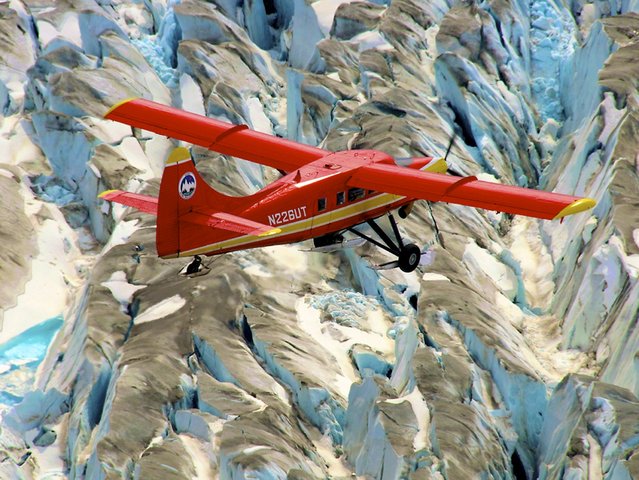
NASA's DHC-3 Otter plane flies in Operation IceBridge-Alaska surveys of mountain glaciers in Alaska in this image released on September 18, 2014. Over the past few decades, average global temperatures have been on the rise, and this warming is happening two to three times faster in the Arctic. (Photo by Chris Larsen/Reuters/NASA/University of Alaska-Fairbanks)

NASA's DHC-3 Otter plane flies in Operation IceBridge-Alaska surveys of mountain glaciers in Alaska in this image released on September 18, 2014. Over the past few decades, average global temperatures have been on the rise, and this warming is happening two to three times faster in the Arctic. (Photo by Chris Larsen/Reuters/NASA/University of Alaska-Fairbanks)
Details
20 Sep 2014 10:28:00