Loading...
Done
We're getting some feedback: “Hi, I have a question. Why is it that 90% of your posts are about women? You don't seem to acknowledge the existence of men unless they were migrants. You're seriously telling me that you can't find a few great accomplishments that MEN are making?? If this is a feminist website I think you should make that public. I've been viewing your posts since 2010 I think, since you first created avaxnews. Now I'm seriously considering blocking you guys”.


And we can reply: We like women more and for that humbly beg for your forgiveness. In general you are right. We promise to rectify the situation somehow.
Details
17 Sep 2018 17:53:00
The Lun-class Ekranoplane was used by the Soviet Navy starting in 1987, and wasn't retired until the late 1990s, after the Soviet Union's fall. (Igor113)

“The Lun-class ekranoplan (NATO reporting name Duck) was a ground effect vehicle (GEV) designed by Rostislav Evgenievich Alexeev and used by the Soviet and Russian navies from 1987 until sometime in the late 1990s. It “flew” using the lift generated by the ground effect of its large wings when close to the surface of the water – about four metres or less. Although they might look similar and/or have related technical characteristics, ekranoplans like the Lun are not aircraft, seaplanes, hovercraft, or hydrofoils – ground effect is a separate technology altogether. The International Maritime Organization classifies these vehicles as maritime ships. The name Lun comes from the Russian for harrier”. – Wikipedia (Photo by Igor113)
Details
08 Aug 2014 10:51:00
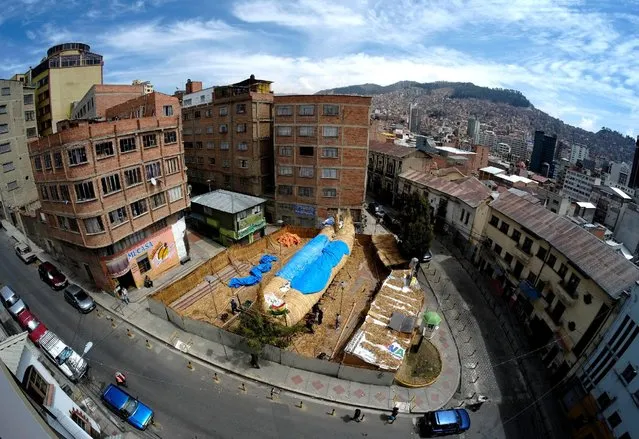
Aerial view of the “Viracocha III”, a boat made only from the totora reed, as it is being prepared to cross the Pacific from Chile to Australia on an expected six-month journey, La Paz, Bolivia, October 19, 2016. An expedition in a boat made only of reeds crafted by indigenous Bolivians is getting ready to cross the Pacific from South America to Australia, in a fresh attempt to prove that ancient mariners were capable of making the journey. Phil Buck, a 51-year-old explorer from the United States, already has led two similar expeditions and will captain the “Viracocha III” set to depart from northern Chile in February on an expected six-month journey. (Photo by David Mercado/Reuters)

Aerial view of the “Viracocha III”, a boat made only from the totora reed, as it is being prepared to cross the Pacific from Chile to Australia on an expected six-month journey, La Paz, Bolivia, October 19, 2016. An expedition in a boat made only of reeds crafted by indigenous Bolivians is getting ready to cross the Pacific from South America to Australia, in a fresh attempt to prove that ancient mariners were capable of making the journey. (Photo by David Mercado/Reuters)
Details
20 Oct 2016 10:53:00
Annual celebration of Dinagyang festival of Iloilo, Philippines. (Photo by Raniel Jose Castañeda/Sony World Photography Awards)

Annual celebration of Dinagyang festival of Iloilo, Philippines. (Photo by Raniel Jose Castañeda/Sony World Photography Awards)
Details
21 Sep 2016 09:56:00
Music Stores

A general view of the Vintage and Rare Guitars shop on Denmark Street on April 20, 2011 in London, England. Denmark Street, in the Soho area of central London, traces its musical connections back to the 1890s and is famous for its connection to contemporary British music after recording studios started setting up there in the 1960s. Many world-renowned recording artists, including: Jimi Hendrix, The s*x Pistols and Elton John have played and recorded in the street. The Rolling Stones recorded their first album in 1964 at the street's Regent Sounds Studio's. Known as London's 'Tin Pan Alley' Denmark Street is regarded as one of, if not the, best music streets in Europe and contains numerous specialist music shops, with many boasting of a long and prestigious musical history.
Details
24 Apr 2011 15:41:00


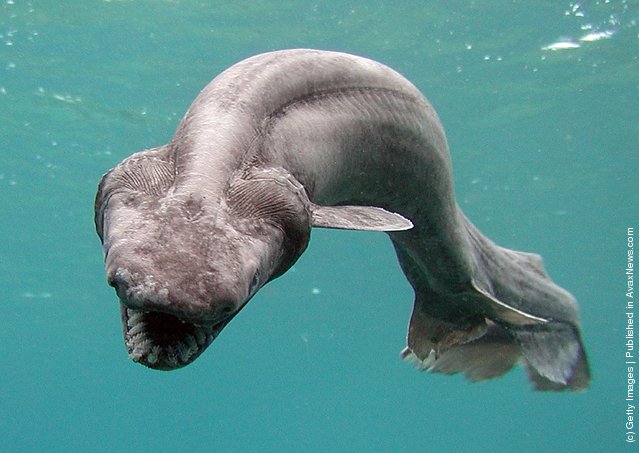
“The frilled shark (Chlamydoselachus anguineus) is one of two extant species of shark in the family Chlamydoselachidae, with a wide but patchy distribution in the Atlantic and Pacific Oceans. This uncommon species is found over the outer continental shelf and upper continental slope, generally near the bottom though there is evidence of substantial upward movements. It has been caught as deep as 1,570 m (5,150 ft), whereas in Suruga Bay, Japan it is most common at depths of 50–200 m (160–660 ft). Exhibiting several “primitive” features, the frilled shark has often been termed a «living fossil»”. – Wikipedia

Photo: A 1.6 meter long Frill shark swims in a tank after being found by a fisherman at a bay in Numazu, on January 21, 2007 in Numazu, Japan. The frill shark, also known as a Frilled shark usually lives in waters of a depth of 600 meters and so it is very rare that this shark is found alive at sea-level. It's body shape and the number of gill are similar to fossils of sharks which lived 350,000,000 years ago. (Photo by Awashima Marine Park/Getty Images)
Details
05 May 2011 10:01:00
South Korean traditional bow artisan Kwon Yeong-Hak works on a bow in his workshop in Yecheon-gun, Gyeongsangbuk-do, South Korea, 26 February 2015. (Photo by Jeon Heon-Kyun/EPA)

South Korean traditional bow artisan Kwon Yeong-Hak works on a bow in his workshop in Yecheon-gun, Gyeongsangbuk-do, South Korea, 26 February 2015. Kwon Yeong-Hak still crafts his bows in the traditional way, carrying on a four-generation family business. The Gakgung bow, of which Kwon is one of the last remaining artisans, is unique to Korea, and is constructed with a variety of materials, including water buffalo horn, oak, bamboo and cattle spinal sinew. A ban on the import of water buffalo horns has put the Gakgung tradition at risk. (Photo by Jeon Heon-Kyun/EPA)
Details
24 Mar 2015 09:54:00
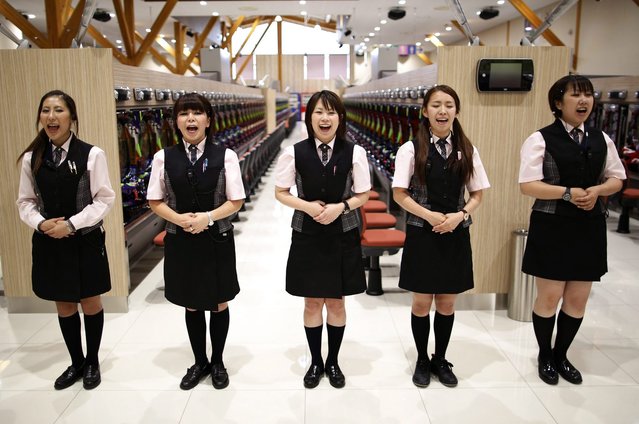
Dynam employees say a greeting message as they receive customer-care training ahead of the grand opening of the company's pachinko parlour in Fukaya, north of Tokyo July 29, 2014. (Photo by Issei Kato/Reuters)

Dynam employees say a greeting message as they receive customer-care training ahead of the grand opening of the company's pachinko parlour in Fukaya, north of Tokyo July 29, 2014. Japan's once-booming pachinko industry, grappling with a greying customer base and the threat of new competition from casinos, is adopting a softer touch and smoke-free zones to lure a new generation of players, particularly women. Pachinko, a modified version of pinball, is a fading national obsession, with about 12,000 parlours nation-wide and one in thirteen people playing the game. But that figure is declining as the population shrinks and younger people prefer games on their mobile phones. (Photo by Issei Kato/Reuters)
Details
25 Aug 2014 10:18:00