Loading...
Done
Tridacna Gigas, or Giant Clams

“The giant clam, Tridacna gigas (known as pā’ua in Cook Islands Māori), is the largest living bivalve mollusc. T. gigas is one of the most endangered clam species. It was mentioned as early as 1825 in scientific reports. One of a number of large clam species native to the shallow coral reefs of the South Pacific and Indian oceans, they can weigh more than 200 kilograms (440 lb) measure as much as 120 cm (47 in) across, and have an average lifespan in the wild of 100 years or more”. – Wikipedia

Photo: Tridacna Gigas, or Giant Clams spew water as a traditional fisherman passes by a small sanctuary on January 23, 2004 near Bolinao in the Northern Philippines. The clams, prime builders for coral reefs and providing shelter for spawning fish and other marine life, are exposed by low tides in the sanctuary. Overfishing and pollution throughout the country are not only threatening food security, but are also starting to choke one of the few working clam sanctuaries in the world. (Photo by David Greedy/Getty Images)
Details
01 Oct 2011 13:10:00
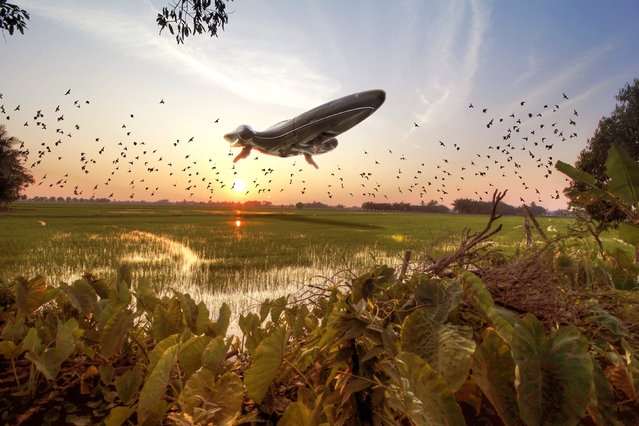
A Nubian Royal Starship hovers over the Malaysian rice fields. (Photo by Zahir Batin/Mercury Press)

A “Star Wars” superfan has brought the universe to his backyard. Amateur photographer Zahir Batin, from Selangor in Malaysia, added stormtroopers, X-wings and other famous sights to his native Tanjong Karang rice fields. The Malaysian snapper decided to combine his love for his hometown with his passion for the out-of-this-world space opera and, in particular, the toys. The amazing shots show TIE fighters on fire flying overhead and AT-AT walking tanks towering over tiny children, as well as Dark Side forces marching through the countryside. Here: a Nubian Royal Starship hovers over the Malaysian rice fields. (Photo by Zahir Batin/Mercury Press)
Details
30 Jun 2015 12:41:00
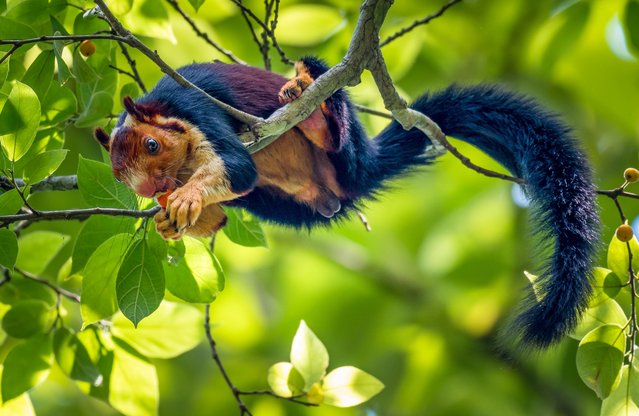
Its main predators are the birds of prey and the leopard. The Giant Squirrel is mostly active in the early hours of the morning and in the evening, resting in the midday. They are typically solitary animals that only come together for breeding. (Photo by Kaushik Vijayan/South West News Service)

The Malabar Giant squirrel – double the size of their grey relatives and measuring up to 36 inches (91.5 cm) from head to tail – lives deep in the forests of India. The athletic animals can leap an incredible 20 feet (6 m) between trees. Photographer Kaushik Vijayan, 39, snapped the animals in their native habit to produce these stunning images. Kaushik, from Kerala State, India, said: “Up until that point I had never heard about a squirrel like that or seen one. The sight was an absolute feast for my eyes. The squirrels fascinated me and I got excited to capture this beauty on my camera”. (Photo by Kaushik Vijayan/South West News Service)
Details
04 Apr 2019 00:03:00
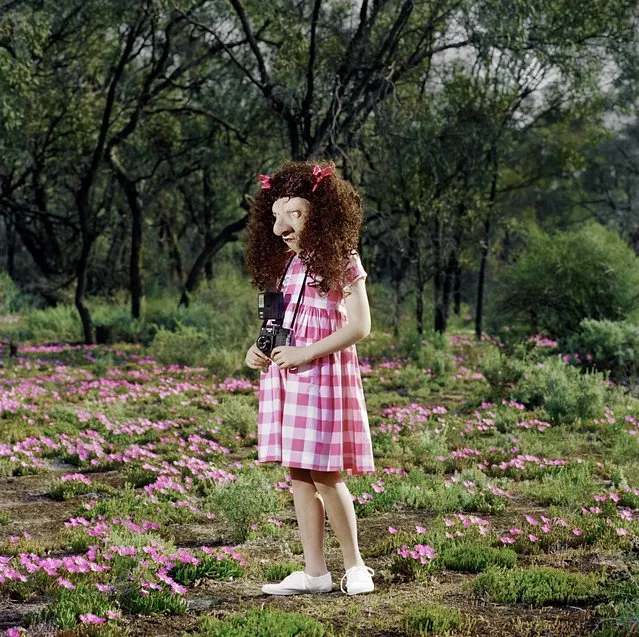
Photo by Polixeni Papapetrou

Australian artist Polixeni Papapetrou trends the line between fantasy/theatre, mythology/reality, archetype/play, male/female, child/adult and animal/human. As with all her work the series The Dreamkeepers tells a story that includes her autobiographical relationship with her children, but it also says a lot more about the condition of childhood - its place in our culture and how we react to images of children in photography.

Details
06 Aug 2012 08:09:00
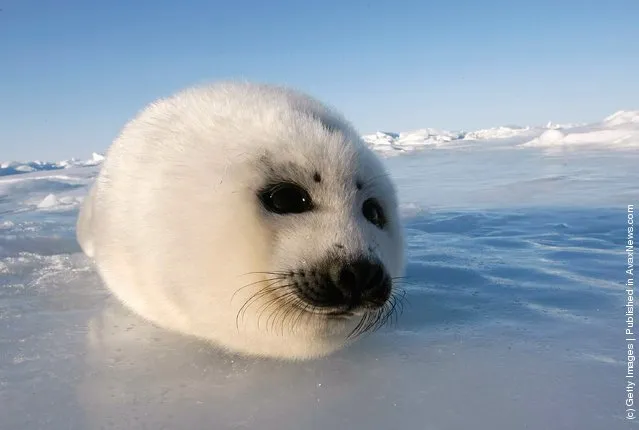
A harp seal pup

“The harp seal or saddleback seal is a species of earless seal native to the northernmost Atlantic Ocean and adjacent parts of the Arctic Ocean. Newborn pups weigh around 11 kilograms (24 lb) and are 80–85 centimetres (31–33 in) long. After birth, the mother only feeds that pup. During the 12 day nursing period, the mother does not eat, losing up to 3 kilograms (7 lb) per day. Harp seal milk contains up to 48% fat, so pups gain over 2.2 kilograms (4.9 lb) per day. During this time, the juvenile's “greycoat” grows in beneath the white neonatal coat, and it weighs 80 pounds (36 kg)”. – Wikipedia

Photo: A harp seal pup lies on an ice floe in the Gulf of Saint Lawrence March 24, 2008 in Charlottetown, Canada. (Photo by Joe Raedle/Getty Images)
Details
19 Sep 2011 15:49:00


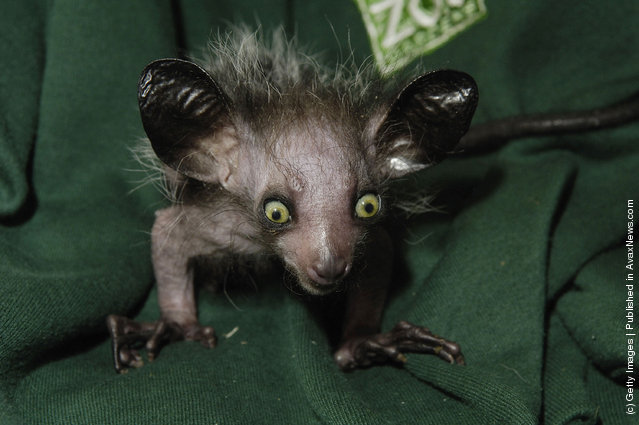
“The aye-aye (Daubentonia madagascariensis) is a lemur, a strepsirrhine primate native to Madagascar that combines rodent-like teeth and a special thin middle finger to fill the same ecological niche as a woodpecker. It is the world's largest nocturnal primate, and is characterized by its unusual method of finding food; it taps on trees to find grubs, then gnaws holes in the wood and inserts its narrow middle finger to pull the grubs out. The only other animal species known to find food in this way is the striped possum. From an ecological point of view the aye-aye fills the niche of a woodpecker as it is capable of penetrating wood to extract the invertebrates within”. – Wikipedia

Photo: In this handout image from Bristol Zoo is seen the first captive bred aye-aye in the UK named “Kintana” (meaning star in Malagasy) April 15, 2005 at Bristol Zoo Gardens, England. The zoo announced today only the second baby aye-aye to be hand-reared in the world (the first was in Jersey Zoo) and has now made his first public appearance since his birth on 11 February 2005. (Photo by Rob Cousins/Bristol Zoo via Getty Images)
Details
13 Apr 2011 13:33:00
Festival goer practice yoga during the O.Z.O.R.A. festival on August 4, 2016 in Tolna, Hungary. Ozora is a village in Tolna County. In recent times it has become famous for the O.Z.O.R.A. psychedelic trance festival which has been held on an estate in Ozora near small village Dadpuszta every year since 2004. The first party was called Solipse and took place during the Solar eclipse of August 11, 1999. The Ozora festival (with Solar United Natives festival) is one of the two big psytrance festivals in Hungary, and is fastest growing psytrance festivals on the world, achieving incredible 60 000 visitors in 2015. (Photo by Mohai Balázs/MTI/MTVA)

Festival goer practice yoga during the O.Z.O.R.A. festival on August 4, 2016 in Tolna, Hungary. Ozora is a village in Tolna County. In recent times it has become famous for the O.Z.O.R.A. psychedelic trance festival which has been held on an estate in Ozora near small village Dadpuszta every year since 2004. The first party was called Solipse and took place during the Solar eclipse of August 11, 1999. (Photo by Mohai Balázs/MTI/MTVA)
Details
05 Aug 2016 13:40:00


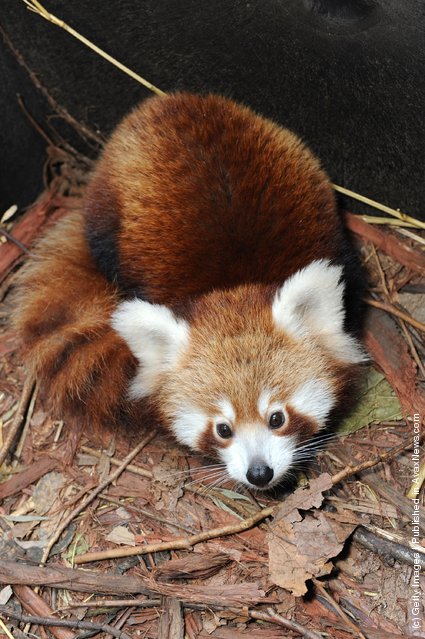
“The red panda (Ailurus fulgens, or shining-cat), is a small arboreal mammal native to the eastern Himalayas and southwestern China. It is the only species of the genus Ailurus. Slightly larger than a domestic cat, it has reddish-brown fur, a long, shaggy tail, and a waddling gait due to its shorter front legs. It feeds mainly on bamboo, but is omnivorous and may also eat eggs, birds, insects, and small mammals. It is a solitary animal, mainly active from dusk to dawn, and is largely sedentary during the day”. – Wikipedia

Photo: In this handout image provided by Taronga Zoo, Seba, a baby Red Panda, explores his new home at Taronga Zoo on April 7, 2011 in Sydney, Australia. The Red Panda cub was born at Christmas and is the 45th to be born at the zoo since 1977. (Photo by Peter Hardin/Taronga Zoo via Getty Images)
Details
07 Apr 2011 08:51:00