A demonstrator runs between burning tires during a curfew, two days after the nationwide anti-government protests turned violent, in Baghdad, Iraq on October 3, 2019. (Photo by Wissm al-Okili/Reuters)
Muslim women offer “Tarawih” mass prayers during the first evening of the holy fasting month of Ramadan at Sheikh Zayed Grand mosque in Solo, Central Java province, Indonesia, March 22, 2023, in this photo taken by Antara Foto. (Photo by Mohammad Ayudha/Antara Foto via Reuters)
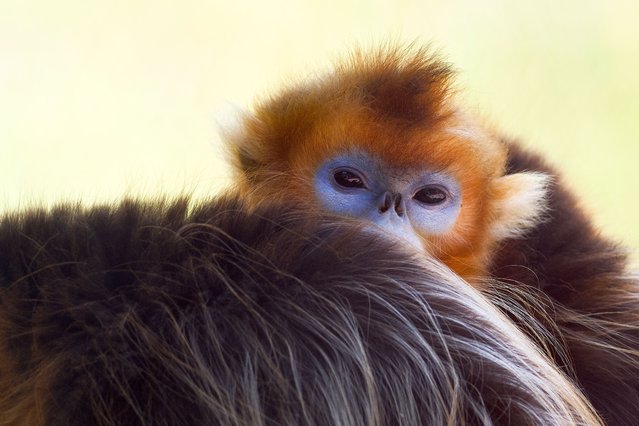
A golden snub-nosed monkeys (Rhinopitheque de Roxelane) looks through its enclosure after quarantine during its presentation at the Beauval Zoopark in Saint-Aignan Central France, on May 7, 2025. ZooParc de Beauval (Loir-et-Cher) welcomed three golden snub-nosed monkeys on April 3, 2025, an endangered species from China, as part of a conservation program, becoming the first zoo outside Asia to house these long-haired, red-furred primates with bluish faces. (Photo by Guillaume Souvant/AFP Photo)
American actress and singer Rachel Zegler sings “Don't Cry For Me Argentina” from the balcony of the London Palladium on June 17, 2025. The show sees Rachel come out onto the balcony to sing to the audience below, and by the third night of the show's limited run the streets have already had to be cordoned off with extra security brought in because the crowds are so big. (Photo by Raphael Pour-Hashemi/The Mega Agency)
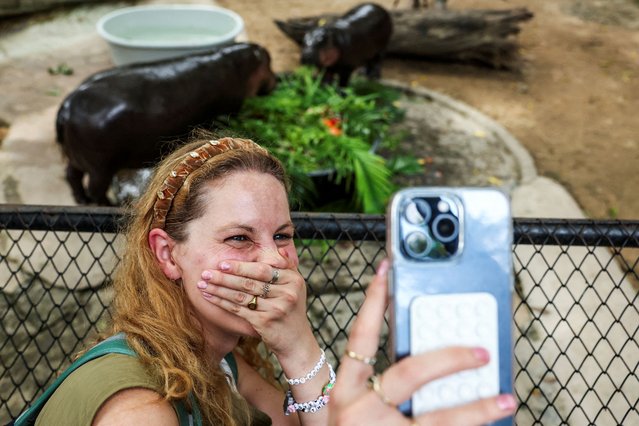
Molly Swindall, 30, who travelled from the United States to meet Moo Deng for the third time, reacts as she takes a selfie with the one-year-old female pygmy hippo, who became a viral internet sensation last year, and her mother Jona, at Khao Kheow Open Zoo in Chonburi province, Thailand, on July 10, 2025. (Photo by Chalinee Thirasupa/Reuters)
A puffin swims underwater in search for fish off the coast of the Farne Islands in Northumberland, North East England in the last decade of July 2025. (Photo by Brian Matthews/Solent News & Photo Agency)
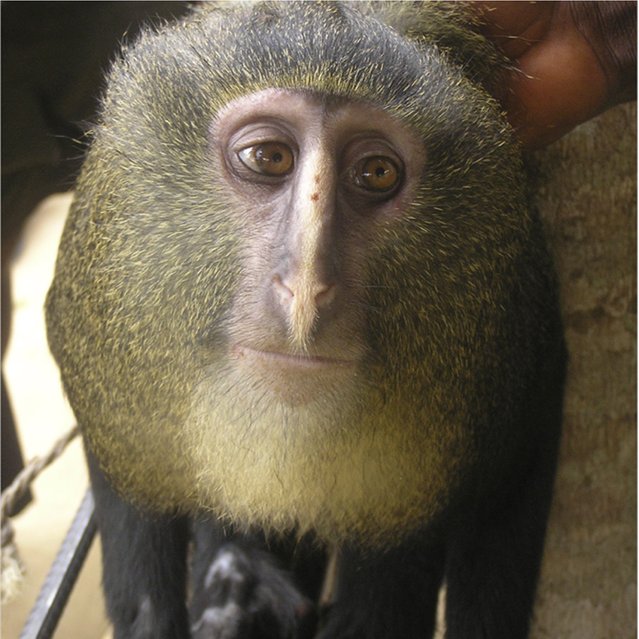
A new species of monkey found in the Democratic Republic of the Congo and identified as Lesula (Cercopithecus lomamiensis) is seen in this undated photograph from an article published September 12, 2012 in the science journal PLOS One. The monkey was first seen in 2007 by researchers John and Terese Hart of the Peabody Museum of Natural History at Yale Research Project. The finding of C. lomamiensis represents only the second new species of African monkey to be discovered in the past 28 years, according to the research article. (Photo by Hart J. A., Detwiler K. M., Gilbert C. C./Reuters)