Loading...
Done
The Oldest Captive Orangutan in the World

Sebastien Laurent, manager of the Zoo, gives a slice of cake to Major, the holdest captive Orang-Outang in the world, as part of its 50th birthday ceremony, on July 17, 2012, at the La Boissiere-du-Doree Zoo near Nantes, western France. (Photo by Alain Jocard/AFP Photo)
Details
18 Jul 2012 06:54:00
Men buy and sell camels at Birqash camel market in Cairo, Egypt

A man walks with a camel at Birqash camel market on January 27, 2012 in Cairo, Egypt. On the edge of the western dessert, thousands of camels are bought and sold every Friday at Brqash camel market, one of the biggest in the Middle East. (Photo by Jeff J. Mitchell/Getty Images)
Details
28 Jan 2012 14:55:00
A Judas is carried through the streets. The crowd pretends to kick and beat the Judases to show scorn. (Photo by Oswaldo Rivas/Reuters)

For 130 years, the people of Masatepe have observed Good Friday by dressing up in colorful masks and costumes and dragging chained “Judases” through the streets of their town in western Nicaragua. Photo: A Judas is carried through the streets. The crowd pretends to kick and beat the Judases to show scorn. (Photo by Oswaldo Rivas/Reuters)
Details
22 Apr 2014 07:51:00
Birds fly over the Atomic Bomb Dome in Hiroshima, western Japan July 29, 2015. On August 6, 1945, the U.S. dropped the atomic bomb on Hiroshima, killing about 140,000 by the end of the year in a city of 350,000 residents, in the world's first nuclear attack. (Photo by Issei Kato/Reuters)

Birds fly over the Atomic Bomb Dome in Hiroshima, western Japan July 29, 2015. On August 6, 1945, the U.S. dropped the atomic bomb on Hiroshima, killing about 140,000 by the end of the year in a city of 350,000 residents, in the world's first nuclear attack. Three days later, a second atomic bomb was dropped on Nagasaki. Influenced by the shadows scorched into outdoor surfaces by the heat of the blasts 70 years ago, Reuters photographer Issei Kato pays homage to survivors, residents and historic buildings in both cities in a personal project that captures the shadows of today. (Photo by Issei Kato/Reuters)
Details
04 Aug 2015 12:01:00
The Perth-based photographer and journalist Frances Andrijich has travelled the Western Australian coast since the early 90s, capturing clotheslines in all their glory. In her images they take the roles of play equipment, Christmas trees and, in the summer, a homemaker’s dream. Andrijich admits she is hopelessly hung up on clotheslines; her latest book celebrates them under the spotlight of the Australian sun. (Photo by Frances Andrijich)

The Perth-based photographer and journalist Frances Andrijich has travelled the Western Australian coast since the early 90s, capturing clotheslines in all their glory. In her images they take the roles of play equipment, Christmas trees and, in the summer, a homemaker’s dream. Andrijich admits she is hopelessly hung up on clotheslines; her latest book celebrates them under the spotlight of the Australian sun. Here: Vera Germanis hangs out underwear in Frances Andrijich’s grandparents’ backyard. This was the photographer’s first clothesline shot, taken in Midland Junction in 1991. (Photo by Frances Andrijich)
Details
29 Mar 2016 11:58:00
In this Sept. 29, 2013 photo, nine-year-old twin sisters Camila, left, and Carla Rodriguez pose for a portrait along their street in Havana, Cuba. 12 sets of twins live along two consecutive blocks in western Havana, ranging in age from newborns to senior citizens. “We love living on this block because we have twin friends”, said Carla. (Photo by Ramon Espinosa/AP Photo)

A street in the Cuban capital, Havana, is home to 12 sets of twins, ranging from toddlers to senior citizens. Some say it could be something in the water. Others point to a tree with mystical significance for locals. And maybe it's just chance. Photo: In this September 29, 2013 photo, nine-year-old twin sisters Camila, left, and Carla Rodriguez pose for a portrait along their street in Havana, Cuba. 12 sets of twins live along two consecutive blocks in western Havana, ranging in age from newborns to senior citizens. “We love living on this block because we have twin friends”, said Carla. (Photo by Ramon Espinosa/AP Photo)
Details
07 Oct 2013 06:44:00
In this photo taken on Wednesday, January 9, 2013, ahead of the Chinese lunar new year of the Snake, following the Chinese zodiac, genetically modified, auspicious, white snakes slither across the altar at the Temple of White Snakes in Taoyuan county, in north western Taiwan. Director of the temple Mr. Lo Chin-shih says the new year of the snake would be a time of steady progress, in contrast to the more turbulent nature of the outgoing year of the dragon. The Chinese new year fall on February 10. (Photo by Wally Santana/AP Photo)

In this photo taken on Wednesday, January 9, 2013, ahead of the Chinese lunar new year of the Snake, following the Chinese zodiac, genetically modified, auspicious, white snakes slither across the altar at the Temple of White Snakes in Taoyuan county, in north western Taiwan. Director of the temple Mr. Lo Chin-shih says the new year of the snake would be a time of steady progress, in contrast to the more turbulent nature of the outgoing year of the dragon. The Chinese new year fall on February 10. (Photo by Wally Santana/AP Photo)
Details
09 Feb 2013 10:53:00
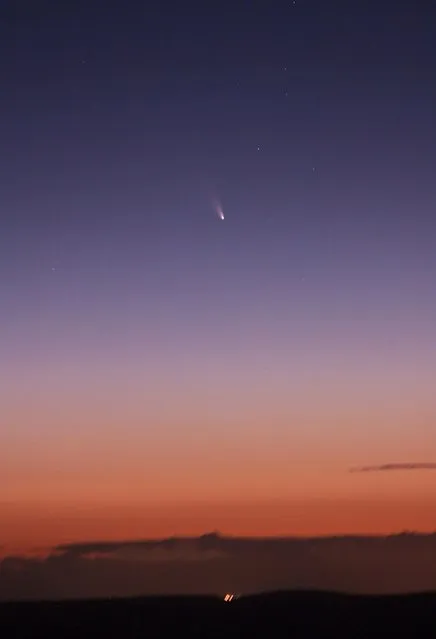
This image provided by NASA shoaws the comet PANSTARRS as seen from Mount Dale, Western Australia on March 5, 2013. According to NASA on March 10, it will make its closest approach to the sun about 28 million miles (45 million kilometers) away. As it continues its nightly trek across the sky, the comet may get lost in the sun's glare but should return and be visible to the naked eye by March 12. (Photo by AP Photo/NASA)

It’s time to start watching for Comet PANSTARRS, one of two comets to get excited about in 2013. Photo: This image provided by NASA shoaws the comet PANSTARRS as seen from Mount Dale, Western Australia on March 5, 2013. According to NASA on March 10, it will make its closest approach to the sun about 28 million miles (45 million kilometers) away. As it continues its nightly trek across the sky, the comet may get lost in the sun's glare but should return and be visible to the naked eye by March 12. (Photo by AP Photo/NASA)
Details
13 Mar 2013 08:03:00