Loading...
Done
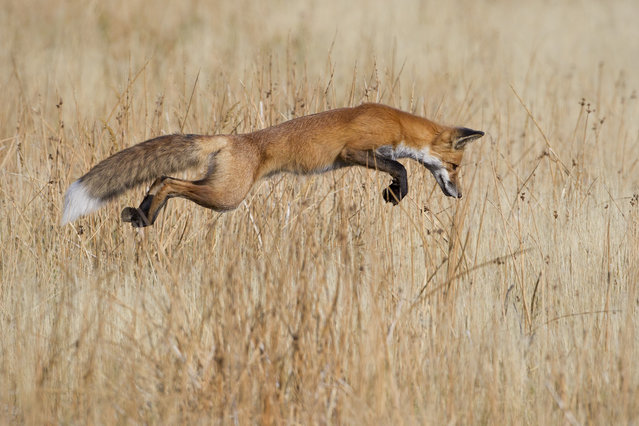
Canada: “Lucky pounce”. (Photo by Connor Stefanison/Wildlife Photographer of the Year 2013)

The winners of The London’s Natural History Museum's prestigious Wildlife Photographer of the Year for 2013 have finally been unveiled. Selected from almost 43,000 entries from 96 countries, the winners offer a glimpse of the stunning array of natural beauty on our planet. Photo: Canada: “Lucky pounce”. “Anticipating the pounce – that was the hardest part”, says Connor, who had come to Yellowstone National Park, Wyoming, USA, in search of wildlife as much as the spectacular landscape. He had found this fox, his first ever, on his last day in the park. It was so absorbed in hunting that Connor had plenty of time to get out of the car and settle behind a rock. It quartered the grassland, back and forth, and then started staring intently at a patch of ground, giving Connor just enough warning of the action to come. When it sprung up, Connor got his shot. And when it landed, the fox got his mouse. (Photo by Connor Stefanison/Wildlife Photographer of the Year 2013)
Details
17 Oct 2013 08:12:00
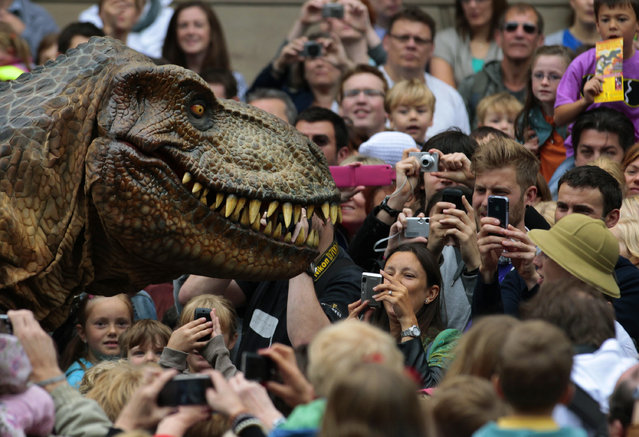
Visitors photograph an animatronic Tyrannosaurus Rex at the National Museum of Scotland, July 29, 2011. (Photo by David Moir/Reuters)

Visitors photograph an animatronic Tyrannosaurus Rex at the National Museum of Scotland, July 29, 2011. (Photo by David Moir/Reuters)
Details
12 Apr 2015 08:02:00
A motorcyclist dodges in the annual water-splashing festival to mark the New Year of the Dai minority in Menglian, Yunnan province April 13, 2015. Picture taken April 13, 2015. (Photo by Wong Campion/Reuters)

A motorcyclist dodges in the annual water-splashing festival to mark the New Year of the Dai minority in Menglian, Yunnan province April 13, 2015. (Photo by Wong Campion/Reuters)
Details
15 Apr 2015 13:03:00
People take pictures of the Tribute in Light while it is illuminated next to the Statue of Liberty (C), One World Trade Center and the Empire State Building during events marking the 14th anniversary of the 9/11 attacks on the World Trade Center in New York September 11, 2015. (Photo by Eduardo Munoz/Reuters)

People take pictures of the Tribute in Light while it is illuminated next to the Statue of Liberty (C), One World Trade Center and the Empire State Building during events marking the 14th anniversary of the 9/11 attacks on the World Trade Center in New York September 11, 2015. (Photo by Eduardo Munoz/Reuters)
Details
13 Sep 2015 12:22:00
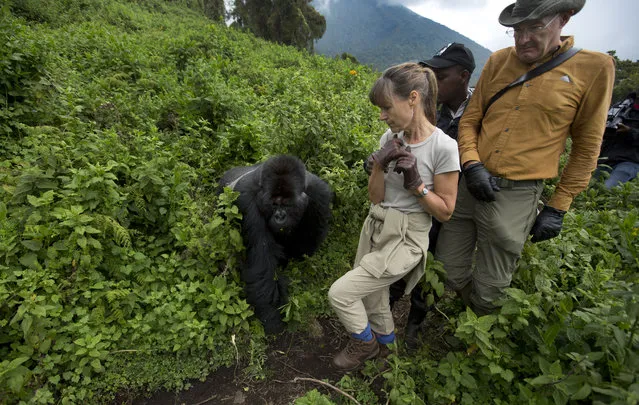
In this photo taken Friday, September 4, 2015, tourists Sarah and John Scott from Worcester, England, take a step back as a male silverback mountain gorilla from the family of mountain gorillas named Amahoro, which means “peace” in the Rwandan language, unexpectedly steps out from the bush to cross their path in the dense forest on the slopes of Mount Bisoke volcano in Volcanoes National Park, northern Rwanda. (Photo by Ben Curtis/AP Photo)

In this photo taken Friday, September 4, 2015, tourists Sarah and John Scott from Worcester, England, take a step back as a male silverback mountain gorilla from the family of mountain gorillas named Amahoro, which means “peace” in the Rwandan language, unexpectedly steps out from the bush to cross their path in the dense forest on the slopes of Mount Bisoke volcano in Volcanoes National Park, northern Rwanda. Deep in Rwanda's steep-sloped forest, increasing numbers of tourists are heading to see the mountain gorillas, a subspecies whose total population is an estimated 900 and who also live in neighboring Uganda and Congo, fueling an industry seen as key to the welfare of the critically endangered species as well as Rwanda's economy. (Photo by Ben Curtis/AP Photo)
Details
18 Sep 2015 14:55:00
Ocean voyage

Do you think that history is a science? Well, not exactly. First, and foremost, history is the state's “legend of wars”, it’s official regalia. Of course, public historians are not interested in scientific truth – quite the opposite. In this respect, any attempt to present a state’s history as altruistic and benevolent as possible is welcomed and encouraged – as opposed to any revisionism attempts that may be more accurate. In this matter, Chinese have surpassed us all – they revised in highly creative manner (but rather shamelessly) the technology already invented by Europeans, a process that resulted in oldest state on the planet. Here is an interesting paradox: ask any sinologist about the Middle Kingdom during second century B.C., and he will describe it to you in such a vivid manner as if he has been living there all his life – but as soon as you will ask him to describe Chinese history in the 19-20th centuries… let's say, his eagerness will be greatly diminished. However, we will discuss China in a different article, and in the meantime we will try to understand how exactly historic “legend of wars” is formed and functions – based on a specific and well-known example. A great example is Ferdinand Magellan's first voyage around the world.
Details
14 Nov 2011 09:11:00
Takeoka Chisaka, Hiroshima, Japan. “One morning in August 1945, I was walking home from the night shift at a factory in Hiroshima. As I reached my door, there was a huge explosion. When I came to, my head was bleeding and I had been blasted 30m away”. (Photo and caption by Sasha Maslov)

Takeoka Chisaka, Hiroshima, Japan. “One morning in August 1945, I was walking home from the night shift at a factory in Hiroshima. As I reached my door, there was a huge explosion. When I came to, my head was bleeding and I had been blasted 30m away. The atomic bomb had detonated. When I found my mother, her eyes were badly burned. A doctor said they had to come out, but he didn’t have the proper tools so used a knife instead. It was hellish. I became a peace-worker after the war. In the 1960s, at a meeting at the UN, I met one of the people who created the atomic bomb. He apologised”. (Photo and caption by Sasha Maslov)
Details
11 May 2015 11:56:00
People visit an art installation “Alley of Flying Umbrellas” in central St. Petersburg, Russia, May 15, 2015. Art installation inspired by “Umbrella Sky Project” of Portuguese town of Agueda and was made of 500 colored umbrellas. (Photo by Anatoly Maltsev/EPA)

People visit an art installation “Alley of Flying Umbrellas” in central St. Petersburg, Russia, May 15, 2015. Art installation inspired by “Umbrella Sky Project” of Portuguese town of Agueda and was made of 500 colored umbrellas. (Photo by Anatoly Maltsev/EPA)
Details
19 May 2015 12:13:00