Loading...
Done
“Cassowaries are large, flightless birds related to emus and (more distantly) to ostriches, rheas, and kiwis”, writes Olivia Judson in the September issue of National Geographic magazine. (Photo by Christian Ziegler/National Geographic)

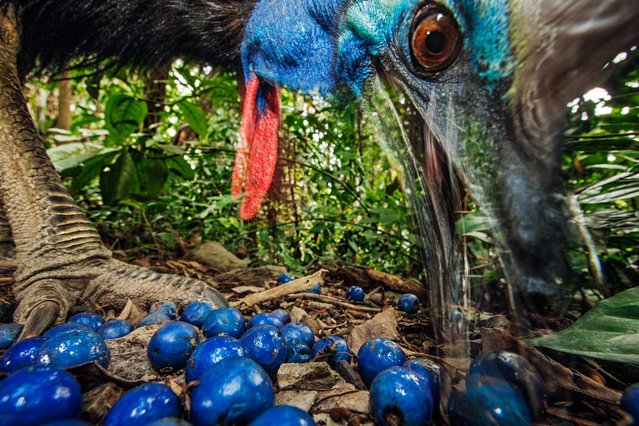
“Cassowaries are large, flightless birds related to emus and (more distantly) to ostriches, rheas, and kiwis”, writes Olivia Judson in the September issue of National Geographic magazine. How large? People-size: Adult males stand well over five foot five and top 110 pounds. Females are even taller, and can weigh more than 160 pounds. Dangerous when roused, they’re shy and peaceable when left alone. But even birds this big and tough are prey to habitat loss. The dense New Guinea and Australia rain forests where they live have dwindled. Today cassowaries might number 1,500 to 2,000. And because they help shape those same forests – by moving seeds from one place to another – “if they vanish”, Judson writes, “the structure of the forest would gradually change” too. (Photo by Christian Ziegler/National Geographic)
Details
06 Jan 2014 12:21:00
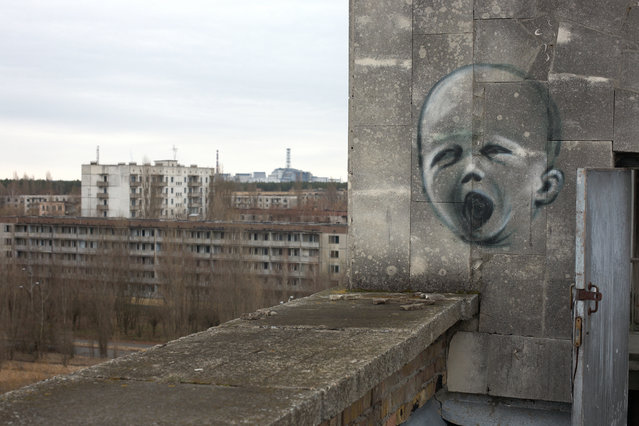
Graffiti of a crying baby on a wall, Chernobyl Power Plant, Chernobyl, Ukraine. (Photo by Hans Neleman/Getty Images)

The Chernobyl disaster was a catastrophic nuclear accident that occurred on 26 April 1986 at the Chernobyl Nuclear Power Plant in Ukraine, which was under the direct jurisdiction of the central authorities of the Soviet Union. The Chernobyl disaster is the worst nuclear power plant accident in history in terms of cost and resulting deaths, and is one of only two classified as a level 7 event (the maximum classification) on the International Nuclear Event Scale (the other being the Fukushima Daiichi nuclear disaster in 2011). Photo: Graffiti of a crying baby on a wall, Chernobyl Power Plant, Chernobyl, Ukraine. (Photo by Hans Neleman/Getty Images)
Details
27 Apr 2014 08:12:00
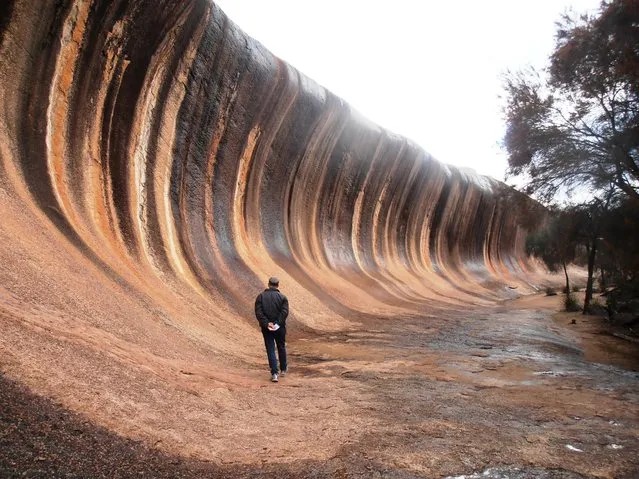
Wave Rock, Arizona

Wave Rock is a natural rock formation that is shaped like a tall breaking ocean wave. The "wave" is about 14 m (46 ft) high and around 110 m (360 ft) long. It forms the north side of a solitary hill, which is known as “Hyden Rock”. This hill, which is a granite inselberg, lies about 3 km (2 mi) east of the small town of Hyden and 296 km (184 mi) east-southeast of Perth, Western Australia. Wave Rock and Hyden Rock are part of a 160 ha (395-acre) nature reserve, Hyden Wildlife Park.
Details
12 Aug 2014 10:21:00
A couple walk on a catwalk in a flooded Saint Mark Square during a period of seasonal high water in Venice on October 29, 2018. (Photo by Manuel Silvestri/Reuters)

A couple walk on a catwalk in a flooded Saint Mark Square during a period of seasonal high water in Venice on October 29, 2018. Venice frequently floods when high winds push in water from the lagoon, but Monday's levels are exceptional and forecast to rise even higher, to 160 centimeters (nearly 63 inches) by mid-afternoon. (Photo by Manuel Silvestri/Reuters)
Details
31 Oct 2018 00:01:00
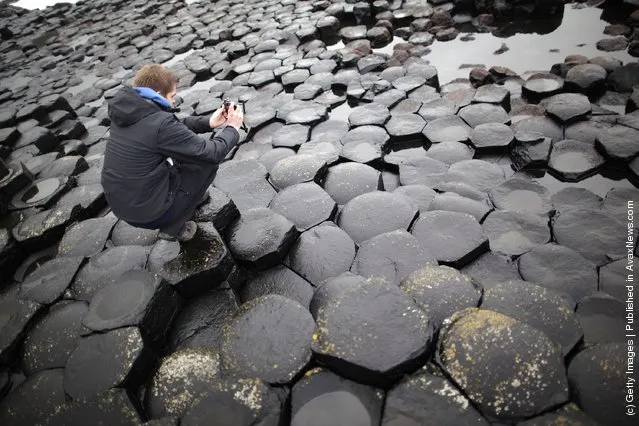
Visitors walk on the Giant's Causway in Portrush, Northern Ireland

“The Giant's Causeway is an area of about 40,000 interlocking basalt columns, the result of an ancient volcanic eruption. It is located in County Antrim on the northeast coast of Northern Ireland, about three miles (4.8 km) northeast of the town of Bushmills. It was declared a World Heritage Site by UNESCO in 1986, and a National Nature Reserve in 1987 by the Department of the Environment for Northern Ireland”. – Wikipedia

Photo: Visitors walk on the Giant's Causway on March 14, 2012 in Portrush, Northern Ireland. (Photo by Peter Macdiarmid/Getty Images)
Details
17 Mar 2012 11:10:00
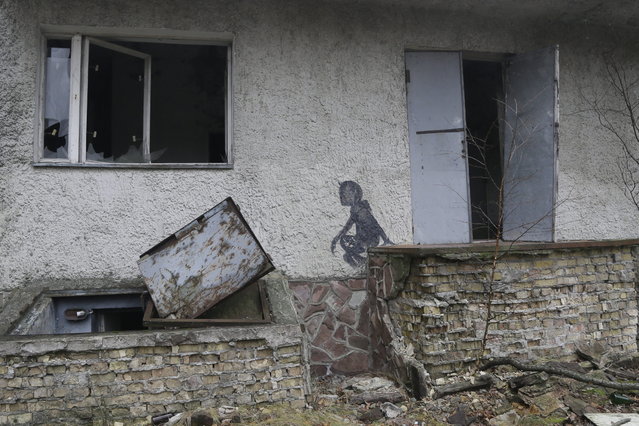
A  view of empty houses in the deserted town of Pripyat near the closed Chernobyl nuclear power plant  Ukraine,  November 27, 2012. (Photo by Efrem Lukatsky/AP Photo)

“Pripyat is a ghost town near the Chernobyl Nuclear Power Plant, within the Chernobyl Exclusion Zone, part of Kiev Oblast (province) of northern Ukraine, near the border with Belarus”. – Wikipedia

Photo: A view of empty houses in the deserted town of Pripyat near the closed Chernobyl nuclear power plant Ukraine, November 27, 2012. Pripyat, the city of 47,000 had already been evacuated after the April 26, 1986, explosion of Reactor No. 4 (Photo by Efrem Lukatsky/AP Photo)
Details
07 Jan 2013 10:50:00
Chernobyl

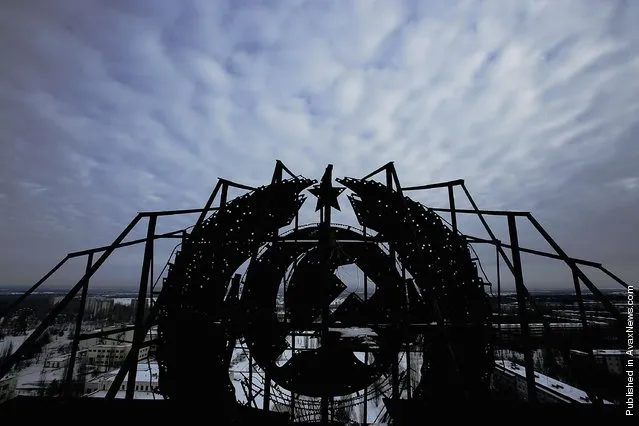
Scaffolding holding a remnant of the Soviet Union, the hammer and sickle, is seen on a rooftop of an abandoned building in the town of Pripyat on January 25, 2006 near Chernobyl, Ukraine. The town of Pripyat, deserted since the 1986 catastrophe, once housed 30,000 people, the majority of being workers from the Chernobyl Nuclear Power Plant. Days after the catastrophe the inhabitants were relocated to other locations in the Soviet Union. The town of Pripyat has remained uninhabited since. Prypyat and the surrounding area will not be safe for human habitation for several centuries. Scientists estimate that the most dangerous radioactive elements will take up to 900 years to decay sufficiently to render the area safe.
Details
14 Mar 2011 10:20:00
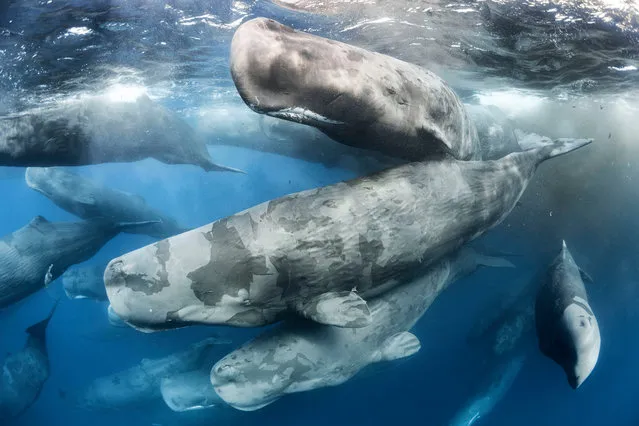
Behaviour: Mammals category. Giant Gathering by Tony Wu, USA. Dozens of sperm whales mingled noisily off Sri Lanka’s northeast coast, stacked as far down as Tony could see. This was a congregation of dozens of social units, like a gathering of the clans. Aggregations like this could be a critical part of the whales’ rich social lives but are rarely reported. Some two thirds of the population was wiped out before commercial whaling was banned in 1986. This kind of major gathering could be “a sign that populations are recovering”, says Tony. (Photo by Tony Wu/Wildlife Photographer of the Year 2017)

Behaviour: Mammals category. Giant Gathering by Tony Wu, USA. Dozens of sperm whales mingled noisily off Sri Lanka’s northeast coast, stacked as far down as Tony could see. This was a congregation of dozens of social units, like a gathering of the clans. Aggregations like this could be a critical part of the whales’ rich social lives but are rarely reported. Some two thirds of the population was wiped out before commercial whaling was banned in 1986. This kind of major gathering could be “a sign that populations are recovering”, says Tony. (Photo by Tony Wu/Wildlife Photographer of the Year 2017)
Details
19 Oct 2017 09:38:00