Loading...
Done
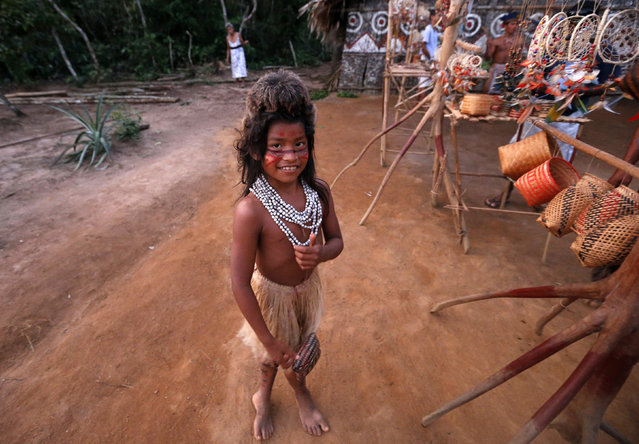
A girl of the Amazonian Tatuyo tribe poses while waiting to sell crafts to tourists in her village in the Rio Negro (Black River) near Manaus city, a World Cup host city, June 23, 2014. Because of their proximity to host city Manaus and their warm welcome, the Tatuyo have enjoyed three weeks of brisk business thanks to the World Cup. Usually, they host between 10 and 30 tourists a day. During the World Cup, this number has rocketed to 250 a day, They have become richer and other communities now come to them to sell them juices and fishes. (Photo by Andres Stapff/Reuters)

A girl of the Amazonian Tatuyo tribe poses while waiting to sell crafts to tourists in her village in the Rio Negro (Black River) near Manaus city, a World Cup host city, June 23, 2014. Because of their proximity to host city Manaus and their warm welcome, the Tatuyo have enjoyed three weeks of brisk business thanks to the World Cup. Usually, they host between 10 and 30 tourists a day. During the World Cup, this number has rocketed to 250 a day, They have become richer and other communities now come to them to sell them juices and fishes. (Photo by Andres Stapff/Reuters)
Details
27 Jun 2014 10:30:00
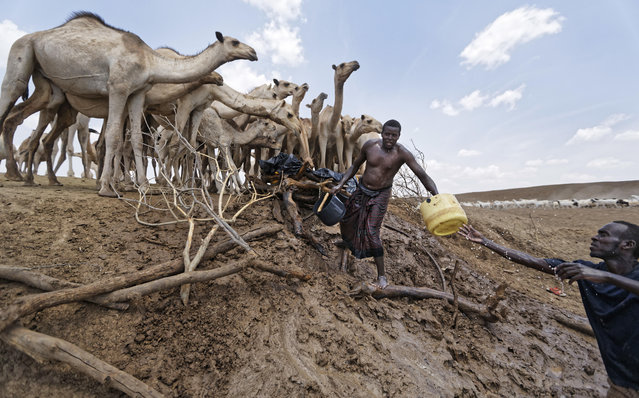
Camel herders scoop up water in plastic buckets from one of the few watering holes in the area, to water their animals near the drought-affected village of Bandarero, near Moyale town on the Ethiopian border, in northern Kenya, Friday, March 3, 2017. The U.N. humanitarian chief, Stephen O'Brien, toured Bandarero village on Friday and called on the international community to act to “avert the very worst of the effects of drought and to avert a famine to make sure we don't go from what is deep suffering to a catastrophe”. (Photo by Ben Curtis/AP Photo)

Camel herders scoop up water in plastic buckets from one of the few watering holes in the area, to water their animals near the drought-affected village of Bandarero, near Moyale town on the Ethiopian border, in northern Kenya, Friday, March 3, 2017. The U.N. humanitarian chief, Stephen O'Brien, toured Bandarero village on Friday and called on the international community to act to “avert the very worst of the effects of drought and to avert a famine to make sure we don't go from what is deep suffering to a catastrophe”. (Photo by Ben Curtis/AP Photo)
Details
05 Mar 2017 00:03:00
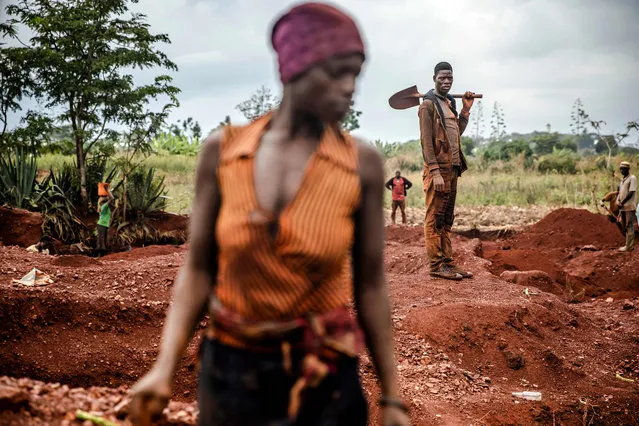
A gold miner observes from the distance how some women miners work at an open-pit gold mine in Nyarugusu, Geita Region, Tanzania on May 27, 2022. Tanzania is a land rich in minerals and one of the main gold producers in Africa, with gold representing more than 90% of the country's mineral exports. Artisanal and small-scale gold mining have culturally and historically relegated women's participation. The extractive sector in Tanzania has historically been a male-dominated industry with high levels of harassment, sеxual abuse, discrimination and misconceptions over women's involvement, and contributions following traditional beliefs. (Photo by Luis Tato/AFP Photo)

A gold miner observes from the distance how some women miners work at an open-pit gold mine in Nyarugusu, Geita Region, Tanzania on May 27, 2022. Tanzania is a land rich in minerals and one of the main gold producers in Africa, with gold representing more than 90% of the country's mineral exports. Artisanal and small-scale gold mining have culturally and historically relegated women's participation. The extractive sector in Tanzania has historically been a male-dominated industry with high levels of harassment, sеxual abuse, discrimination and misconceptions over women's involvement, and contributions following traditional beliefs. (Photo by Luis Tato/AFP Photo)
Details
13 Jun 2022 04:31:00
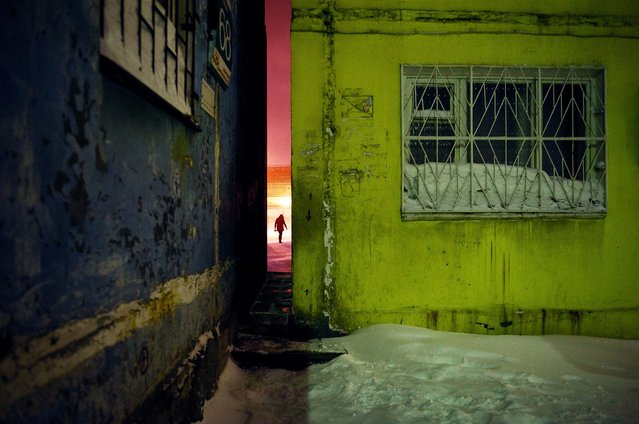
2013. A woman is visible through a narrow passageway between two buildings. Norilsk's urban spaces were designed to shorten distances around large developments and give residents maximum protection from arctic winds. (Photo by Elena Chernyshova)

Elena Chernyshova's vision of Norilsk, Russia, the northernmost city in the world, is a series of surprises by which she extracts otherworldly beauty from ugly realities. Here: 2013. A woman is visible through a narrow passageway between two buildings. Norilsk's urban spaces were designed to shorten distances around large developments and give residents maximum protection from arctic winds. (Photo by Elena Chernyshova)
Details
10 Jan 2016 08:03:00
A female is doused with wine as people take part in a wine battle, in the small village of Haro, northern Spain, Friday, June 29, 2018. (Photo by Alvaro Barrientos/AP Photo)

A female is doused with wine as people take part in a wine battle, in the small village of Haro, northern Spain, Friday, June 29, 2018. La Batalla de Vino is held each June in the town of Haro on the feast of St Peter, an event organizers say draws thousands of people. On Friday, participants soaked each other with buckets and toy spray guns, turning their clothes a shade of purple. (Photo by Alvaro Barrientos/AP Photo)
Details
02 Jul 2018 06:03:00
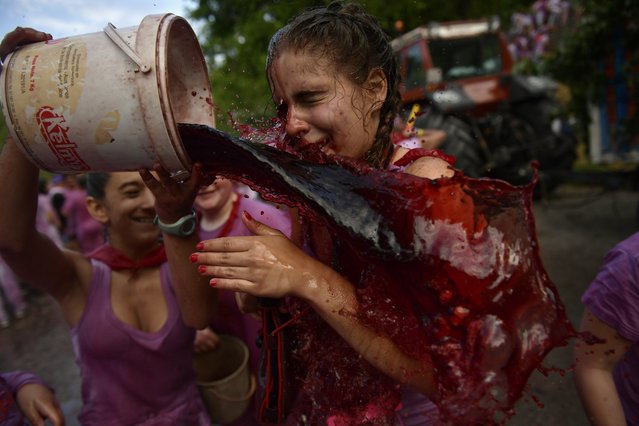
A man pours red wine on a girl's head during the Batalla del Vino (Battle of Wine) in Haro, on June 29, 2015. Every year thousands of locals and tourists climb a mountain in the northern Spanish province of La Rioja to celebrate St. Peter's day covering each other in red wine while tanker trucks filled with wine distribute the alcoholic beverage to water pistols, back mounted spraying devices, buckets which are randomly poured on heads and into any other available container. (Photo by Cesar Manso/AFP Photo)

A man pours red wine on a girl's head during the Batalla del Vino (Battle of Wine) in Haro, on June 29, 2015. Every year thousands of locals and tourists climb a mountain in the northern Spanish province of La Rioja to celebrate St. Peter's day covering each other in red wine while tanker trucks filled with wine distribute the alcoholic beverage to water pistols, back mounted spraying devices, buckets which are randomly poured on heads and into any other available container. More than nine thousand people threw around 130,000 litres of wine during this year's Haro Wine Festival, according to local media. (Photo by Cesar Manso/AFP Photo)
Details
30 Jun 2015 11:56:00
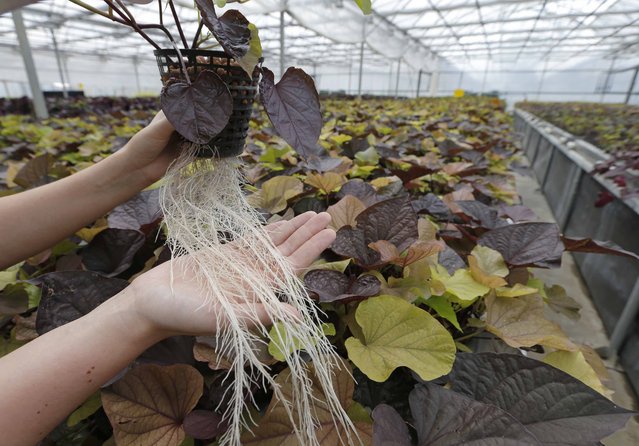
An employee holds a plant with roots at the Plant Advanced Technologies (PAT) company greenhouse in Laronxe near Nancy, Eastern France, June 19, 2015. The farmers employed at the site in Laronxe are growing plants in a special way with a view to “milking” them for use in medicines, cosmetics and agrochemicals. (Photo by Vincent Kessler/Reuters)

An employee holds a plant with roots at the Plant Advanced Technologies (PAT) company greenhouse in Laronxe near Nancy, Eastern France, June 19, 2015. The farmers employed at the site in Laronxe are growing plants in a special way with a view to “milking” them for use in medicines, cosmetics and agrochemicals. Several major brands, including Germany's BASF and France's Chanel, have teamed up with Plant Advanced Technologies (PAT) in the hope of securing privileged access to the so-called “biomolecules” it extracts through the use of a patented technique. (Photo by Vincent Kessler/Reuters)
Details
23 Jul 2015 10:56:00


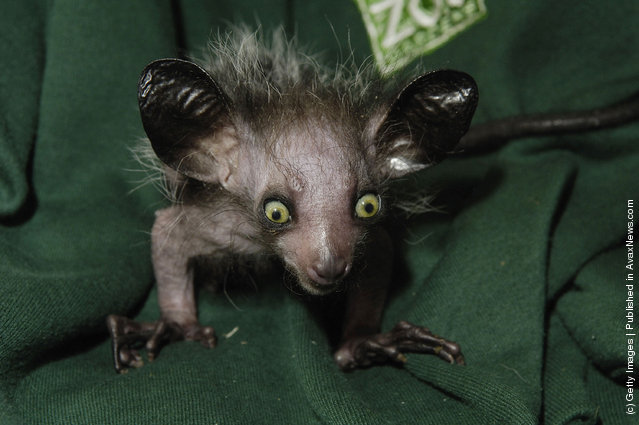
“The aye-aye (Daubentonia madagascariensis) is a lemur, a strepsirrhine primate native to Madagascar that combines rodent-like teeth and a special thin middle finger to fill the same ecological niche as a woodpecker. It is the world's largest nocturnal primate, and is characterized by its unusual method of finding food; it taps on trees to find grubs, then gnaws holes in the wood and inserts its narrow middle finger to pull the grubs out. The only other animal species known to find food in this way is the striped possum. From an ecological point of view the aye-aye fills the niche of a woodpecker as it is capable of penetrating wood to extract the invertebrates within”. – Wikipedia

Photo: In this handout image from Bristol Zoo is seen the first captive bred aye-aye in the UK named “Kintana” (meaning star in Malagasy) April 15, 2005 at Bristol Zoo Gardens, England. The zoo announced today only the second baby aye-aye to be hand-reared in the world (the first was in Jersey Zoo) and has now made his first public appearance since his birth on 11 February 2005. (Photo by Rob Cousins/Bristol Zoo via Getty Images)
Details
13 Apr 2011 13:33:00