Loading...
Done
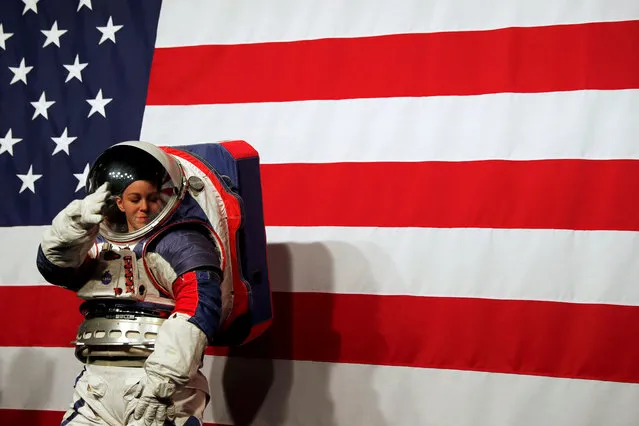
Advanced Space Suit Engineer at NASA Kristine Davis wears the xEMU prototype space suit for the next astronaut to the moon by 2024, during its presentation at NASA headquarters in Washington, U.S., October 15, 2019. (Photo by Carlos Jasso/Reuters)

Advanced Space Suit Engineer at NASA Kristine Davis wears the xEMU prototype space suit for the next astronaut to the moon by 2024, during its presentation at NASA headquarters in Washington, U.S., October 15, 2019. (Photo by Carlos Jasso/Reuters)
Details
22 Oct 2019 00:03:00
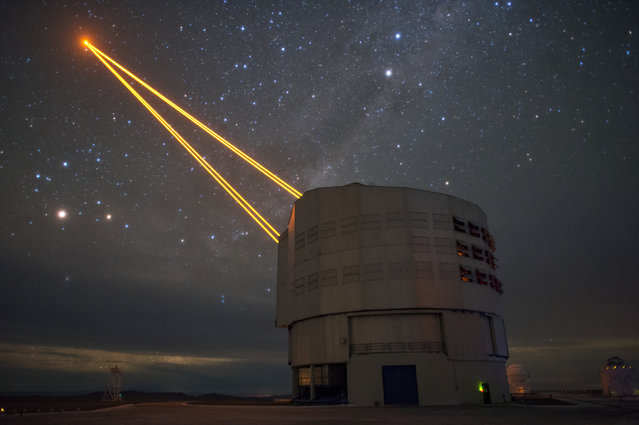
Four pillars of light from the 4 Laser Guide Star Facility on ESO's Very Large Telescope (VLT) are shown reaching into the Chilean night sky in this image from ESO Photo Ambassador Fred Kamphues, on September 2, 2016. The lasers are a key part of the adaptive optics system on the VLT. Adaptive optics allows astronomers to drastically reduce the atmospheric distortion present at even the best sites in the world for astronomy, including Paranal in Chile, the home of the VLT. (Photo by F. Kamphues/ESO)

Four pillars of light from the 4 Laser Guide Star Facility on ESO's Very Large Telescope (VLT) are shown reaching into the Chilean night sky in this image from ESO Photo Ambassador Fred Kamphues, on September 2, 2016. The lasers are a key part of the adaptive optics system on the VLT. Adaptive optics allows astronomers to drastically reduce the atmospheric distortion present at even the best sites in the world for astronomy, including Paranal in Chile, the home of the VLT. (Photo by F. Kamphues/ESO)
Details
23 Feb 2017 00:06:00
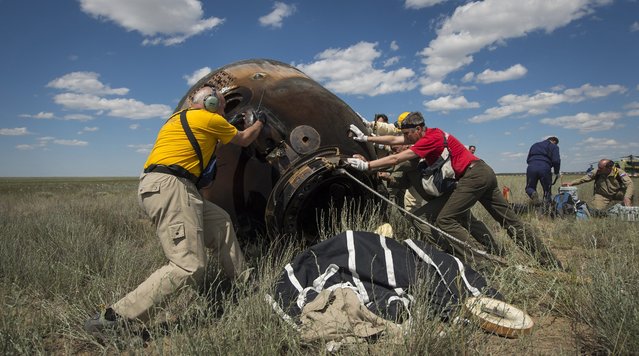
A handout phptopgraph made avaiable by NASA showing Russian support personnel roll the Soyuz TMA-19M spacecraft after it landed with with with Expedition 47 crew members Tim Kopra of NASA, Tim Peake of the European Space Agency, and Yuri Malenchenko of Roscosmos near the town of Zhezkazgan, Kazakhstan 18 June 2016. Kopra, Peake, and Malenchenko are returning after six months in space where they served as members of the Expedition 46 and 47 crews onboard the International Space Station. (Photo by Bill Ingalls/EPA/NASA)

A handout phptopgraph made avaiable by NASA showing Russian support personnel roll the Soyuz TMA-19M spacecraft after it landed with with with Expedition 47 crew members Tim Kopra of NASA, Tim Peake of the European Space Agency, and Yuri Malenchenko of Roscosmos near the town of Zhezkazgan, Kazakhstan 18 June 2016. Kopra, Peake, and Malenchenko are returning after six months in space where they served as members of the Expedition 46 and 47 crews onboard the International Space Station. (Photo by Bill Ingalls/EPA/NASA)
Details
19 Jun 2016 10:20:00
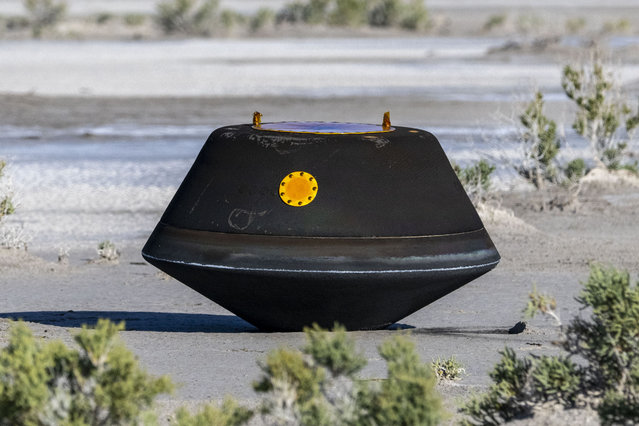
In this photo provided by NASA, the sample return capsule from NASA's Osiris-Rex mission lies on the ground shortly after touching down in the desert, at the Department of Defense's Utah Test and Training Range on Sunday, September 24, 2023. The sample was collected from the asteroid Bennu in October 2020. (Photo by Keegan Barber/NASA via AP Photo)

In this photo provided by NASA, the sample return capsule from NASA's Osiris-Rex mission lies on the ground shortly after touching down in the desert, at the Department of Defense's Utah Test and Training Range on Sunday, September 24, 2023. The sample was collected from the asteroid Bennu in October 2020. (Photo by Keegan Barber/NASA via AP Photo)
Details
27 Nov 2024 03:45:00
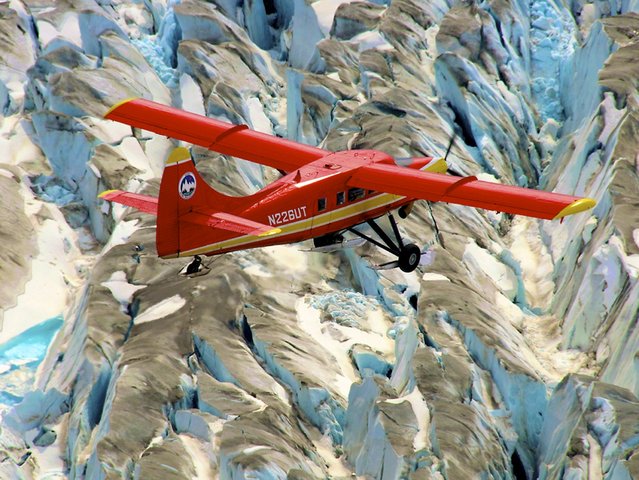
NASA's DHC-3 Otter plane flies in Operation IceBridge-Alaska surveys of mountain glaciers in Alaska in this image released on September 18, 2014. Over the past few decades, average global temperatures have been on the rise, and this warming is happening two to three times faster in the Arctic. (Photo by Chris Larsen/Reuters/NASA/University of Alaska-Fairbanks)

NASA's DHC-3 Otter plane flies in Operation IceBridge-Alaska surveys of mountain glaciers in Alaska in this image released on September 18, 2014. Over the past few decades, average global temperatures have been on the rise, and this warming is happening two to three times faster in the Arctic. (Photo by Chris Larsen/Reuters/NASA/University of Alaska-Fairbanks)
Details
20 Sep 2014 10:28:00
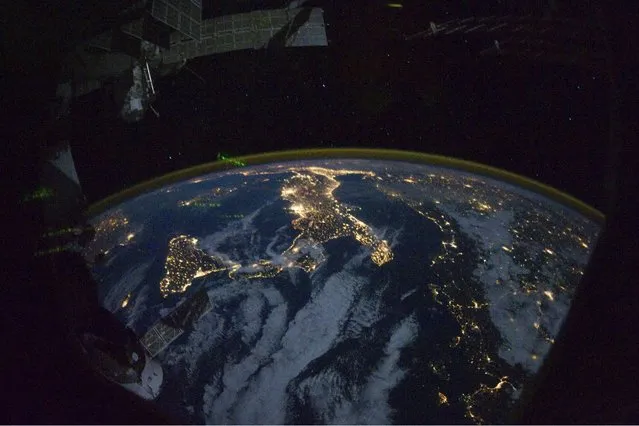
This image provided by NASA shows parts of Europe and Africa very easily recognizable in this night time image shot by one of the Expedition 25 crew members aboard the International Space Station flying 220 miles above Earth on Thursday Oct. 28, 2010. The view “looks” northward over Sicily and the “boot” of Italy, with the Mediterranean Sea representing most of the visible water in the view and the Adriatic Sea to the right of center. Tunisia is partially visible at left. Part of a docked Russian spacecraft and other components of the ISS are in the foreground. (Photo by AP photo/NASA)

This image provided by NASA shows parts of Europe and Africa very easily recognizable in this night time image shot by one of the Expedition 25 crew members aboard the International Space Station flying 220 miles above Earth on Thursday October 28, 2010. The view “looks” northward over Sicily and the “boot” of Italy, with the Mediterranean Sea representing most of the visible water in the view and the Adriatic Sea to the right of center. Tunisia is partially visible at left. Part of a docked Russian spacecraft and other components of the ISS are in the foreground. (Photo by AP Photo/NASA)
Details
11 May 2013 12:29:00
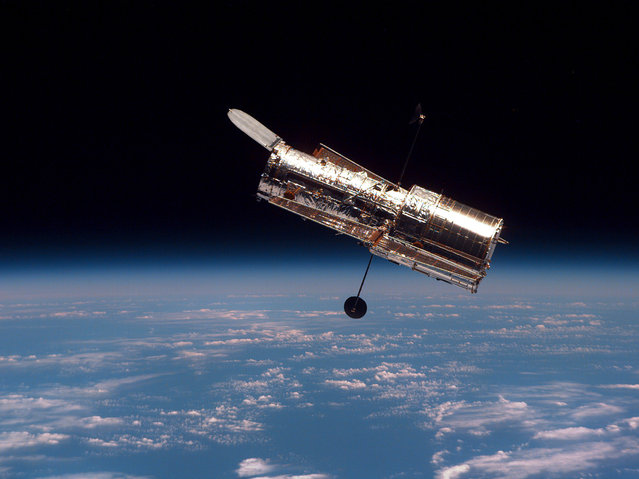
The Hubble Space Telescope is shown following its release from the space shuttle Discovery Wednesday, February 19, 1997. The Hubble Space Telescope, one of NASA'S crowning glories, marks its 25th anniversary on Friday, April 24, 2015. With more than 1 million observations, including those of the farthest and oldest galaxies ever beholden by humanity, no man-made satellite has touched as many minds or hearts as Hubble. (Photo by AP Photo/NASA)

The Hubble Space Telescope is shown following its release from the space shuttle Discovery Wednesday, February 19, 1997. The Hubble Space Telescope, one of NASA'S crowning glories, marks its 25th anniversary on Friday, April 24, 2015. With more than 1 million observations, including those of the farthest and oldest galaxies ever beholden by humanity, no man-made satellite has touched as many minds or hearts as Hubble. (Photo by AP Photo/NASA)
Details
24 Apr 2015 11:25:00
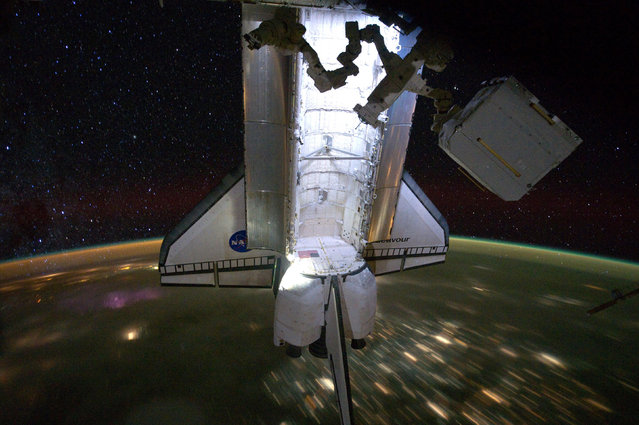
Backdropped by a night time view of the Earth and the starry sky, the Space Shuttle Endeavour is seen docked to the International Space Station on May 28, 2011. (Photo by Reuters/NASA)

Backdropped by a night time view of the Earth and the starry sky, the Space Shuttle Endeavour is seen docked to the International Space Station on May 28, 2011. (Photo by Reuters/NASA)
Details
21 Sep 2014 10:50:00