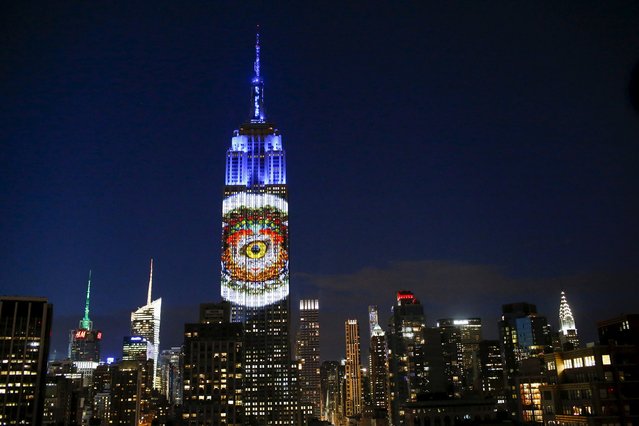
Images are projected onto the Empire State Building as part of an endangered species projection to raise awareness, in New York August 1, 2015. (Photo by Eduardo Munoz/Reuters)
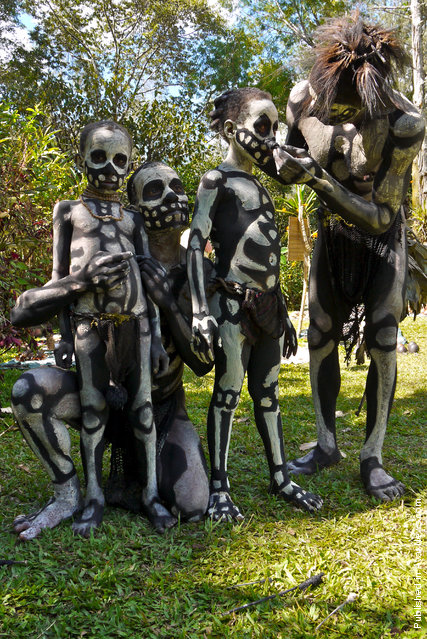
Skeleton bodypainting in Chimbu tribe. Village Mindima, Simbu (a Highlands Region province in Papua New Guinea), September 14, 2009. (Photo by Rita Willaert; Source: Flickr)
Professional bodybuilders (L-R) Victor Martinez of the Dominican Republic, Mamdouh Elssbiay of Egypt, and Cedric McMillan and Juan Morel of U.S, pose during the Arnold Classic Brazil 2015 in Rio de Janeiro, May 30, 2015. REUTERS/Ricardo Moraes
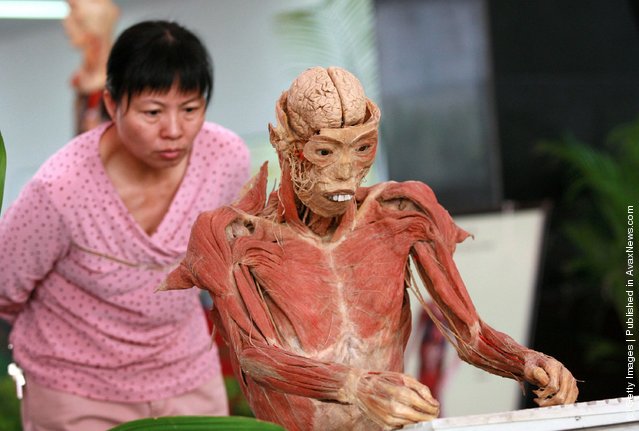
A visitor views a human body specimen during the “Human Body's Wonder Scientific Travelling Exhibition” at the Haikou Gymnasium April 30, 2006 in Haikou of Hainan Province, China. The exhibition displays 13 complete real human body specimens and about 300 pieces of small samples, such as organs, skin, etc with the purpose to promote science and help people know more about their bodies. (Photo by China Photos/Getty Images)
A model poses with her bodypainting designed by bodypainting artist Arianna Barlini from Italy, in the 2016 World Bodypainting Festival, 2016 in Poertschach am Woerthersee, Austria. (Photo by Didier Messens/Getty Images)
Using acrylic paint, 19-year old Japanese student and artist Chooo-San has transformed the bodies of herself and a handful of lucky volunteers into ones that appear to be from another planet. Bored with technology, she wanted to see how far she could go with creating eye-catching illusions in the real world, rather than relying on programs like Photoshop.
For more than a century, the Barcelona skyline has been graced (or marred, depending on who’s talking) by the spectacle of the Basilica designed by Anton Gaudi, first started in 1882. If you want to know what it’ll look like when finished, don’t fret — 2026 is right around the corner. Or you can watch this video, released last week on YouTube by Basílica de la Sagrada Família and titled simply “2026 We Build Tomorrow,” a 3-D artists’ rendering of the building stages through completion.
(If 144 years sounds like a long time to finish a cathedral, keep in mind that there were decades that they didn’t work on it — and that Notre Dame de Paris took 182 years, although the 13th century Parisians didn’t have diesel-powered industrial cranes.) Now, if only the video could show us what the admission and hours will be in 2026 (and how to avoid the inevitable long lines).