Loading...
Done
A doll forms part of a sculpture as part of an exhibit titled The Sea Isnt Made for Fish at Rio de Janeiro Federal University in Rio de Janeiro, Brazil, Monday, June 1, 2015. Art students have taken advantage of a material they have in endless supply trash to create an exhibition that aims to draw attention to the fetid state of the citys Guanabara Bay, where the Olympic sailing events are to be held next year. (AP Photo/Silvia Izquierdo)

A doll forms part of a sculpture as part of an exhibit titled The Sea Isn't Made for Fish at Rio de Janeiro Federal University in Rio de Janeiro, Brazil, Monday, June 1, 2015. Art students have taken advantage of a material they have in endless supply trash to create an exhibition that aims to draw attention to the fetid state of the citys Guanabara Bay, where the Olympic sailing events are to be held next year. (AP Photo/Silvia Izquierdo)
Details
08 Jun 2015 15:25:00
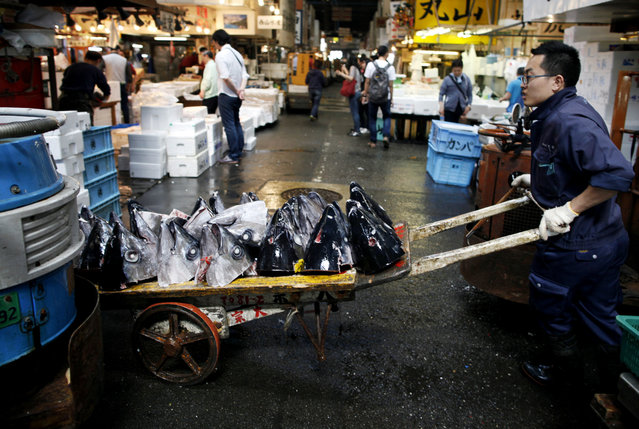
In this April 28, 2015 file photo, heads of tuna on a cart are carried by a fish dealer after the day's auction at Tsukiji Wholesale Market in Tokyo. In one of the biggest of Japan's many New Year holiday rituals, early on Tuesday, January 5, 2016, Tokyo's Tsukiji market will auction off with much fanfare a huge, glistening tuna, likely destined for one of the big sushi chains. If all goes as planned, it will be the last such auction at 80-year-old Tsukiji. (Photo by Shuji Kajiyama/AP Photo)

In this April 28, 2015 file photo, heads of tuna on a cart are carried by a fish dealer after the day's auction at Tsukiji Wholesale Market in Tokyo. In one of the biggest of Japan's many New Year holiday rituals, early on Tuesday, January 5, 2016, Tokyo's Tsukiji market will auction off with much fanfare a huge, glistening tuna, likely destined for one of the big sushi chains. If all goes as planned, it will be the last such auction at 80-year-old Tsukiji. (Photo by Shuji Kajiyama/AP Photo)
Details
06 Jan 2016 08:03:00
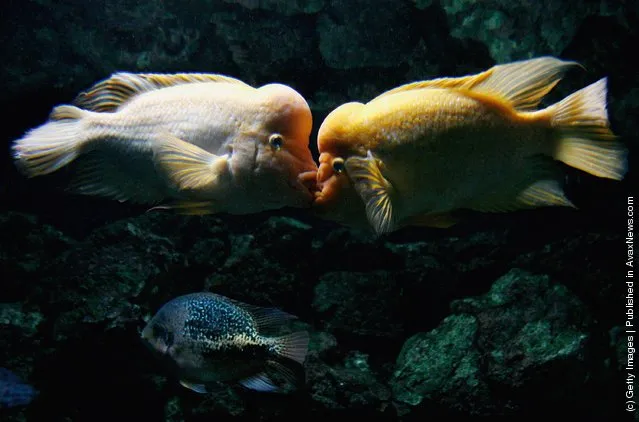
Midas Cichlid a.k.a. Amphilophus Citrinellus

“Amphilophus citrinellus is a large cichlid fish endemic to the San Juan River and adjacent watersheds in Costa Rica and Nicaragua. In the aquarium trade A. citrinellus is often sold under the trade name of Midas cichlid. A. citrinellus are omnivorous and their diet consists of plant material, molluscs and smaller fish”. – Wikipedia

Photo: Two Midas Cichlid (lat: amphilophus citrinellus) fish are seen in an aquarium at Hellabrunn zoo on December 23, 2009 in Munich, Germany. (Photo by Alexandra Beier/Getty Images)
Details
17 Aug 2011 11:29:00
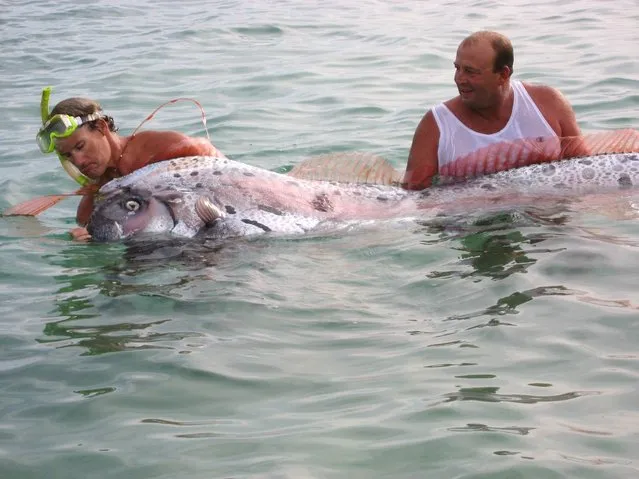
Regalecus Glesne

“The king of herrings or giant oarfish, an oarfish of the family Regalecidae, is the world's longest bony fish. Its total length has been documented to reach 17 m (56 ft), and it can weigh up to 300 kg (661 lb)”. – Wikipedia
Details
23 May 2012 13:38:00


“The Portuguese Water Dog is a breed of working dog as classified by the American Kennel Club. Portuguese Water Dogs are originally from the Portuguese region of the Algarve, from where the breed expanded to all around Portugal's coast, where they were taught to herd fish into fishermen's nets, to retrieve lost tackle or broken nets, and to act as couriers from ship to ship, or ship to shore. Portuguese Water Dogs rode in bobbing fishing trawlers as they worked their way from the warm Atlantic waters of Portugal to the frigid fishing waters off the coast of Iceland where the fleets caught cod to bring home. Portuguese Water Dogs were often taken with sailors during the Portuguese discoveries”. – Wikipedia

Photo: Kix, a Portuguese Water Dog , enjoys a walk around the muddy fields near his home before the grooming and preparation starts for this years Crufts on March 3, 2009 in Telford, England. (Photo by Christopher Furlong/Getty Images)
Details
26 Jul 2011 11:27:00
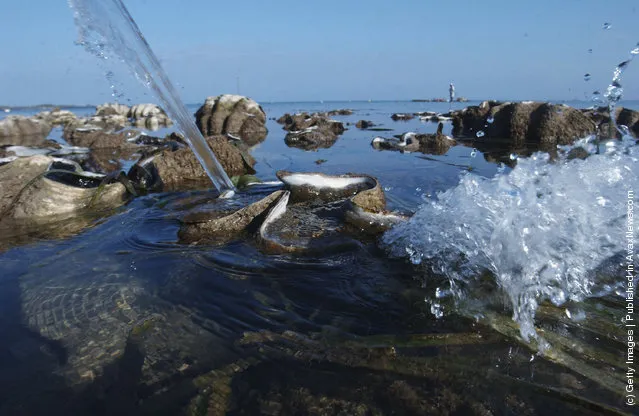
Tridacna Gigas, or Giant Clams

“The giant clam, Tridacna gigas (known as pā’ua in Cook Islands Māori), is the largest living bivalve mollusc. T. gigas is one of the most endangered clam species. It was mentioned as early as 1825 in scientific reports. One of a number of large clam species native to the shallow coral reefs of the South Pacific and Indian oceans, they can weigh more than 200 kilograms (440 lb) measure as much as 120 cm (47 in) across, and have an average lifespan in the wild of 100 years or more”. – Wikipedia

Photo: Tridacna Gigas, or Giant Clams spew water as a traditional fisherman passes by a small sanctuary on January 23, 2004 near Bolinao in the Northern Philippines. The clams, prime builders for coral reefs and providing shelter for spawning fish and other marine life, are exposed by low tides in the sanctuary. Overfishing and pollution throughout the country are not only threatening food security, but are also starting to choke one of the few working clam sanctuaries in the world. (Photo by David Greedy/Getty Images)
Details
01 Oct 2011 13:10:00
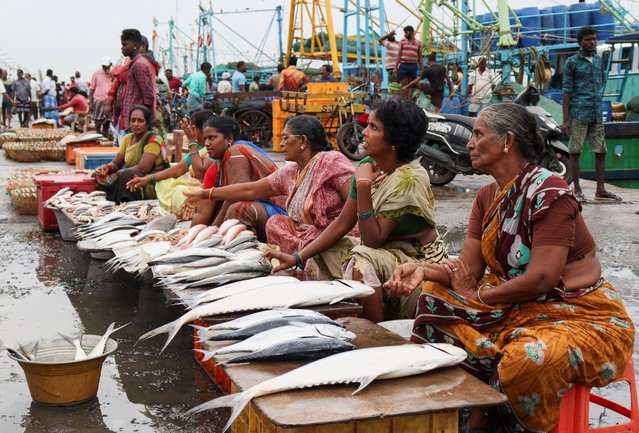
Women wait for customers at the fish harbour in Kasimedu Fish market, Chennai, India, on June 26, 2024. (Photo by Riya Mariyam R./Reuters)

Women wait for customers at the fish harbour in Kasimedu Fish market, Chennai, India, on June 26, 2024. (Photo by Riya Mariyam R./Reuters)
Details
06 Nov 2024 03:43:00
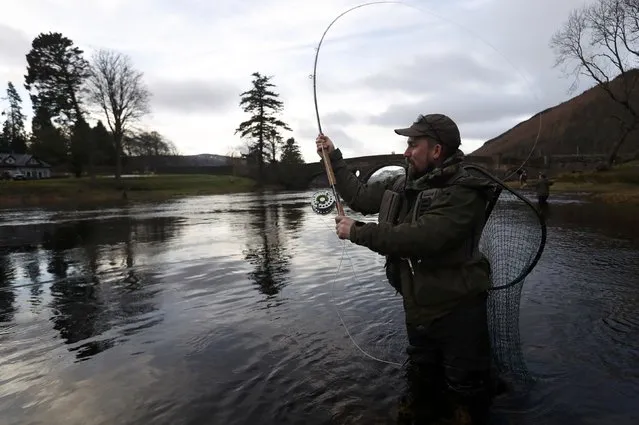
An angler fishes on the opening day of the salmon fishing season on the River Tay at Kenmore in Scotland, Britain January 16, 2017. (Photo by Russell Cheyne/Reuters)

An angler fishes on the opening day of the salmon fishing season on the River Tay at Kenmore in Scotland, Britain January 16, 2017. (Photo by Russell Cheyne/Reuters)
Details
17 Jan 2017 12:18:00