Loading...
Done
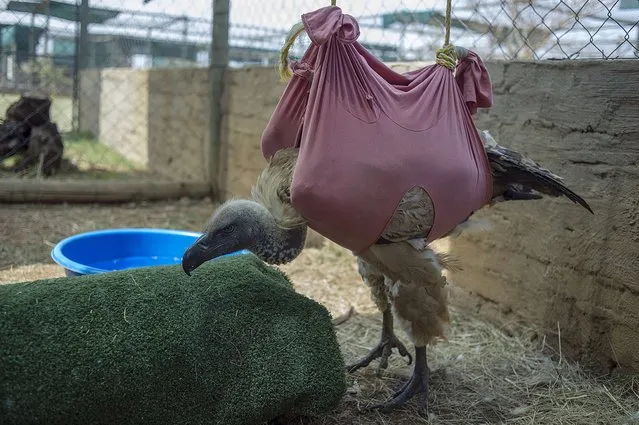
An injured vulture is treated at the VulPro Vulture Rehabilitation Centre in Hartebeepoortdam in the Magalisburg region on September 15, 2015. Confined to southern Africa, just under 4,000 breeding pairs of Cape Vultures remain in the wild, mostly in South Africa, Lesotho and Botswana. Unless conservation efforts are successful, Africa's largest vulture species may be facing eventual extinction. (Photo by Mujahid Safodien/AFP Photo)

An injured vulture is treated at the VulPro Vulture Rehabilitation Centre in Hartebeepoortdam in the Magalisburg region on September 15, 2015. Confined to southern Africa, just under 4,000 breeding pairs of Cape Vultures remain in the wild, mostly in South Africa, Lesotho and Botswana. Unless conservation efforts are successful, Africa's largest vulture species may be facing eventual extinction. (Photo by Mujahid Safodien/AFP Photo)
Details
19 Sep 2015 12:27:00
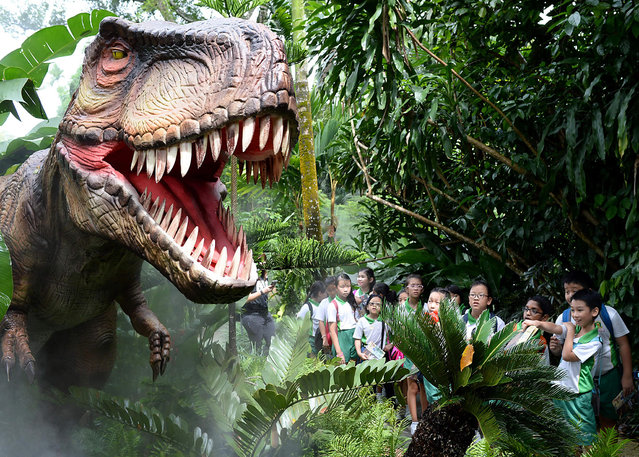
Schoolchildren look at a lifelike animatronics display of a dinosaur at the dinosaur-themed Zoo-rassic Park in Singapore on November 16, 2016. To raise awareness on the sixth mass extinction, the Singapore Zoo and River Safari displayed lifelike dinosaur animatronics where visitors can trail along the Dinosaur Valley which does not involve living animals. (Photo by Roslan Rahman/AFP Photo)

Schoolchildren look at a lifelike animatronics display of a dinosaur at the dinosaur-themed Zoo-rassic Park in Singapore on November 16, 2016. To raise awareness on the sixth mass extinction, the Singapore Zoo and River Safari displayed lifelike dinosaur animatronics where visitors can trail along the Dinosaur Valley which does not involve living animals. (Photo by Roslan Rahman/AFP Photo)
Details
17 Nov 2016 11:47:00
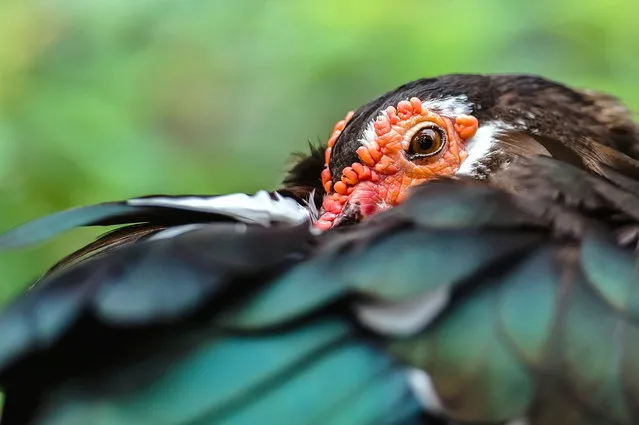
Beautiful Nicobar Pigeon

The Nicobar pigeon (Caloenas nicobarica) is a pigeon found on small islands and in coastal regions from the Nicobar Islands, east through the Malay Archipelago, to the Solomons and Palau. It is the only living member of the genus Caloenas and the closest living relative of the extinct dodo.
Details
06 Sep 2014 17:09:00
Apocalyptic Metropolises by Daniel Del Nero

Italian artist Daniel Del Nero created this aerily beautiful series of architectural scale models, that he constructed with black paper, and covered with flour and a layer of mold. The effect is that of peering into the distant future, long after the extinction of humanity itself.
Details
15 Nov 2012 09:14:00
Li Guoqiang talks on his phone outside his house at Guangfuli neighbourhood, in Shanghai, China, April 1, 2016. Li, 38, is a deliveryman who rents a place at Guangfuli. (Photo by Aly Song/Reuters)

Li Guoqiang talks on his phone outside his house at Guangfuli neighbourhood, in Shanghai, China, April 1, 2016. Li, 38, is a deliveryman who rents a place at Guangfuli. In a corner of Shanghai, surrounded by a cement wall, lies one of the world's most valuable fields of debris and garbage. On paper, the Guangfuli neighbourhood is a real estate investor's dream: a plot in the middle of one of the world's most expensive and fast-rising property markets. But the reality is more like a developer's nightmare, thanks to hundreds of people living there who have refused to budge from their ramshackle homes for nearly 16 years as the local authority sought to clear the land for new construction. (Photo by Aly Song/Reuters)
Details
06 May 2016 13:54:00
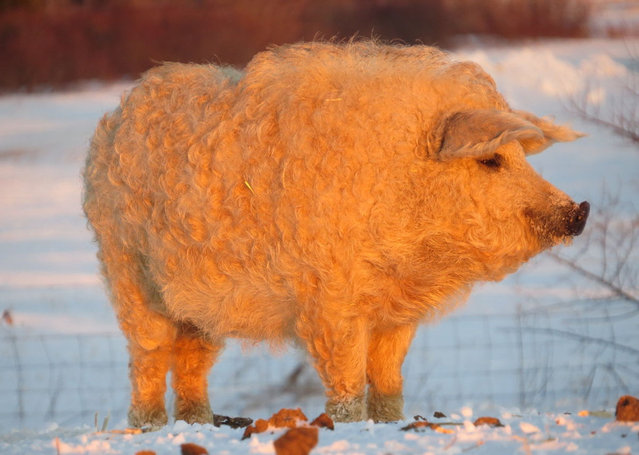
Mangalitsa The Hairy Pig

When you look at the picture of a furry pig that resembles a sheep from a distance, you may think that this may be the result of the work of some crazy scientist that tinkered with the pig’s genome. However, in this case, this is not true. Mangalica is a natural breed of pigs, which were bred in Europe for their lard. This breed of pigs is very unique, since the only other breed of pigs which had a long coat was Loncolnshire Curly Coat, which is now extinct. In the past, these pigs were quite popular, since they were able to produce a lot of lard. However, when the demand for pig lard dwindled, the population of these pigs rapidly decreased, making it a “rare breed”.
Details
01 Dec 2014 13:42:00
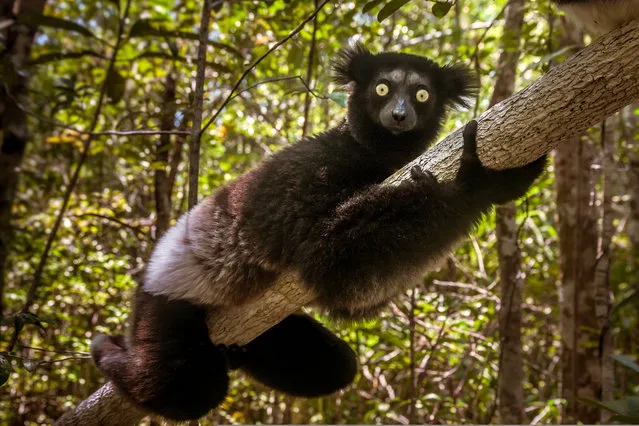
The secretive indri (Indri indri) of Madagascar, the largest living lemur. It is also critically endangered and highly evolutionarily distinct with no close relatives, which makes its branch one of most precarious on the mammal evolutionary tree. In the likely event that the indri goes extinct, we will lose 19m years of unique evolutionary history from the mammal tree of life. (Photo by Pierre-Yves Babelon/Aarhus University)

The secretive indri (Indri indri) of Madagascar, the largest living lemur. It is also critically endangered and highly evolutionarily distinct with no close relatives, which makes its branch one of most precarious on the mammal evolutionary tree. In the likely event that the indri goes extinct, we will lose 19m years of unique evolutionary history from the mammal tree of life. (Photo by Pierre-Yves Babelon/Aarhus University)
Details
18 Nov 2018 00:02:00
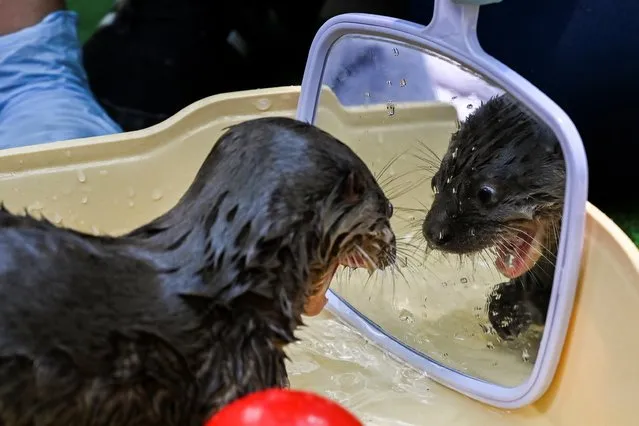
A river otter (lontra longicaudis) of 6-weeks-old looks in the mirror during a bath in the Animal Welfare Unit of the Zoo in Cali, Colombia, on October 22, 2019. The baby otter was found abandoned brought to the Cali Zoo for breeding, for its extensive experience in raising these species. According to the International Union for Conservation of Nature the river otter (lontra longicaudis) are in danger of extinction, because of mining, agriculture, pollution of rivers and housing construction in their habitat. (Photo by Luis Robayo/AFP Photo)

A river otter (lontra longicaudis) of 6-weeks-old looks in the mirror during a bath in the Animal Welfare Unit of the Zoo in Cali, Colombia, on October 22, 2019. The baby otter was found abandoned brought to the Cali Zoo for breeding, for its extensive experience in raising these species. According to the International Union for Conservation of Nature the river otter (lontra longicaudis) are in danger of extinction, because of mining, agriculture, pollution of rivers and housing construction in their habitat. (Photo by Luis Robayo/AFP Photo)
Details
27 Oct 2019 00:03:00