Loading...
Done
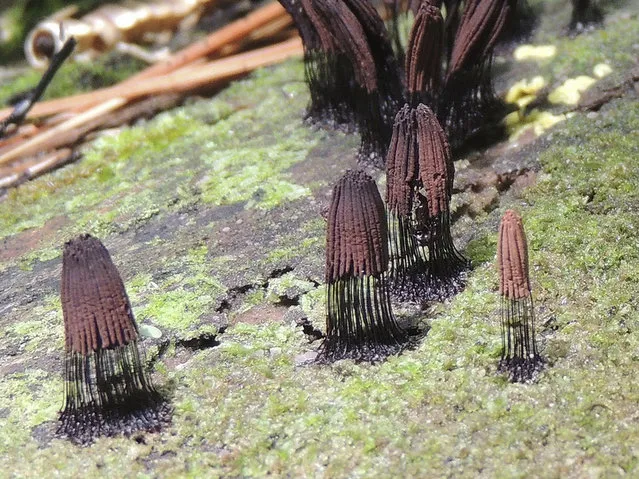
Stemonitis  Axifera

Stemonitis axifera is a species of slime mold. It fruits in clusters on dead wood, and has distinctive tall reddish-brown sporangia, supported on slender stalks. The species was first described as Trichia axifera by Jean Baptiste François Pierre Bulliard in 1791. Thomas Huston MacBride transferred it to the genus Stemonitis in 1889. Stemonitis fasciculata and Stemonitis smithii are synonyms.
Details
08 Feb 2014 10:30:00
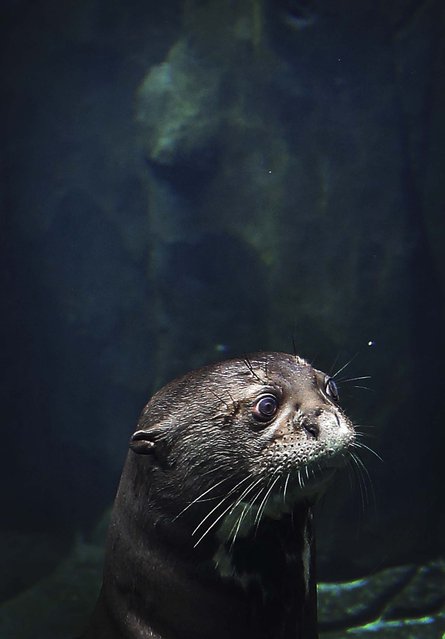
A giant river otter, the world's largest otter species, looks out of its enclosure at the newly completed River Safari in Singapore, on March 25, 2013. (Photo by Wong Maye-E/Associated Press)

A giant river otter, the world's largest otter species, looks out of its enclosure at the newly completed River Safari in Singapore, on March 25, 2013. (Photo by Wong Maye-E/Associated Press)
Details
30 Mar 2013 12:22:00
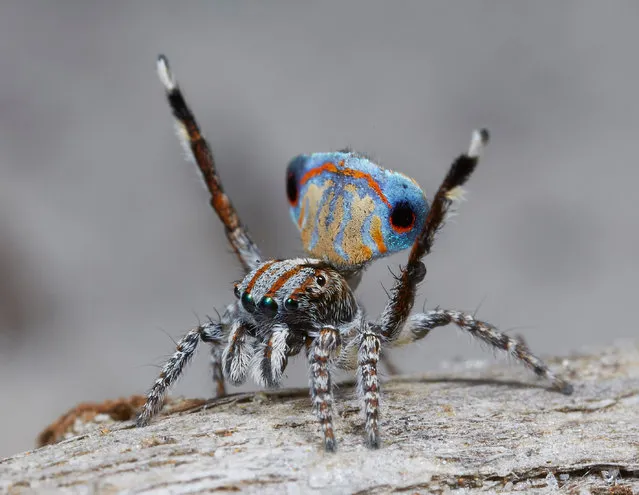
Several new species of peacock spider – just a few millimetres long and featuring extraordinary colours – have been discovered in Western Australia and South Australia. Jürgen Otto, a biologist from Sydney, has been researching the arachnids since 2005, and has gained a significant following online with his footage. He believes there are now 48 confirmed species of peacock spider within the Maratus genus, found across Australia but particularly in Western Australia – and many more awaiting confirmation. Here: Maratus Tasmanicus, one of seven new species of peacock spiders studied by the Sydney biologist Jürgen Otto. (Photo by Jürgen Otto)

Several new species of peacock spider – just a few millimetres long and featuring extraordinary colours – have been discovered in Western Australia and South Australia. Jürgen Otto, a biologist from Sydney, has been researching the arachnids since 2005, and has gained a significant following online with his footage. He believes there are now 48 confirmed species of peacock spider within the Maratus genus, found across Australia but particularly in Western Australia – and many more awaiting confirmation. Here: Maratus Tasmanicus, one of seven new species of peacock spiders studied by the Sydney biologist Jürgen Otto. (Photo by Jürgen Otto)
Details
30 May 2016 08:40:00
Tin and Naing win live on a small boat which they sail throughout the Delta region in Myanmar. The former gardeners once had a home on land but it was destroyed when a powerful cyclone ravaged the area in 2008. Since then, the couple have not been able to afford to rebuild their home, so they live on the boat from which they sell fish paste to make a living. (Photo by Muse Mohammed/IOM)

The ferocity of crises worldwide is forcing a record number of people to flee their homes, seeking some form of safety within their own country or across international borders. There are 65.3 million displaced people worldwide, including 21.3 million refugees. Most have lost their homes to armed conflict or natural disasters but other factors, such as extreme poverty and climate change, also drive displacement. The International Organisation for Migration commissioned photojournalist Muse Mohammed to document the plight of the displaced. (Photo by Muse Mohammed/IOM)
Details
02 Jan 2017 12:04:00
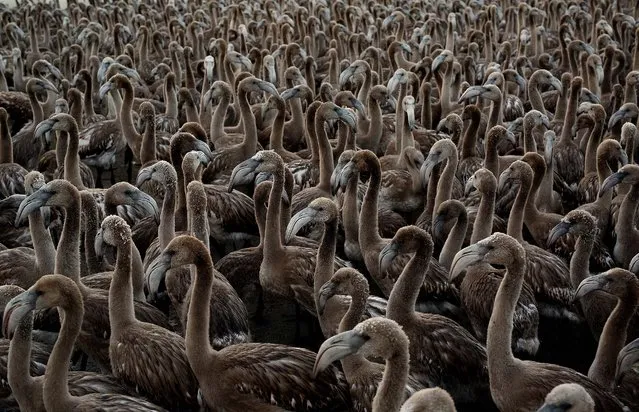
Flamingo chicks walk in an enclosure before they are tagged in Fuente de Piedra, Spain, on Jule 19, 2014. Fuente de Piedra lagoon is a natural reserve with more than 170 different species recorded and one of the main breeding grounds for flamingos in the Iberian Peninsule. Hundreds of flamingo chicks are tagged and checked annually to record the evolution of the species. (Photo by Pablo Blazquez Dominguez/Getty Images)

Flamingo chicks walk in an enclosure before they are tagged in Fuente de Piedra, Spain, on Jule 19, 2014. Fuente de Piedra lagoon is a natural reserve with more than 170 different species recorded and one of the main breeding grounds for flamingos in the Iberian Peninsule. Hundreds of flamingo chicks are tagged and checked annually to record the evolution of the species. (Photo by Pablo Blazquez Dominguez/Getty Images)
Details
21 Jul 2014 10:51:00
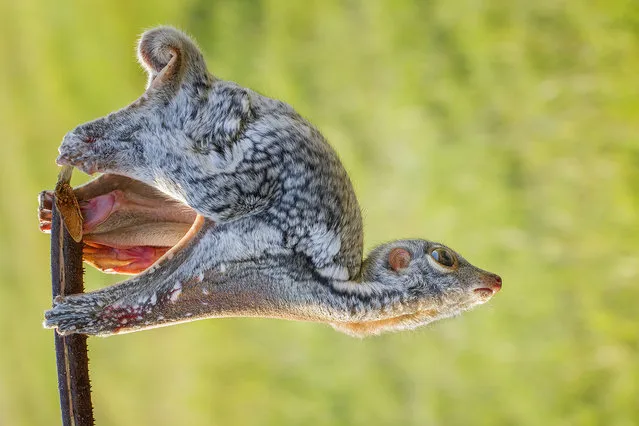
“Warming up”. This photo I capture in the early afternoon, the animal species of lemurs fly. Photo location: Sambas, West Kalimantan, Indonesia. (Photo and caption by Hendy Mp/National Geographic Photo Contest)

“Warming up”. This photo I capture in the early afternoon, the animal species of lemurs fly. Photo location: Sambas, West Kalimantan, Indonesia. (Photo and caption by Hendy Mp/National Geographic Photo Contest)
Details
03 Oct 2014 11:52:00
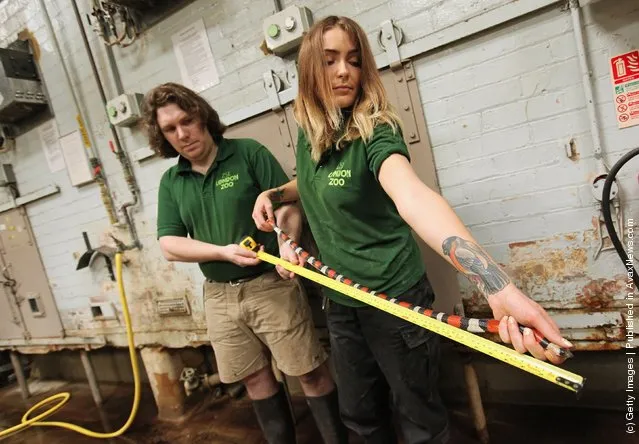
Zookeepers measure the length of a pueblan milk snake

Zookeepers measure the length of a pueblan milk snake in the Reptile House of ZSL London Zoo as part of their annual weighing and measuring of their animals on August 25, 2011 in London, England. The heights and weights of over 750 different animal species at the zoo are recorded into the International Species Information System, to monitor their health and share the data with other zoos across the world. (Photo by Oli Scarff/Getty Images)
Details
26 Aug 2011 09:42:00
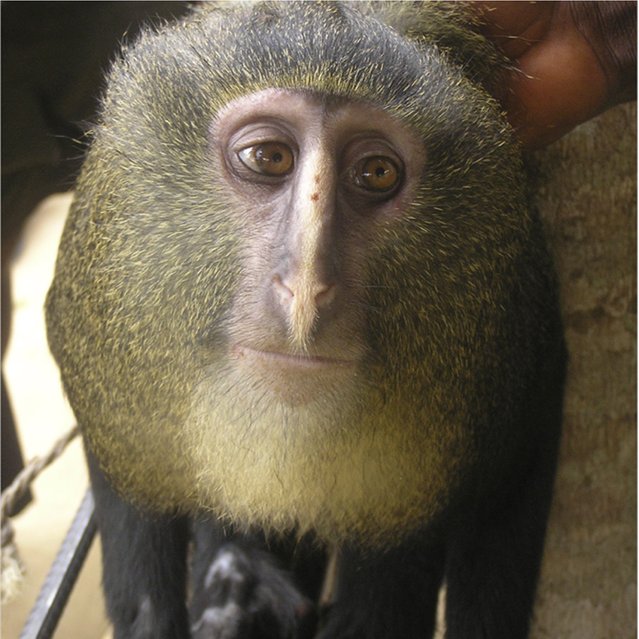
A new species of monkey found in the Democratic Republic of the Congo and identified as Lesula (Cercopithecus lomamiensis) is seen in this undated photograph from an article published September 12, 2012 in the science journal PLOS One. (Photo by Hart J. A., Detwiler K. M., Gilbert C. C./Reuters)

A new species of monkey found in the Democratic Republic of the Congo and identified as Lesula (Cercopithecus lomamiensis) is seen in this undated photograph from an article published September 12, 2012 in the science journal PLOS One. The monkey was first seen in 2007 by researchers John and Terese Hart of the Peabody Museum of Natural History at Yale Research Project. The finding of C. lomamiensis represents only the second new species of African monkey to be discovered in the past 28 years, according to the research article. (Photo by Hart J. A., Detwiler K. M., Gilbert C. C./Reuters)
Details
27 Sep 2012 08:17:00