People wrapped in blankets sit on the road as they are evacuated from a hotel after an earthquake in Kumamoto, southern Japan, in this photo taken by Kyodo April 14, 2016. A powerful earthquake with a magnitude of 6.5 knocked over buildings in southern Japan on Thursday evening, and police said people may be trapped underneath. (Photo by Reuters/Kyodo News)
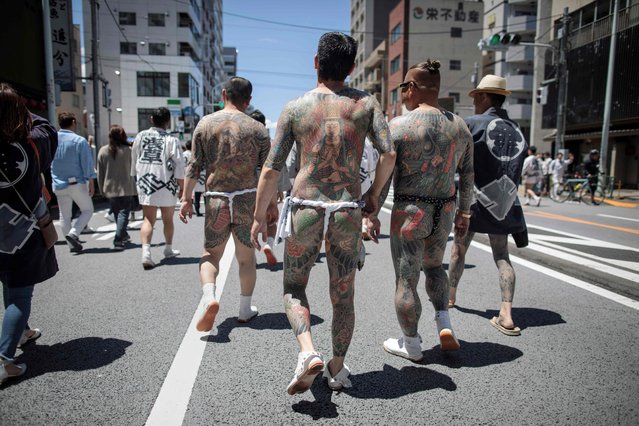
Participants with traditional Japanese tattoos (Irezumi), related to the Yakuza, walk through the Asakusa district during the annual Sanja Matsuri festival in Tokyo on May 20, 2018. Sanja Matsuri festival is a celebration for the three founders of Sensoji Temple in the Asakusa neighbourhood with nearly two million people visiting during the three-day event. (Photo by Behrouz Mehri/AFP Photo)
Tourists take photographs as a wild sika deer eats a bag on June 6, 2019 in Nara, Japan. Nara's free-roaming deer have become a huge attraction for tourists. However, an autopsy on a deer that was recently found dead near one of the city's famous temples discovered 3.2kg of plastic in its stomach and caused concern at the effect of tourism as Japan struggles to cope with a huge increase in domestic and international tourists. (Photo by Carl Court/Getty Images)
Women in yukatas, or casual summer kimonos, take their selfie in front of paper lanterns during the annual Mitama Festival at the Yasukuni Shrine, where more than 2.4 million war dead are enshrined, in Tokyo, Japan July 13, 2017. (Photo by Kim Kyung-Hoon/Reuters)
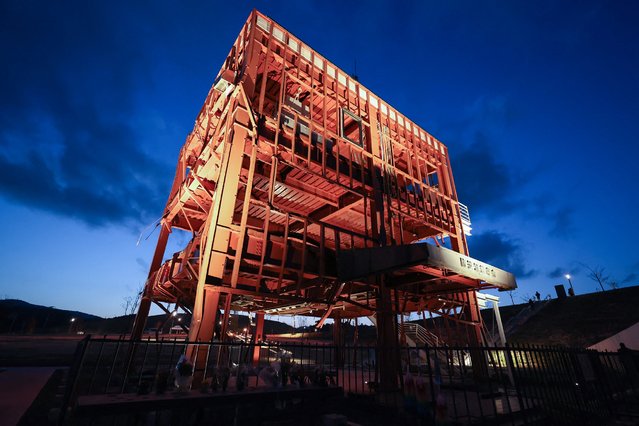
This photo taken on March 10, 2025 shows the former disaster prevention office building in Minamisanriku Town, Miyagi Prefecture, lit up on the eve of the 14th anniversary of the 2011 earthquake and tsunami disaster. (Photo by JIJI Press/AFP Photo)
A young woman wearing the summer Kimono, “Yukata” watches the goldfishes during the press preview of “Eco Edo Nihombashi Art Aquarium 2014” exhibition in Tokyo on July 10, 2014. The two-month-long goldfish exhibition will starts July 11. (Photo by Toshifumi Kitamura/AFP Photo)
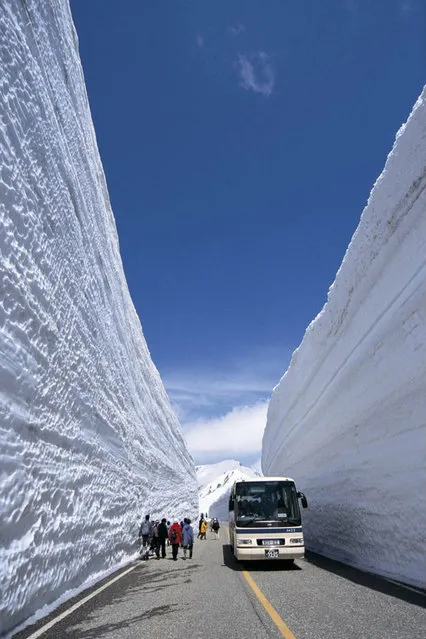
The Tateyama Kurobe Alpine Route is an international mountain sightseeing route some 90 kilometers (56 miles) long. The route goes across the 3,000-meter-high North Alpine mountains, the so-called “roof of Japan,” and connects Toyama and Shinano Omachi. You can enjoy the panorama by taking a train, highland bus, trolley bus, cable car, and ropeway. Since the lines opened in June 1971, the Tateyama mountain area has been transformed from an isolated spot into one of the nation’s best sightseeing areas, where a million guests visit every year.