Loading...
Done
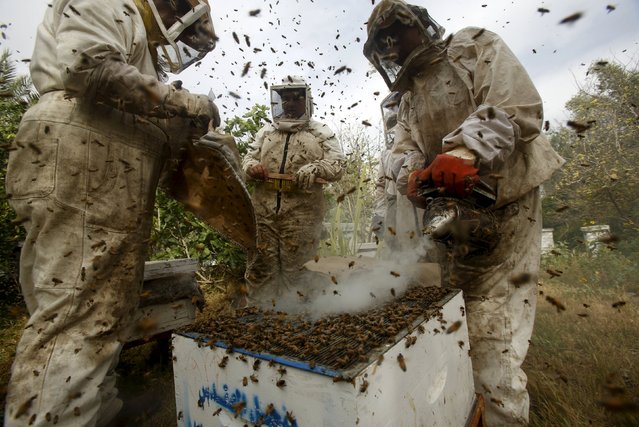
A Palestinian beekeeper uses smoke to calm bees in the process of collecting honey at a farm in Rafah, in the southern Gaza Strip April 11, 2016. (Photo by Suhaib Salem/Reuters)

A Palestinian beekeeper uses smoke to calm bees in the process of collecting honey at a farm in Rafah, in the southern Gaza Strip April 11, 2016. Rateb Samour sees 250 patients a day, whose complaints range from hair loss to cerebral palsy and cancer. He is not a doctor and has never worked in a hospital. Samour inherited the skill of bee-sting therapy from his father. From 2003 the agricultural engineer dedicated all his time to study and develop the alternative-medicine treatment of apitherapy, which uses bee-related products from honey, propolis – or bee glue used to build hives – to venom. (Photo by Suhaib Salem/Reuters)
Details
13 Apr 2016 09:14:00
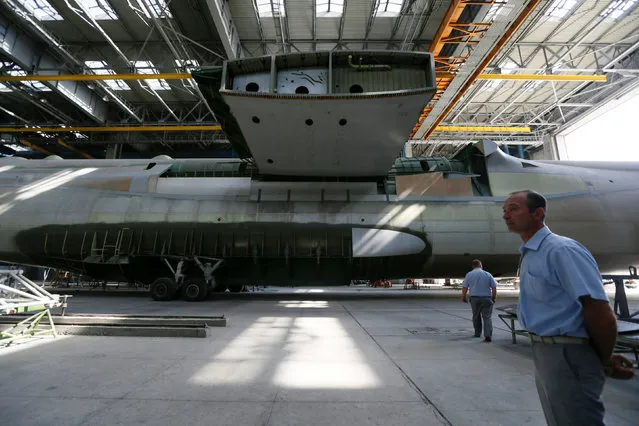
Employees stand near an airframe for the second Antonov-225 Mriya plane at Antonov aircraft plant in Kiev, Ukraine, September 7, 2016. Ukraine hopes to attract $500 million of investment from China to complete an updated version of the world's biggest aircraft, the Antonov-225 Mriya, the president of manufacturer Antonov said on Wednesday. The Antonov-225 is a cargo plane designed as part of the former Soviet Union's space programme. The only one completed is still in use and can carry up to 250 tonnes up to 4,000 km (2,485 miles). Work to manufacture a second plane was started in 1988 and never completed, but Antonov has now found a potential investor in the Aerospace Industry Corporation of China (AICC). (Photo by Valentyn Ogirenko/Reuters)

Employees stand near an airframe for the second Antonov-225 Mriya plane at Antonov aircraft plant in Kiev, Ukraine, September 7, 2016. Ukraine hopes to attract $500 million of investment from China to complete an updated version of the world's biggest aircraft, the Antonov-225 Mriya, the president of manufacturer Antonov said on Wednesday. (Photo by Valentyn Ogirenko/Reuters)
Details
08 Sep 2016 10:07:00
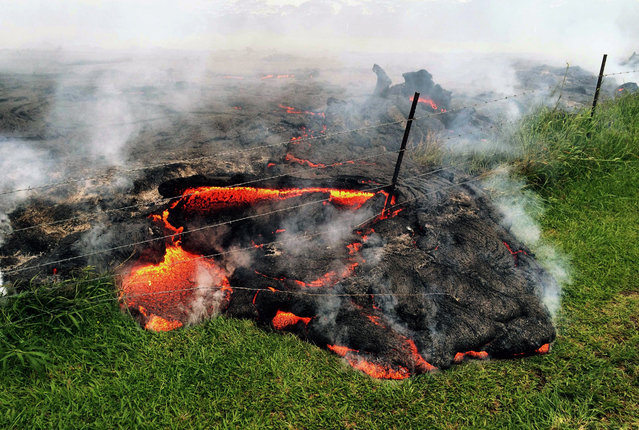
This October 25, 2014 photo provided by the U.S. Geological Survey shows lava flow advancing across the pasture between the Pahoa cemetery and Apa'a Street, engulfing a barbed wire fence, near the town of Pahoa on the Big Island of Hawaii. (Photo by AP Photo/U.S. Geological Survey)

This October 25, 2014 photo provided by the U.S. Geological Survey shows lava flow advancing across the pasture between the Pahoa cemetery and Apa'a Street, engulfing a barbed wire fence, near the town of Pahoa on the Big Island of Hawaii. Dozens of residents in this rural area of Hawaii were placed on alert as flowing lava continued to advance. Authorities on Sunday, October 26, 2014 said lava had advanced about 250 yards since Saturday morning and was moving at the rate of about 10 to 15 yards an hour, consistent with its advancement in recent days. The flow front passed through a predominantly Buddhist cemetery, covering grave sites in the mostly rural region of Puna, and was roughly a half-mile from Pahoa Village Road, the main street of Pahoa. (Photo by AP Photo/U.S. Geological Survey)
Details
27 Oct 2014 11:47:00
United States Coast Guard Academy Cadets Second Class Aurimas Juodka, left, and Sheila Bertrand get in the face of “swab” Kevin Lennox as Bravo Company finishes at the barber shop and mailroom during R-Day, the reporting-in day that marks the beginning of the 7-week “Swab Summer” for the class of 2018 Monday, June 30, 2014, in New London, Conn. (Photo by Sean D. Elliot/AP Photo/The Day)

United States Coast Guard Academy Cadets Second Class Aurimas Juodka, left, and Sheila Bertrand get in the face of “swab” Kevin Lennox as Bravo Company finishes at the barber shop and mailroom during R-Day, the reporting-in day that marks the beginning of the 7-week “Swab Summer” for the class of 2018 Monday, June 30, 2014, in New London, Conn. About 250 prospective cadets, Swabs, start the program designed to indoctrinate them to the military life of the academy and at the end will be accepted into the corps of cadets. (Photo by Sean D. Elliot/AP Photo/The Day)
Details
05 Jul 2014 12:20:00
A girl of the Amazonian Tatuyo tribe poses while waiting to sell crafts to tourists in her village in the Rio Negro (Black River) near Manaus city, a World Cup host city, June 23, 2014. Because of their proximity to host city Manaus and their warm welcome, the Tatuyo have enjoyed three weeks of brisk business thanks to the World Cup. Usually, they host between 10 and 30 tourists a day. During the World Cup, this number has rocketed to 250 a day, They have become richer and other communities now come to them to sell them juices and fishes. (Photo by Andres Stapff/Reuters)

A girl of the Amazonian Tatuyo tribe poses while waiting to sell crafts to tourists in her village in the Rio Negro (Black River) near Manaus city, a World Cup host city, June 23, 2014. Because of their proximity to host city Manaus and their warm welcome, the Tatuyo have enjoyed three weeks of brisk business thanks to the World Cup. Usually, they host between 10 and 30 tourists a day. During the World Cup, this number has rocketed to 250 a day, They have become richer and other communities now come to them to sell them juices and fishes. (Photo by Andres Stapff/Reuters)
Details
27 Jun 2014 10:30:00
A picture of Moon Ji-sung, a high school student who died in the Sewol ferry disaster, hangs in her room in Ansan April 7, 2015. Her dream was to be a flight attendant. (Photo by Kim Hong-Ji/Reuters)

A picture of Moon Ji-sung, a high school student who died in the Sewol ferry disaster, hangs in her room in Ansan April 7, 2015. Her dream was to be a flight attendant. Nearly a year after the Sewol ferry sank on April 16, 2014, with the death of 250 students, some families keep their children’s bedrooms intact to remember and honour their loved ones. More than 300 people, most of them students and teachers from Danwon High School, are dead, or missing and presumed dead, after the Sewol ferry sank on a routine trip from the port of Incheon, near Seoul, to the holiday island of Jeju. (Photo by Kim Hong-Ji/Reuters)
Details
14 Apr 2015 11:18:00
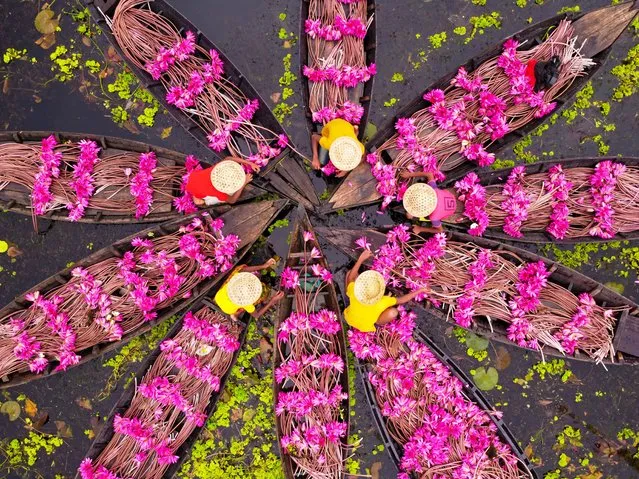
Farmers arrange bunches of water lilies after harvesting them from the wetlands in Barishal, Bangladesh on March 21, 2023. Floating through 10,000 acres of canal, farmers use their little boats to fetch the flowers. They break through the layer of water lilies on the surface of the water as they practice the traditional craft of picking water lilies by hand. Every flower is carefully hand-picked, collected inside the farmers' little wooden boat, tied in bundles, and sold to markets. After working for an entire day, a farmer can pick around 80 to 120 bundles of water lilies. Water lily harvesting is a major source of income for more than 250 families in the area. (Photo by Joy Saha/Cover Images)

Farmers arrange bunches of water lilies after harvesting them from the wetlands in Barishal, Bangladesh on March 21, 2023. Floating through 10,000 acres of canal, farmers use their little boats to fetch the flowers. (Photo by Joy Saha/Cover Images)
Details
01 May 2023 04:00:00
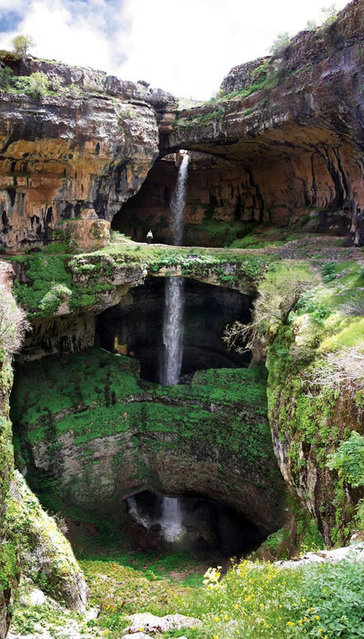
Baatara Gorge Waterfall

Discovered in 1952 by French bio-speleologist Henri Coiffait, the waterfall and accompanying sinkhole were fully mapped in the 1980s by the Spéléo club du Liban. The cave is also known as the "Cave of the Three Bridges." Traveling from Laklouk to Tannourine one passes the village of Balaa, and the "Three Bridges Chasm" (in French "Gouffre des Trois Ponts") is a five-minute journey into the valley below where one sees three natural bridges, rising one above the other and overhanging a chasm descending into Mount Lebanon. During the spring melt, a 90–100-metre (300–330 ft) cascade falls behind the three bridges and then down into the 250-metre (820 ft) chasm. A 1988 fluorescent dye test demonstrated that the water emerged at the spring of Dalleh in Mgharet al-Ghaouaghir.
Details
31 Aug 2013 11:27:00