Loading...
Done
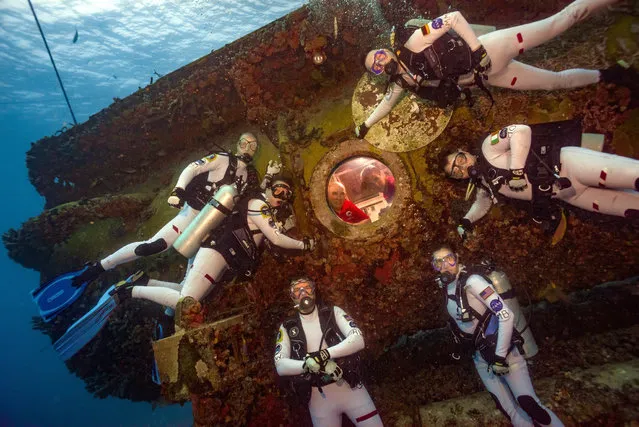
The NASA Extreme Environment Mission Operations (NEEMO) 21 mission began on July 21 as an international crew of aquanauts splashed down to the undersea Aquarius Reef Base, located 62 feet below the surface of the Atlantic Ocean in the Florida Keys National Marine Sanctuary. The NEEMO 21 crew will perform research both inside and outside the habitat during a 16-day simulated space mission. During simulated spacewalks carried out underwater, they will evaluate tools and mission operation techniques that could be used in future space missions, including journeys to Mars. (Photo by Karl Shreeves/NASA)

The NASA Extreme Environment Mission Operations (NEEMO) 21 mission began on July 21 as an international crew of aquanauts splashed down to the undersea Aquarius Reef Base, located 62 feet below the surface of the Atlantic Ocean in the Florida Keys National Marine Sanctuary. The NEEMO 21 crew will perform research both inside and outside the habitat during a 16-day simulated space mission. During simulated spacewalks carried out underwater, they will evaluate tools and mission operation techniques that could be used in future space missions, including journeys to Mars. (Photo by Karl Shreeves/NASA)
Details
31 Jul 2016 11:29:00
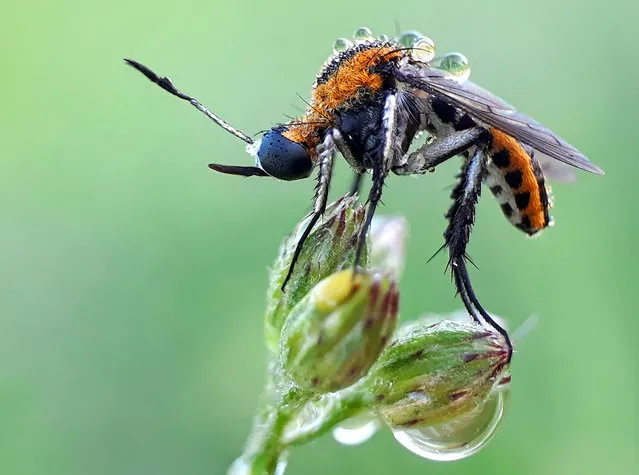
Komangs macro photography of insects using his Samsung Galaxy J7 and homemade camera lens in Bali, Indonesia. (Photo by Komang Wirnata/Caters News Agency)

These snaps were captured by a pro phone camera photographer. You can see the intricate detail in each shot, from the shining eyes of the insects to the tiny water droplets that splash down on them. Here: Komangs macro photography of insects using his Samsung Galaxy J7 and homemade camera lens in Bali, Indonesia. (Photo by Komang Wirnata/Caters News Agency)
Details
10 Jan 2018 06:59:00
Members of the Indonesian Presidential Security Forces (Paspampres) show their skills during the simulation of a terrorist attack in Jakarta, Indonesia, 29 December 2016. According to reports in local media the Indonesian security forces have already arrested 21 terrorists suspects and fatally shot five of them, who were allegedly planning attacks in the Indonesian capital during the Christmas and New Year's Eve celebrations this year. The presentation was shown on the occasion of a visit by Indonesian President Joko Widodo and a delegation to the Paspampres  headquarters in Jakarta. (Photo by Bagus Indahono/EPA)

Members of the Indonesian Presidential Security Forces (Paspampres) show their skills during the simulation of a terrorist attack in Jakarta, Indonesia, 29 December 2016. According to reports in local media the Indonesian security forces have already arrested 21 terrorists suspects and fatally shot five of them, who were allegedly planning attacks in the Indonesian capital during the Christmas and New Year's Eve celebrations this year. The presentation was shown on the occasion of a visit by Indonesian President Joko Widodo and a delegation to the Paspampres headquarters in Jakarta. (Photo by Bagus Indahono/EPA)
Details
30 Dec 2016 10:57:00
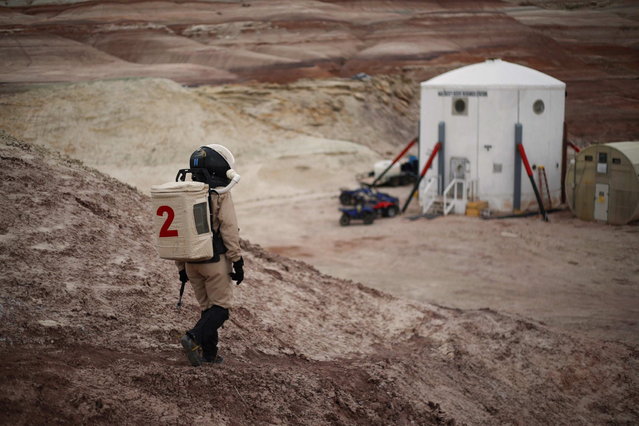
Csilla Orgel, a geologist of Crew 125 EuroMoonMars B mission, makes her way back to the Mars Desert Research Station (MDRS) in the Utah desert March 3, 2013. (Photo by Jim Urquhart/Reuters)

NASA says it could be another 20 years before humans touch down on Mars, but in a sense, the Mars Society has been exploring the red planet for more than a decade – in Utah. Photo: Csilla Orgel, a geologist of Crew 125 EuroMoonMars B mission, makes her way back to the Mars Desert Research Station (MDRS) in the Utah desert March 3, 2013. The MDRS aims to investigate the feasibility of a human exploration of Mars and uses the Utah desert's Mars-like terrain to simulate working conditions on the red planet. Scientists, students and enthusiasts work together developing field tactics and studying the terrain. All outdoor exploration is done wearing simulated spacesuits and carrying air supply packs and crews live together in a small communication base with limited amounts of electricity, food, oxygen and water. Everything needed to survive must be produced, fixed and replaced on site. (Photo by Jim Urquhart/Reuters)
Details
14 Mar 2013 12:11:00
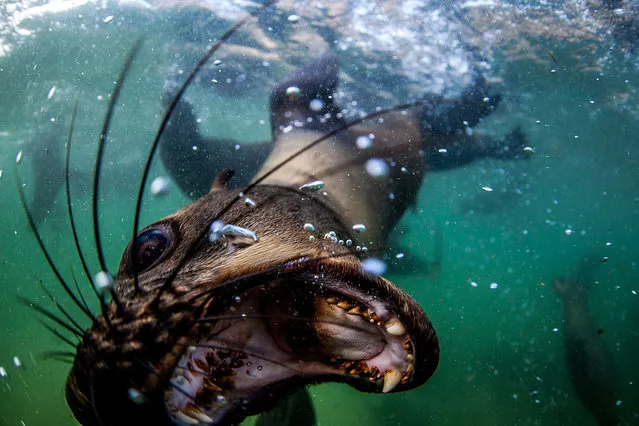
A seal playfully tries to bite the camera, taken on February 2016 in Plettenberg Bay, South Africa. A group of friendly seals get up close and personal with the camera. The pod of brown fur seals, also known as “cape fur seals”, were shot in Plettenberg Bay in South Africa by dive tour operator Rainer Schimpf. The playful creatures prove they are not camera shy in the slightest as they they swim upside down, grin widely and attempt to bite the camera lens. (Photo by Rainer Schimpf/Barcroft Media)

A seal playfully tries to bite the camera, taken on February 2016 in Plettenberg Bay, South Africa. A group of friendly seals get up close and personal with the camera. The pod of brown fur seals, also known as “cape fur seals”, were shot in Plettenberg Bay in South Africa by dive tour operator Rainer Schimpf. The playful creatures prove they are not camera shy in the slightest as they they swim upside down, grin widely and attempt to bite the camera lens. (Photo by Rainer Schimpf/Barcroft Media)
Details
13 Apr 2016 09:38:00
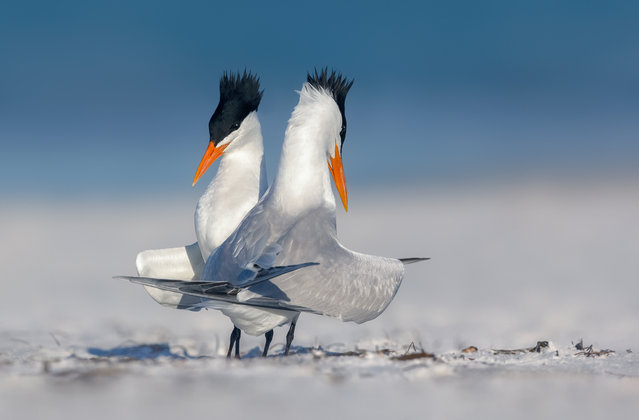
Behaviour winner: Courting Royals: two royal terns in courtship display by Kristian Bell. Another beautiful morning on a beautiful beach on the Gulf Coast of Florida seemed to prompt these two royal terns to commence an intricate courtship dance. The photograph was taken with a Canon 300mm lens and 2x extender. (Photo by Kristian Bell/Deakin University/Royal Society Publishing Photography Competition 2018)

Behaviour winner; Courting Royals: two royal terns in courtship display by Kristian Bell. Another beautiful morning on a beautiful beach on the Gulf Coast of Florida seemed to prompt these two royal terns to commence an intricate courtship dance. The photograph was taken with a Canon 300mm lens and 2x extender. (Photo by Kristian Bell/Deakin University/Royal Society Publishing Photography Competition 2018)
Details
06 Dec 2018 00:05:00
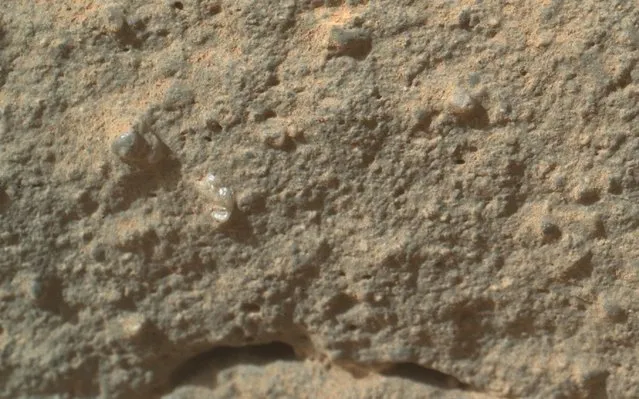
Scientists say that a “Martian flower”, seen here in an image from the Curiosity rover's Mars Hand Lens Imager, is a 2-millimeter-wide grain or pebble that's embedded in the surrounding rock. Another, darker-colored mineral grain can be seen above and to the left. (Photo by NASA)

“The scientists behind NASA's $2.5 billion Curiosity rover mission on Mars on Tuesday explained the nature of a tiny, gleaming "flower" embedded in Red Planet rock, and revealed where they'll be using the SUV-sized robot's drill for the first time”. – Alan Boyle via NBCNews.com

Photo: Scientists say that a “Martian flower”, seen here in an image from the Curiosity rover's Mars Hand Lens Imager, is a 2-millimeter-wide grain or pebble that's embedded in the surrounding rock. Another, darker-colored mineral grain can be seen above and to the left. (Photo by NASA)
Details
16 Jan 2013 11:12:00
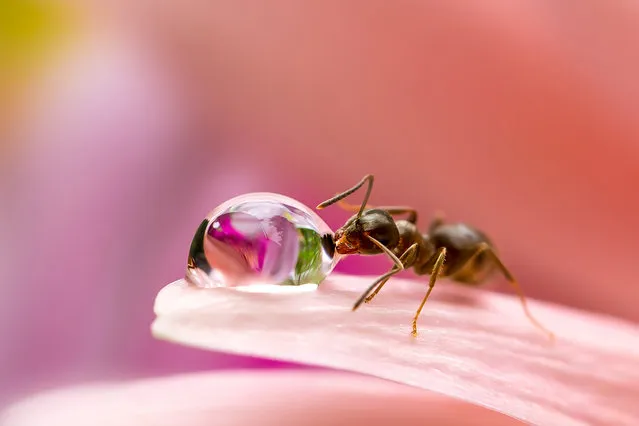
A macro view of an ant taking a sip from a water droplet on the edge of a flower in Obihiro, Japan. Animal-Lover Miki Asai has gone a step beyond feeding bread to the ducks – by syringe-feeding water to tiny ants. The office worker from Obihiro City, Japan, squirts droplets near the tiny insects and then uses a macro lens to capture quenching their thirst. The amateur photographer started capturing these images near her house in July 2013 after spotting an ant struggling in the rain. (Photo by Miki Asai/Barcroft Media)

A macro view of an ant taking a sip from a water droplet on the edge of a flower in Obihiro, Japan. Animal-Lover Miki Asai has gone a step beyond feeding bread to the ducks – by syringe-feeding water to tiny ants. The office worker from Obihiro City, Japan, squirts droplets near the tiny insects and then uses a macro lens to capture quenching their thirst. The amateur photographer started capturing these images near her house in July 2013 after spotting an ant struggling in the rain. (Photo by Miki Asai/Barcroft Media)
Details
09 Sep 2014 08:34:00