Loading...
Done
Oresund Bridge

The Öresund or Øresund Bridge is a double-track railway and dual carriageway bridge-tunnel across the Øresund strait between Scania (southernmost Sweden) and Denmark. The bridge runs nearly 8 km (5 miles) from the Swedish coast to the artificial island of Peberholm, which lies in the middle of the strait. The remainder of the link is by a 4 km (2.5 mile) tunnel from Peberholm to the Danish island of Amager. The Øresund Bridge is the longest combined road and rail bridge in Europe, and connects two major metropolitan areas: Copenhagen, the Danish capital city, and the major Swedish city of Malmö. It connects the road and rail networks of Scandinavia with those of Central and Western Europe.
Details
10 Sep 2013 11:23:00
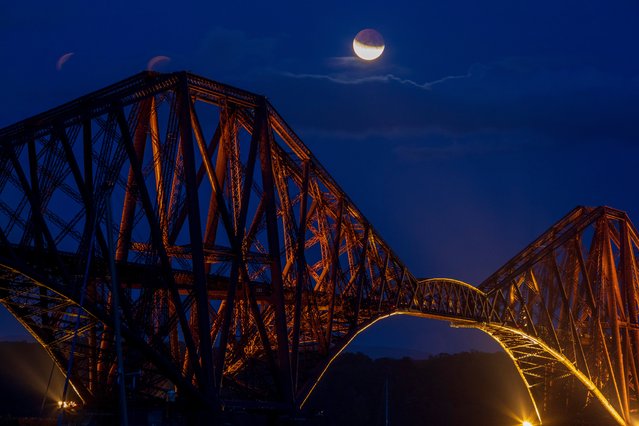
The moon rising above the Forth Rail Bridge in The Firth of Forth from North Queensferry, England on July 16, 2019. (Photo by South West News Service)

The moon rising above the Forth Rail Bridge in The Firth of Forth from North Queensferry, England on July 16, 2019. (Photo by South West News Service)
Details
14 Mar 2020 00:01:00
In this November 2, 2018 photo, a voodoo believer who is supposed to be possessed with Gede spirit performs rituals near Baron Samedi's tomb during the annual Voodoo festival Fete Gede at Cite Soleil Cemetery in Port-au-Prince, Haiti. As a proof that they got into trance and their bodies got possessed by Gedes, they drink and wash their faces, their eyes and even their genitals with a mixture of raw rum and hot chili peppers that, according to believers, could burn the skin of any human alive. (Photo by Dieu Nalio Chery/AP Photo)

In this November 2, 2018 photo, a voodoo believer who is supposed to be possessed with Gede spirit performs rituals near Baron Samedi's tomb during the annual Voodoo festival Fete Gede at Cite Soleil Cemetery in Port-au-Prince, Haiti. As a proof that they got into trance and their bodies got possessed by Gedes, they drink and wash their faces, their eyes and even their genitals with a mixture of raw rum and hot chili peppers that, according to believers, could burn the skin of any human alive. (Photo by Dieu Nalio Chery/AP Photo)
Details
06 Nov 2018 00:05:00
Writing Letter

“Kusakabe Kimbei (1841 – 1934) was a Japanese photographer. He usually went by his given name, Kimbei, because his clientele, mostly non-Japanese-speaking foreign residents and visitors, found it easier to pronounce than his family name. Kusakabe Kimbei worked with Felice Beato and Baron Raimund von Stillfried as a photographic colourist and assistant before opening his own workshop in Yokohama in 1881 in the Benten-dōri quarter, and from 1889 operating in the Honmachi quarter. He also opened a branch in the Ginza quarter of Tokyo”. – Wikipedia

Photo: Writing Letter. (Photo by Kusakabe Kimbei)
Details
21 Apr 2012 13:28:00
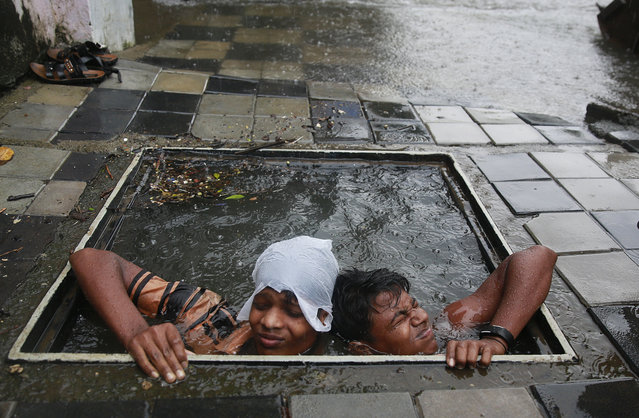
Municipal workers try to retrieve the lid of a manhole to prevent pedestrians from falling in, in Mumbai, India, Wednesday, September 20, 2017. Incessant rainfall in India's commercial capital has affected air and rail traffic, and schools and colleges remained shut for the day. (Photo by Rafiq Maqbool/AP Photo)

Municipal workers try to retrieve the lid of a manhole to prevent pedestrians from falling in, in Mumbai, India, Wednesday, September 20, 2017. Incessant rainfall in India's commercial capital has affected air and rail traffic, and schools and colleges remained shut for the day. (Photo by Rafiq Maqbool/AP Photo)
Details
30 Sep 2017 06:02:00
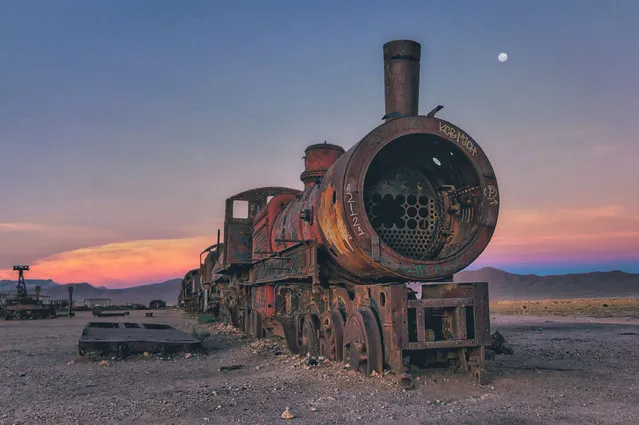
Many of the trains and locomotives are British imports and have been eroded by the harsh Bolivian climate. (Photo by Chris Staring/Rex Features/Shutterstock)

Chris Staring photographs a mysterious train graveyard in the heart of southern Bolivia, where the skeletons of British steam locomotives and rail cars rust away on the edge of the world’s largest salt flats. More than 100 rail cars and locomotives can be found in different states of decay in the train graveyard. (Photo by Chris Staring/Rex Features/Shutterstock)
Details
03 Jul 2016 10:46:00
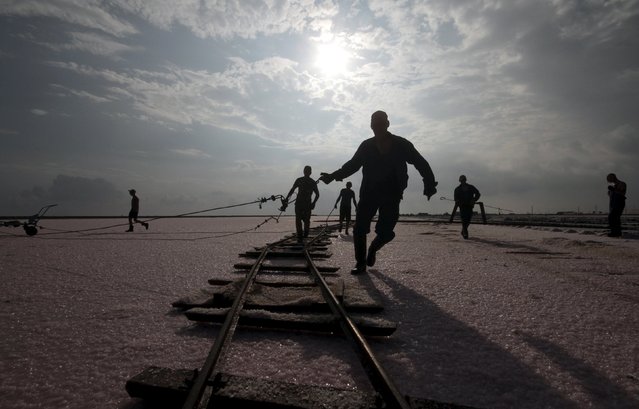
Workers adjust rails at the bed of a drained area of a lake used for the production of salt at the Sasyk-Sivash lake near the city of Yevpatoria, Crimea, September 25, 2015. The area has a long tradition of salt production, prepared from salt flats flooded with water from the Black Sea. (Photo by Pavel Rebrov/Reuters)

Workers adjust rails at the bed of a drained area of a lake used for the production of salt at the Sasyk-Sivash lake near the city of Yevpatoria, Crimea, September 25, 2015. The area has a long tradition of salt production, prepared from salt flats flooded with water from the Black Sea. (Photo by Pavel Rebrov/Reuters)
Details
28 Sep 2015 08:01:00
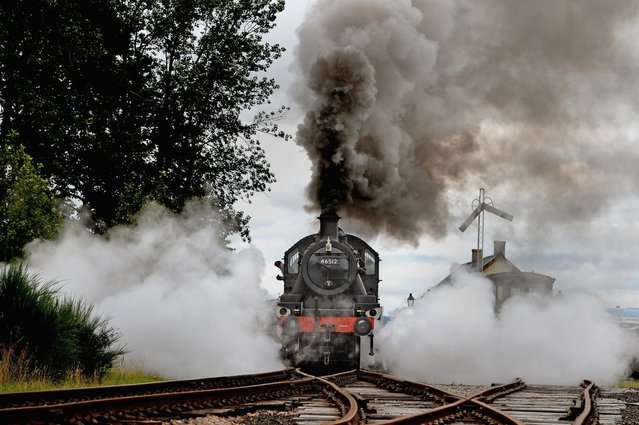
Henry Leese drives a 1952 British Rail Ivatt number 46512 at Strathspey Steam Railway on August 27, 2013 in Aviemore,Scotland. This year marks the 150th anniversary of the Highland Main Line built as a transportation link to the South for lairds and landowners living in northern Scotland. (Photo by Jeff J. Mitchell/Getty Images)

Henry Leese drives a 1952 British Rail Ivatt number 46512 at Strathspey Steam Railway on August 27, 2013 in Aviemore,Scotland. This year marks the 150th anniversary of the Highland Main Line built as a transportation link to the South for lairds and landowners living in northern Scotland. (Photo by Jeff J. Mitchell)
Details
03 Sep 2013 10:36:00