Loading...
Done
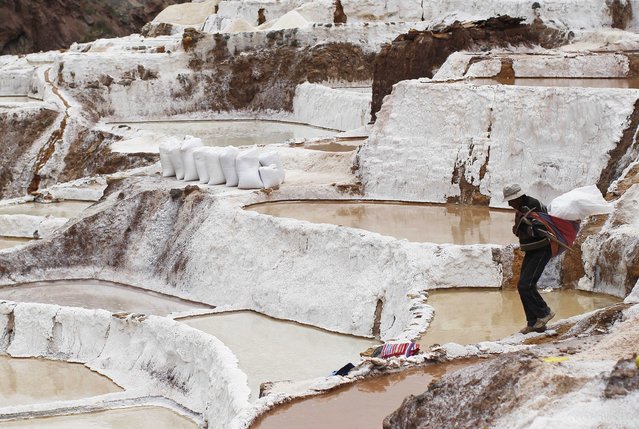
A worker carries a bag of salt after collecting it from a pond at the Maras mines in Cuzco December 3, 2014. Salt has been obtained in Maras since pre-Incan times by evaporating highly salty local subterranean stream water. The water is intricately channelled through constructions, flowing gradually down onto several hundred ancient terraced ponds. (Photo by Enrique Castro-Mendivil/Reuters)

A worker carries a bag of salt after collecting it from a pond at the Maras mines in Cuzco December 3, 2014. Salt has been obtained in Maras since pre-Incan times by evaporating highly salty local subterranean stream water. The water is intricately channelled through constructions, flowing gradually down onto several hundred ancient terraced ponds. From each pond, a local member of the mine cooperative can produce 150 to 200 kilos per month which can be sold in the markets at $0.34 per kilogram, according to miners. (Photo by Enrique Castro-Mendivil/Reuters)
Details
05 Dec 2014 13:36:00
A penitent called “Morion” checks his mobile phone in Mogpog town on Marinduque island in central Philippines April 14, 2014. During the annual festival, masked and costumed penitents called “Moriones” dress in attire that is the local interpretation of what Roman soldiers wore during biblical times. Holy Week is celebrated in many Christian traditions during the week before Easter. (Photo by Erik De Castro/Reuters)

A penitent called “Morion” checks his mobile phone in Mogpog town on Marinduque island in central Philippines April 14, 2014. During the annual festival, masked and costumed penitents called “Moriones” dress in attire that is the local interpretation of what Roman soldiers wore during biblical times. Holy Week is celebrated in many Christian traditions during the week before Easter. (Photo by Erik De Castro/Reuters)
Details
19 Apr 2014 11:52:00
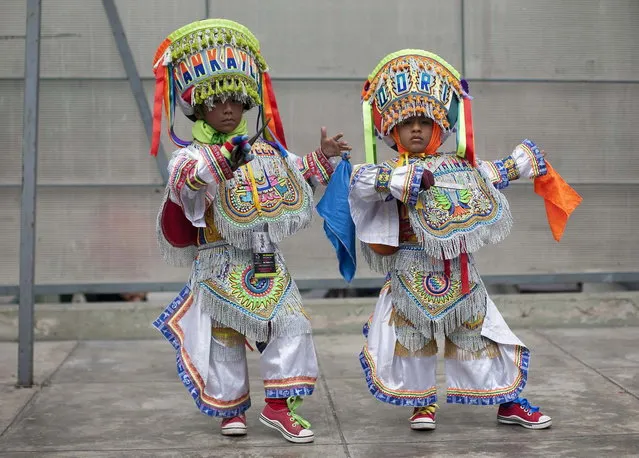
Young “scissors” dancers pose after performing in a national scissors dance competition at Lima's Exposition Park, May 18, 2014. The Danza de las tijeras, or scissors dance, is a traditional dance from the Peruvian southern region of the Andes, in which two or more performers take turns dancing while accompanied with music from a harp and a violin. Dancers would display various skills and moves, which include cutting the air with the use of a scissors. (Photo by Enrique Castro-Mendivil/Reuters)

Young “scissors” dancers pose after performing in a national scissors dance competition at Lima's Exposition Park, May 18, 2014. The Danza de las tijeras, or scissors dance, is a traditional dance from the Peruvian southern region of the Andes, in which two or more performers take turns dancing while accompanied with music from a harp and a violin. Dancers would display various skills and moves, which include cutting the air with the use of a scissors. (Photo by Enrique Castro-Mendivil/Reuters)
Details
20 May 2014 10:54:00


Castro's soldiers at Playa de Giron, Cuba, after thwarting the ill-fated US backed 'Bay of Pigs' invasion. (Photo by Graf/Getty Images). April, 1961
Details
23 Apr 2011 10:59:00
In this January 11, 2018 photo, a skater jumps a ramp during the inauguration of a new recreational space for skateboarders, created in an abandoned gym at the Educational complex Ciudad Libertad, a former military barracks that the late Fidel Castro turned into a school complex after the revolution in Havana, Cuba. Foreign skateboard enthusiasts supply their Cuban counterparts with boards and other equipment. (Photo by Ramon Espinosa/AP Photo)

In this January 11, 2018 photo, a skater jumps a ramp during the inauguration of a new recreational space for skateboarders, created in an abandoned gym at the Educational complex Ciudad Libertad, a former military barracks that the late Fidel Castro turned into a school complex after the revolution in Havana, Cuba. Foreign skateboard enthusiasts supply their Cuban counterparts with boards and other equipment. (Photo by Ramon Espinosa/AP Photo)
Details
03 Feb 2018 06:51:00
An American white pelican takes flight on the island of Petatan in the municipality of Cojumatlan de Regules, Michoacan state, Mexico on February 23, 2024. The island becomes home to the pelicans during the winter, when they travel from the north of the United States and the south of Canada to the warmer waters of Lake Chapala in Mexico. The birds are a tourist attraction and people gather on the island's boardwalk to feed them and watch them fly. (Photo by Enrique Castro/AFP Photo)

An American white pelican takes flight on the island of Petatan in the municipality of Cojumatlan de Regules, Michoacan state, Mexico on February 23, 2024. The island becomes home to the pelicans during the winter, when they travel from the north of the United States and the south of Canada to the warmer waters of Lake Chapala in Mexico. The birds are a tourist attraction and people gather on the island's boardwalk to feed them and watch them fly. (Photo by Enrique Castro/AFP Photo)
Details
24 May 2025 02:21:00
A woman squeezes between two public buses in downtown Lima, March 17, 2014. Bogota and two other Latin American capitals – Mexico City, and Lima in Peru – were named as the three capitals with the least safe transport systems for women in the Thomson Reuters Foundation poll of more than 6,550 women and gender and city planning experts. (Photo by Enrique Castro-Mendivil/Reuters)

A woman squeezes between two public buses in downtown Lima, March 17, 2014. Bogota and two other Latin American capitals – Mexico City, and Lima in Peru – were named as the three capitals with the least safe transport systems for women in the Thomson Reuters Foundation poll of more than 6,550 women and gender and city planning experts. Women in Latin America say they face a wide range of daily threats on public transport, and not enough is done to ensure their safety. (Photo by Enrique Castro-Mendivil/Reuters)
Details
04 Nov 2014 12:00:00
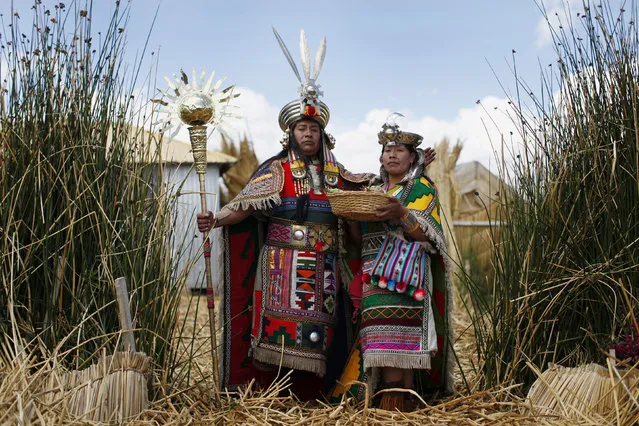
An Andean man and a woman, depicting Inca's legendary characters Manco Capac and Mama Ocllo, pose for a portrait in a Uros island at Lake Titicaca before a re-enactment in Puno November 5, 2014. The Uros islands are a group of 70 man-made totora reed islands floating on the lake, which according to Peru's tourism board iPeru is the world's highest navigable lake at over 4,000 meters above sea level. (Photo by Enrique Castro-Mendivil/Reuters)

An Andean man and a woman, depicting Inca's legendary characters Manco Capac and Mama Ocllo, pose for a portrait in a Uros island at Lake Titicaca before a re-enactment in Puno November 5, 2014. The Uros islands are a group of 70 man-made totora reed islands floating on the lake, which according to Peru's tourism board iPeru is the world's highest navigable lake at over 4,000 meters above sea level. The Uros people fish and hunt, but tourism is their main source of livelihood. (Photo by Enrique Castro-Mendivil/Reuters)
Details
07 Nov 2014 12:52:00