Loading...
Done
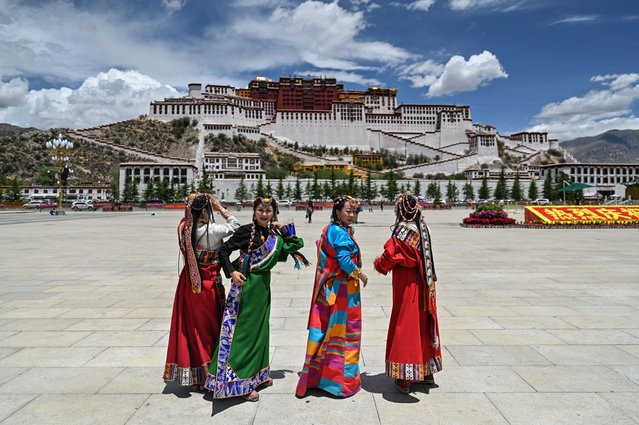
This photograph taken during a government organised media tour shows people in traditional costume standing in Potala Palace Square as the Potala Palace – classified as a World Heritage Site by Unesco in 1994 – is seen in the background in the regional capital Lhasa, in China's Tibet Autonomous Region, on June 1, 2021. (Photo by Hector Retamal/AFP Photo)

This photograph taken during a government organised media tour shows people in traditional costume standing in Potala Palace Square as the Potala Palace – classified as a World Heritage Site by Unesco in 1994 – is seen in the background in the regional capital Lhasa, in China's Tibet Autonomous Region, on June 1, 2021. (Photo by Hector Retamal/AFP Photo)
Details
11 Jun 2021 09:42:00
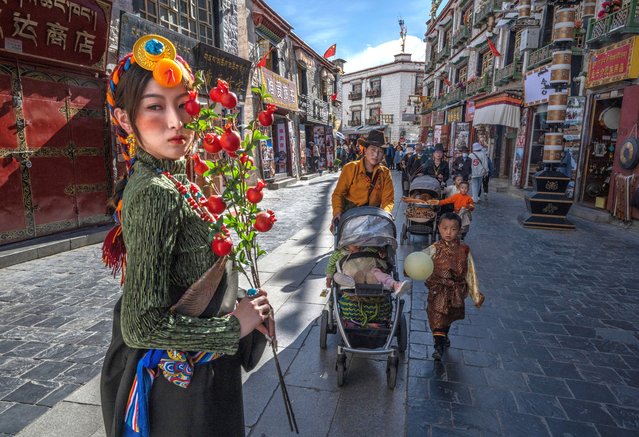
A woman has her photo taken wearing tradtional clothing as a Tibetan Buddhist woman and her family walk the kora near the Jokhang Temple, a UNESCO heritage site, during a government organized visit for journalists on June 1, 2021 in Lhasa, Tibet Autonomous Region, China. (Photo by Kevin Frayer/Getty Images)

A woman has her photo taken wearing tradtional clothing as a Tibetan Buddhist woman and her family walk the kora near the Jokhang Temple, a UNESCO heritage site, during a government organized visit for journalists on June 1, 2021 in Lhasa, Tibet Autonomous Region, China. (Photo by Kevin Frayer/Getty Images)
Details
22 Jun 2021 07:59:00
Potala Palace In Tibetan

The Potala Palace in Lhasa, Tibet Autonomous Region, China, was the chief residence of the Dalai Lama until the 14th Dalai Lama fled to India during the 1959 Tibetan uprising. It is now a museum and UNESCO World Heritage Site.
Details
17 Jun 2014 10:48:00
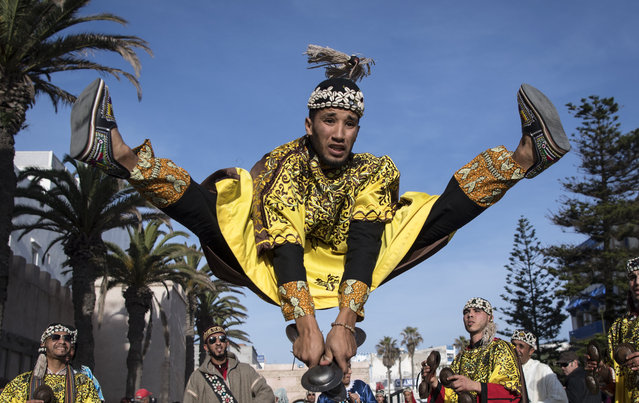
A Gnawa traditional group performs in the city of Essaouira on December 14, 2019, to celebrate the decision of adding the Gnawa culture to UNESCO's list of Intangible Cultural Heritage of Humanity. Gnawa culture, a centuries-old Moroccan practice rooted in music, African rituals and Sufi traditions, was added to UNESCO's list of Intangible Cultural Heritage of Humanity earlier in the week. Gnawa refers to a “set of musical productions, fraternal practices and therapeutic rituals where the secular mixes with the sacred”, according to the nomination submitted by Morocco. Often dressed in colourful outfits, Gnawa musicians play the guenbri, a type of lute with three strings, accompanied by steel castanets called krakebs. (Photo by Fadel Senna/AFP Photo)

A Gnawa traditional group performs in the city of Essaouira on December 14, 2019, to celebrate the decision of adding the Gnawa culture to UNESCO's list of Intangible Cultural Heritage of Humanity. Gnawa culture, a centuries-old Moroccan practice rooted in music, African rituals and Sufi traditions, was added to UNESCO's list of Intangible Cultural Heritage of Humanity earlier in the week. Gnawa refers to a “set of musical productions, fraternal practices and therapeutic rituals where the secular mixes with the sacred”, according to the nomination submitted by Morocco. Often dressed in colourful outfits, Gnawa musicians play the guenbri, a type of lute with three strings, accompanied by steel castanets called krakebs. (Photo by Fadel Senna/AFP Photo)
Details
18 Dec 2019 00:05:00
In this May 2, 2015 photo, skywriter Nathan Hammond releases smoke as he writes messages of hope and love over New Orleans, during the New Orleans Jazz & Heritage Festival. Hammond was commissioned by local entrepreneur, Frank Scurlock, who said the messages were simply his way of reminding people that goodness can still flourish in a world that seems increasingly marred by violence. (Photo by Gerald Herbert/AP Photo)

In this May 2, 2015 photo, skywriter Nathan Hammond releases smoke as he writes messages of hope and love over New Orleans, during the New Orleans Jazz & Heritage Festival. Hammond was commissioned by local entrepreneur, Frank Scurlock, who said the messages were simply his way of reminding people that goodness can still flourish in a world that seems increasingly marred by violence. (Photo by Gerald Herbert/AP Photo)
Details
06 May 2015 13:57:00
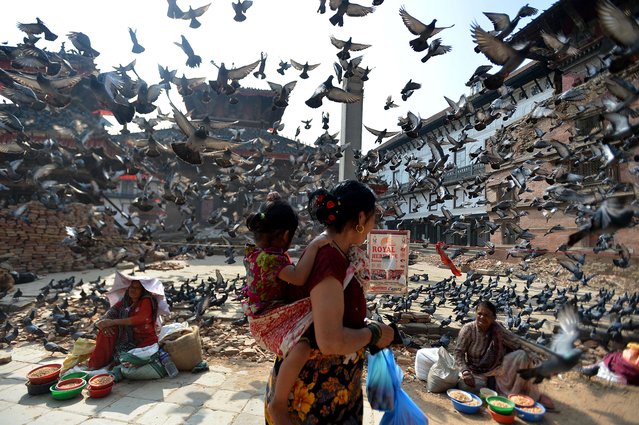
Flying pigeons pass over Nepalese street vendors near the earthquake damaged UNESCO World Heritage Site, Durbar Square in Kathmandu on May 20, 2015. Nearly 8,500 people have now been confirmed dead in the disaster, which destroyed more than half a million homes and left huge numbers of people without shelter with just weeks to go until the monsoon rains. (Photo by Ishara S. Kodikara/AFP Photo)

Flying pigeons pass over Nepalese street vendors near the earthquake damaged UNESCO World Heritage Site, Durbar Square in Kathmandu on May 20, 2015. Nearly 8,500 people have now been confirmed dead in the disaster, which destroyed more than half a million homes and left huge numbers of people without shelter with just weeks to go until the monsoon rains. (Photo by Ishara S. Kodikara/AFP Photo)
Details
23 May 2015 10:25:00
Members of the Legio X Fretensis (Malta) re-enactment group take part in a display of ancient Roman army life at Fort Rinella in Kalkara, outside Valletta, March 22, 2015. The event “Romanus”, organised by the Malta Heritage Trust, consisted of talks, hands-on displays, static exhibitions of weapons and equipment, food and wine tasting and large-scale re-enactments depicting different forms of Roman warfare in the field. (Photo by Darrin Zammit Lupi/Reuters)

Members of the Legio X Fretensis (Malta) re-enactment group take part in a display of ancient Roman army life at Fort Rinella in Kalkara, outside Valletta, March 22, 2015. The event “Romanus”, organised by the Malta Heritage Trust, consisted of talks, hands-on displays, static exhibitions of weapons and equipment, food and wine tasting and large-scale re-enactments depicting different forms of Roman warfare in the field. (Photo by Darrin Zammit Lupi/Reuters)
Details
23 Mar 2015 10:20:00
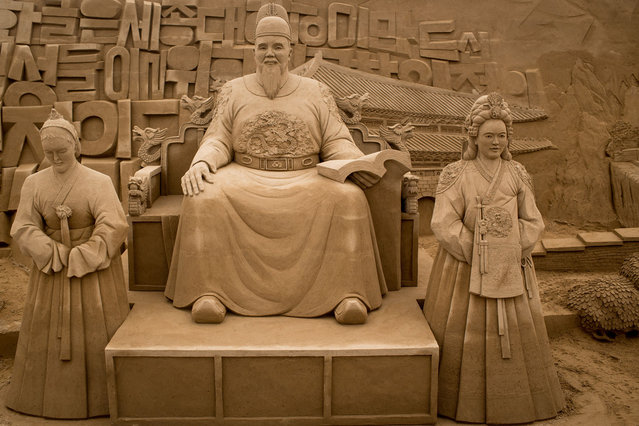
A large sand sculpture is seen at the site of Yokohama Sand Art Exhibition – Culture City of East Asia 2014 on July 16, 2014 in Yokohama, Japan. Producer and sand sculptor Katsuhiko Chaen invited artists from around the world including South Korea and China, to recreate the World Heritage and historical buildings in China, Japan and South Korea. The exhibition will be open from July 19 to November 3, 2014. (Photo by Chris McGrath/Getty Images)

A large sand sculpture is seen at the site of Yokohama Sand Art Exhibition – Culture City of East Asia 2014 on July 16, 2014 in Yokohama, Japan. Producer and sand sculptor Katsuhiko Chaen invited artists from around the world including South Korea and China, to recreate the World Heritage and historical buildings in China, Japan and South Korea. The exhibition will be open from July 19 to November 3, 2014. (Photo by Chris McGrath/Getty Images)
Details
17 Jul 2014 12:21:00