Loading...
Done
European herring gulls at Llobregat Delta. (Photo by Xavi Bou/Rex Features/Shutterstock)

The Spanish photographer Xavi Bou digitally combines sequential pictures of birds to create a single image, or chronophotograph, that reveals the shapes of their flight paths against Catalonian skies. His work shows the variety and beauty to be found in the daily activities of the local birds, including spiralling storks, swooping starlings and giddy swifts. Here: European herring gulls at Llobregat Delta. (Photo by Xavi Bou/Rex Features/Shutterstock)
Details
13 Oct 2016 11:22:00
A girl on a swing in the sky. (Photo by Ali Jardine/Caters News)

A stay-at-home mom's surreal iPhone snaps of her children have seen her rack up more than a half-million Instagram fans. Ali Jardine, 42, photographs silhouettes of her two kids in fairy-tale environments, from a spiraling night sky to sunsets. The creative mom has gained more than 519,000 followers online since she got her first iPhone in November 2010. And due to her success, Ali, who is from Petaluma, Calif., has been able to monetize her work, helping the likes of HP and Samsung with Instagram campaigns. Here: a girl on a swing in the sky. (Photo by Ali Jardine/Caters News)
Details
03 Apr 2015 13:09:00
Two rainbows emerge from a black storm above the mountains, on August 19, 2014, in Kingman, Arizona.  Double tornadoes, lightning storms and rotating supercells – this is what it's like to chase storms for a year.(Photo by Roger Hill/Barcroft Media)

Two rainbows emerge from a black storm above the mountains, on August 19, 2014, in Kingman, Arizona. Double tornadoes, lightning storms and rotating supercells – this is what it's like to chase storms for a year. These dramatic images show apocalyptic weather throughout 2014 from a lightning storm to a pair of rainbows. Roger Hill, 57, has been chasing storms in the United States for thirty years and runs a tour operation with his wife Caryn. His favourite photograph of the year was also one of the most difficult to get – as two violent tornadoes tore through Pilger, Nebraska on June 16. The spiraling winds killed a five-year-old girl and injured at least 19 others, and as Roger tried to get the perfect shot debris began to rain down on his car. (Photo by Roger Hill/Barcroft Media)
Details
25 Feb 2015 09:27:00


An image produced by the Hubble telescope of the perfectly “edge-on” galaxy, or NGC 4013, March 1, 2001. This new Hubble picture reveals, with great detail, huge clouds of dust and gas extending along, as well as far above, the galaxy's main disk. NGC 4013 is a spiral galaxy, similar to the Milky Way, lying some 55 million light-years from Earth in the direction of the constellation Ursa Major. Viewed face-on, it would look like a nearly circular pinwheel, but NGC 4013 happens to be seen edge-on from our vantage point. Even at 55 million light-years, the galaxy is larger than Hubble's field of view, and the image shows only a little more than half of the object, albeit with unprecedented detail. (Photo Courtesy of NASA/Newsmakers)
Details
28 Feb 2015 22:33:00
Palestinian groom Mohamed abu Daga and his bride Israa wear face masks amid the COVID-19 epidemic, during a photoshoot at a studio before their wedding ceremony in Khan Yunis in the southern Gaza Strip, on March 23, 2020. Authorities in Gaza confirmed on March 22 the first two cases of novel coronavirus, identifying them as Palestinians who had travelled to Pakistan and were being held in quarantine since their return, as the United Nations warned of potential disastrous outcomes to an outbreak given the high poverty rates and weak health system in the coastal strip, under Israeli blockade since 2007. (Photo by Said Khatib/AFP Photo)

Palestinian groom Mohamed abu Daga and his bride Israa wear face masks amid the COVID-19 epidemic, during a photoshoot at a studio before their wedding ceremony in Khan Yunis in the southern Gaza Strip, on March 23, 2020. Authorities in Gaza confirmed on March 22 the first two cases of novel coronavirus, identifying them as Palestinians who had travelled to Pakistan and were being held in quarantine since their return, as the United Nations warned of potential disastrous outcomes to an outbreak given the high poverty rates and weak health system in the coastal strip, under Israeli blockade since 2007. (Photo by Said Khatib/AFP Photo)
Details
27 Mar 2020 00:07:00
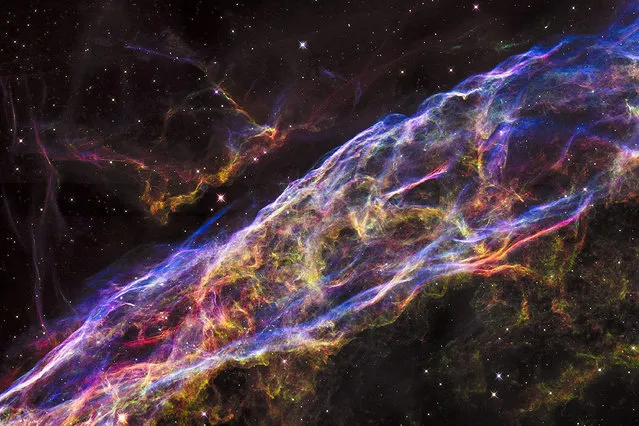
A small section of the expanding remains of the Veil Nebula, a massive star that exploded about 8,000 years ago. The entire nebula is 110 light-years across, covering six full moons on the sky as seen from Earth, and resides about 2,100 light-years away in the constellation Cygnus, the Swan. (Photo by Reuters/NASA/ESA/Hubble)

A small section of the expanding remains of the Veil Nebula, a massive star that exploded about 8,000 years ago. The entire nebula is 110 light-years across, covering six full moons on the sky as seen from Earth, and resides about 2,100 light-years away in the constellation Cygnus, the Swan. (Photo by Reuters/NASA/ESA/Hubble)
Details
29 Feb 2016 11:30:00
A firefighter recovers after climbing the 1800 steps of the Costanera Centre Tower as part of the “Race for Life” aimed at encouraging organ donation in Chile, in Santiago, on October 16, 2016. (Photo by Claudio Reyes/AFP Photo)

A firefighter recovers after climbing the 1800 steps of the Costanera Centre Tower as part of the “Race for Life” aimed at encouraging organ donation in Chile, in Santiago, on October 16, 2016. More than 500 volunteer firefighters are expected to climb the 1800 steps of the tallest building in South America to promote and encourage organ donation in the country. (Photo by Claudio Reyes/AFP Photo)
Details
26 Oct 2016 10:46:00
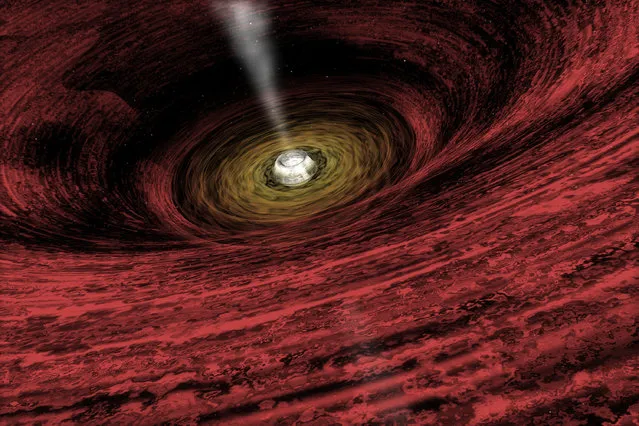
An artist's impression of a growing supermassive black hole located in the early Universe is seen in this NASA handout illustration released on June 15, 2011. Using the deepest X-ray image ever taken, astronomers found the first direct evidence that massive black holes were common in the early universe. This discovery from NASA's Chandra X-Ray Observatory shows that very young black holes grew more aggressively than previously thought, in tandem with the growth of their host galaxies. (Photo by Reuters/NASA/Chandra X-Ray Observatory/A.Hobart)

An artist's impression of a growing supermassive black hole located in the early Universe is seen in this NASA handout illustration released on June 15, 2011. Using the deepest X-ray image ever taken, astronomers found the first direct evidence that massive black holes were common in the early universe. This discovery from NASA's Chandra X-Ray Observatory shows that very young black holes grew more aggressively than previously thought, in tandem with the growth of their host galaxies. (Photo by Reuters/NASA/Chandra X-Ray Observatory/A.Hobart)
Details
11 Feb 2016 12:57:00