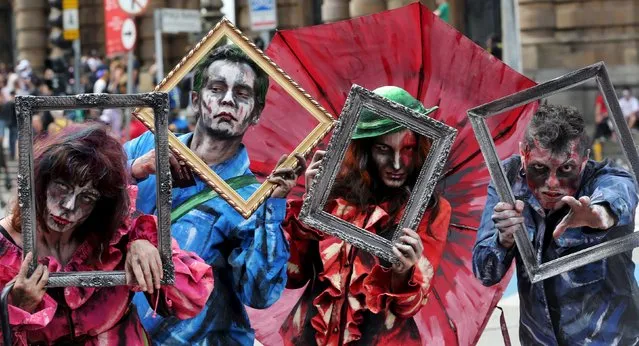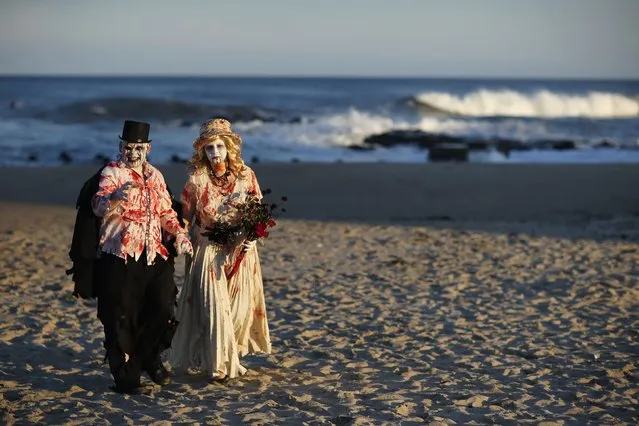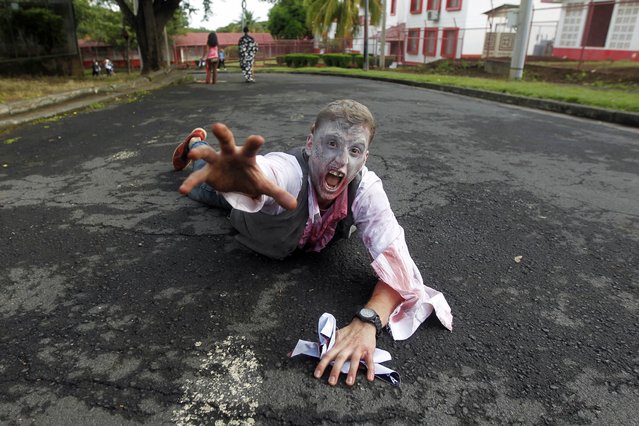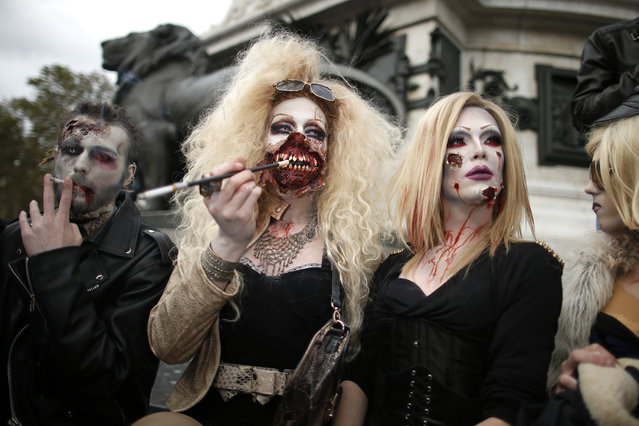
Revellers with their bodies and faces painted attend the "Zombie Walk" parade in Sao Paulo, Brazil, November 2, 2015. (Photo by Paulo Whitaker/Reuters)
Men and Women dressed as zombies walk through Hyde Park on February 25, 2012 in Sydney, Australia. The annual Zombie Walk raises money for the Brain Foundation and this year teamed up with FX channel in promotion of “The Walking Dead” series premiering in Australia this weekend. (Photo by Brendon Thorne/Getty Images)
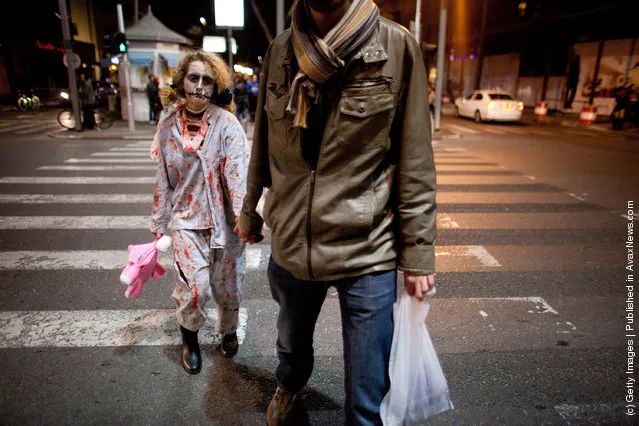
Israelis participate in a “Zombie Walk” during the Jewish holiday of Purim on March 6, 2012 in Tel Aviv, Israel. The carnival-like Purim holiday is celebrated with parades and costume parties to commemorate the deliverance of the Jewish people from a plot to exterminate them in the ancient Persian empire 2,500 years ago, as described in the Book of Esther. (Photo by Uriel Sinai/Getty Images)
Mortsafes were contraptions designed to protect graves from disturbance. Resurrectionists had supplied the schools of anatomy in Scotland since the early 18th century. This was due to the necessity for medical students to learn anatomy by attending dissections of human subjects, which was frustrated by the very limited allowance of dead bodies – for example the corpses of executed criminals – granted by the government, which controlled the supply.
Demonstrators wear skull masks during an anti government protest, as Chile's President Michelle Bachelet delivers a speech inside the National Congress, in Valparaiso city, Chile May 21, 2016. (Photo by Ivan Alvarado/Reuters)
A voodoo believer, dressed as "Gede", a spirit of voodoo, sits on the cross of Baron Samdi during celebrations at the cemetery of Port-au-Prince, Haiti, November 1, 2016. Voodoo believers and devotees offer candles, alcohol and food. The Day of the Dead is celebrated on the first two days of November during All Saints and All Souls Day. (Photo by Andres Martinez Casares/Reuters)
Actors wrapped in blankets react at the set of the post-apocalyptic movie “Zombie Era” at an abandoned factory complex in Langfang, Hebei province, China December 16, 2016. (Photo by Damir Sagolj/Reuters)
Dargavs is a small necropolis outside the village of Dargavs in North Ossetia-Alania. It comprises 99 different tombs and crypts. It is often called city of the dead. Some sources say the oldest of the crypts dates back to the 12th century, though others say the oldest crypt dates back to 14th century and some say it dates to the 16th century. At the back of the complex there is a tower, though the top of it is destroyed.